

QlikView
by Qlik
What is QlikView?
Get Best Quote for QlikView
Connect with SaaSrat experts to get the best quote for your business.
You're all set!
A specialist for QlikView will reach out within 1 business day.
QlikView Features
QlikView Server (legacy
EOS Oct 31 2026)
Qlik Sense (active product)
Qlik Cloud Analytics
Associative Engine (in-memory)
Qlik Sense Mobile (iOS plus Android)
View All 29 Features
QlikView Pricing Plans
Qlik Cloud Analytics Standard
- Approximately USD 825 per month for up to 20 users
- Qlik Sense Cloud Analytics
- Associative Engine
- Insight Advisor AI
- Standard support
- 800 plus connectors via Qlik Talend
Qlik Cloud Analytics Premium
- Approximately USD 2,700 per month
- Mid-market scale
- All Standard features
- Qlik AutoML
- Qlik Answers GenAI
- Priority support
- Advanced governance
Qlik Sense Enterprise (Custom)
- Custom pricing for enterprise deployments
- Qlik Sense Enterprise on Kubernetes
- Qlik Cloud Gov (FedRAMP)
- Qlik Talend Data Integration
- Dedicated success engineer
- Multi-year EA discounts
QlikView Resources
QlikView Screenshots
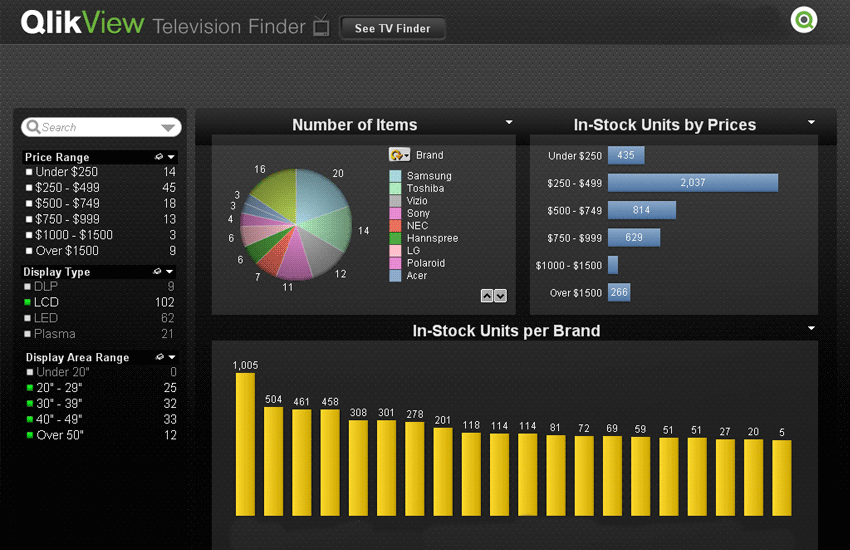
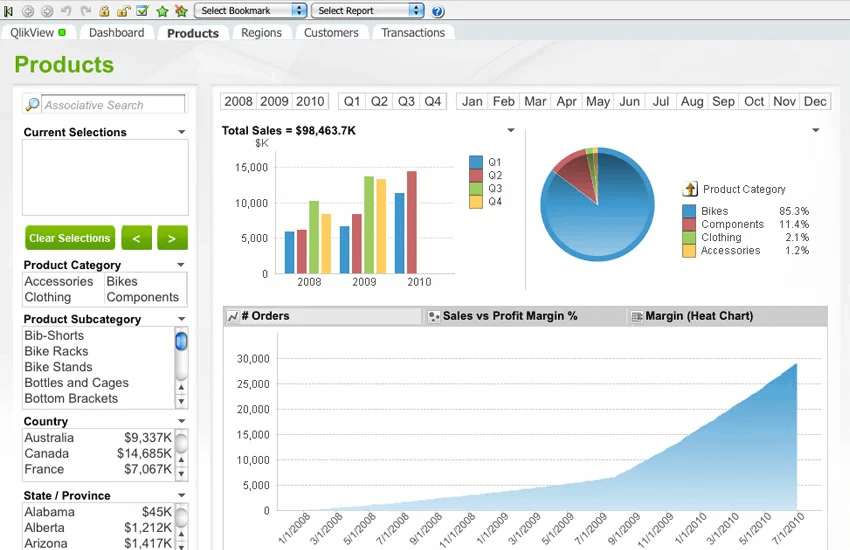
Description
QlikView is the original guided-analytics product from Qlik, the Pennsylvania-headquartered analytics vendor that pioneered the in-memory Associative Engine in 1993. The platform powers dashboards, scorecards, and what-if analysis for finance, supply chain, and operations teams that need to slice data across many sources without writing SQL. Today, however, Qlik treats QlikView as a legacy maintenance product. Active development, AI features, and cloud delivery all sit inside Qlik Sense and Qlik Cloud Analytics, and Qlik has scheduled QlikView end of support for October 31, 2026.
If you are running QlikView 12.x and renewing maintenance, this profile gives you the honest picture: what QlikView still does well, why the Associative Engine still matters, and how a migration to Qlik Sense or Qlik Cloud Analytics typically plays out. If you are buying BI software fresh in 2026, you should evaluate Qlik Sense, not QlikView, against options like Tableau, Microsoft Power BI, or Looker Studio.
QlikView at a Glance
QlikView shipped its first commercial release in 1993 out of Lund, Sweden, founded by Bjorn Berg and Staffan Gestrelius. Qlik moved its head office to Radnor, Pennsylvania, was taken private by Thoma Bravo in August 2016 in a roughly $3.0 billion transaction, and took a follow-on minority investment from the Abu Dhabi Investment Authority alongside Thoma Bravo in 2024. Qlik reports more than 40,000 customers worldwide across QlikView and Qlik Sense combined.
The current and final QlikView release is version 12.90, shipped May 2024. Qlik has published a fixed lifecycle: October 31, 2026 is the last day QlikView receives security updates, hotfixes, and standard support. After that date the binaries continue to run, but you are on unsupported software with no patches against new CVEs. That single calendar fact should anchor any QlikView renewal conversation in 2026.
Why the Associative Engine still matters
QlikView and Qlik Sense share the same in-memory analytics engine, known internally as QIX. Unlike SQL-query tools that send a fresh query to a database for every click, QIX loads compressed data into memory and tracks associations between every value across every loaded table. When you click a country, region, or product, the engine instantly shows three states across the entire model:
- Green for values you have selected.
- White for values that are still possible given your selections.
- Gray for values that are excluded.
That three-color associative feedback is unique to Qlik. Tools built on top of SQL query engines, including most modern cloud dashboards, hide excluded values entirely, which is faster to build but quietly removes the "what is not in my filter" question from the analyst's view. Finance, audit, and supply chain teams who learned BI on QlikView often cite that single behavior as the reason they stay on the platform through a Qlik Sense migration rather than moving to Microsoft Power BI or Sigma Computing.
QlikView Product Suite
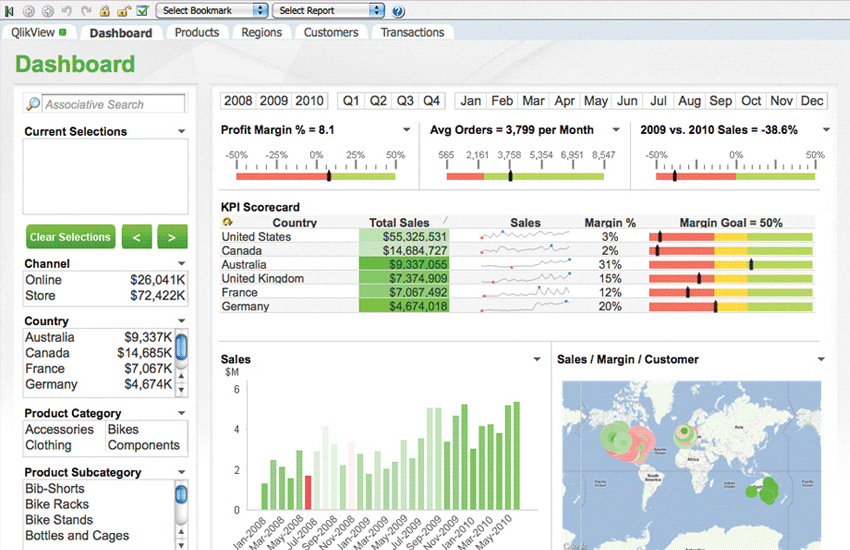
A QlikView deployment normally consists of three pieces: QlikView Desktop for developers, QlikView Server for hosting documents, and QlikView Publisher for scheduled data reloads and distribution. End users open a .qvw application either through the Windows IE plugin, the AccessPoint web portal, or the QlikView Mobile clients. Inside a document analysts get:
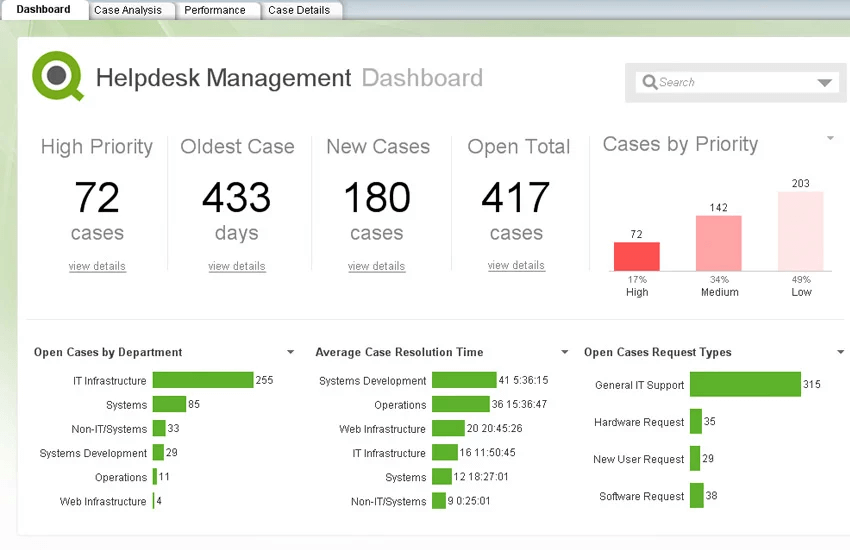
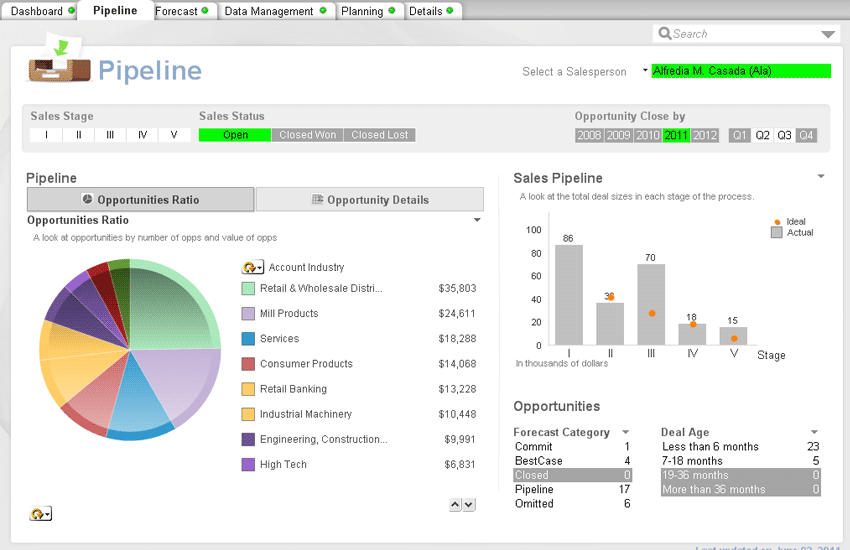
- Guided analytics dashboards with selection bookmarks and current selection boxes.
- Pivot tables, straight tables, and statistical objects that recalculate on every selection.
- Set analysis expressions for cohort, year-over-year, and what-if modeling.
- Section access for row-level security driven by AD groups or a security table.
- Server-side data reloads against 100+ ODBC, OLE DB, and native connectors.
The trade off is that QlikView is a desktop-authored, server-published product. There is no browser authoring, no native Git workflow, and no SaaS delivery. Compared with cloud-native peers such as Looker Studio, Metabase, or Holistics, the build experience feels distinctly 2010s.
Qlik Sense and Qlik Cloud Analytics: the modern path
Qlik Sense launched in 2014 as the successor product. It keeps the Associative Engine but rebuilds the front end as a browser-first, drag-and-drop authoring experience with responsive layouts, mobile-ready charts, and a public extension API. Qlik Cloud Analytics is the multi-tenant SaaS version of Qlik Sense, delivered from Qlik-managed AWS regions. On top of Qlik Sense, Qlik has shipped a stack of AI features that QlikView never received:
- Insight Advisor for natural language queries and chart recommendations.
- Insight Advisor AutoML for no-code predictive models with feature importance and SHAP-style explanations.
- Qlik Answers, a generative AI assistant that grounds answers in your governed datasets and documents.
- Qlik Predict, the productized scoring layer that pushes ML predictions back into Qlik apps and downstream systems.
None of those features will be back-ported to QlikView. If AI or natural language search is on your 2026 roadmap, that capability lives on the Qlik Sense side of the house.
Deployment, mobile, and connectors
Across the Qlik portfolio you have three deployment routes: Qlik Cloud Analytics SaaS, Qlik Sense Enterprise on Windows for on-prem or private cloud, and QlikView on Windows Server for legacy estates. Qlik Sense Mobile ships as native iOS and Android apps with offline caching for field analysts, an option QlikView only partially supported through its older mobile clients.
For data movement Qlik bundles Qlik Data Integration, the unified product line that absorbed Attunity in 2019 and the Talend acquisition in 2023. Together they cover 800+ sources and targets including SAP, Salesforce, Snowflake, Databricks, AWS, Azure, GCP, Oracle, Workday, and ServiceNow, plus log-based change data capture for transactional databases. That breadth is one of the strongest reasons enterprise buyers stay inside the Qlik ecosystem rather than splitting BI and ELT across Tellius, Redash, or Amazon QuickSight.
How Much Does QlikView Cost
Qlik no longer publishes QlikView pricing on its public site, and new QlikView licenses are not commonly sold. Renewals are quoted by Qlik account teams against your existing CAL count. For Qlik Cloud Analytics, which is what Qlik will actually quote a new buyer in 2026, vendor pages return a "Contact sales" shell and third-party aggregators publish the figures below. Treat them as directional rather than rate-card.
| Plan | Monthly price | What it includes |
|---|---|---|
| Qlik Cloud Analytics Standard | From ~$825/mo | 20 full users, core Qlik Sense, Insight Advisor, governed apps |
| Qlik Cloud Analytics Premium | From ~$2,700/mo | 20 full users plus 10,000 basic users, AutoML, advanced governance |
| Qlik Cloud Analytics Enterprise | ~$11,000 to $27,500/mo (custom) | Higher data volumes, Qlik Answers, dedicated capacity, enterprise SLAs |
| Per-user Professional | $70 to $150 per user/mo | Full authoring, sharing, and consumption |
| Per-user Analyzer | $30 to $50 per user/mo | Read and explore only, no authoring |
For comparison, mid-market alternatives such as Zoho Analytics and Domo publish lower entry tiers, while enterprise peers like IBM Cognos Analytics, MicroStrategy, and Sisense sit in the same custom-quote band as Qlik.
Hidden Costs and Contract Gotchas
QlikView is in extended-support wind-down, which changes the cost equation:
- Extended support fees. Customers staying past mainstream end-of-life pay extended-support uplifts that escalate year over year.
- Migration to Qlik Sense. The shift from QlikView to Qlik Sense or Qlik Cloud is not a click; budget partner-led migration of $40,000 to $250,000 depending on app count.
- Talent cost. QlikView developer pool is shrinking; hourly rates for remaining QlikView contractors run 20% to 40% above Qlik Sense contractors.
- Dual-license overlap. Most enterprises run QlikView and Qlik Sense in parallel for 12 to 24 months during migration, doubling license spend.
Pros and Cons of QlikView
Pros
- The Associative Engine remains best-in-class for ad-hoc, in-memory exploration.
- Deep installed base and battle-tested governance in regulated industries.
- Pixel-perfect dashboard control that newer self-service tools sacrifice.
Cons
- Extended-support timeline means the platform is sunsetting; migration is a question of when, not if.
- Modern UI lags Qlik Sense, Power BI, and Tableau.
- Talent and partner ecosystem shrinking year over year.
Who Should Use QlikView
QlikView only makes sense for organizations already running it at scale who need to extend the platform's life for one to three years while planning migration to Qlik Sense or Qlik Cloud. New BI buyers should not select QlikView; evaluate Microsoft Power BI, Tableau, or Qlik Sense instead.
QlikView Alternatives
Buyers replacing QlikView typically shortlist:
- Microsoft Power BI for cost-effective self-service across the Microsoft stack.
- Tableau for analyst-led visual exploration.
- Qlik Sense and Qlik Cloud Analytics for the cleanest path to keep existing QlikView semantics.
- IBM Cognos Analytics and MicroStrategy for governed enterprise reporting at the same tier.
- Sisense for embedded analytics use cases.
What Real Buyers Report
Qlik's customer page highlights HSBC, Honda, Cisco, Mercedes-Benz, Sony, and PayPal as named references across QlikView and Qlik Sense deployments. The two products together serve the 40,000+ customer base that Qlik reports globally. On the analyst-share side, Qlik held 7.4% mindshare in the data visualization category in September 2025, down from 8.7% the prior year as buyers migrated to Power BI and Tableau Cloud. That softening is a fair signal that QlikView renewals alone will not hold a customer through the next refresh cycle: the Qlik Sense and Qlik Cloud Analytics story is what closes business in 2026.
Security and compliance
Qlik Cloud Analytics carries the certifications most enterprise procurement teams ask for: SOC 2 Type 2, SOC 3, HITRUST for HIPAA workloads, ISO 27001, ISO 27017, ISO 27018, GDPR alignment, FedRAMP through Qlik Cloud Government, IRAP for Australian government, and CASA Tier 3. QlikView on-prem inherits whatever your own Windows environment is certified for, which is one reason regulated buyers in healthcare and financial services historically preferred it. Once you migrate to Qlik Cloud Analytics, the compliance posture is Qlik's responsibility rather than yours.
Reviews and what users say
Public review data tracks the two products separately. Qlik Sense holds 4.3 out of 5 across 1,718 G2 reviews, with reviewers calling out the Associative Engine, scripting flexibility, and depth of set analysis, and flagging a steep learning curve for new developers. QlikView scores 8.2 out of 10 on PeerSpot, with feedback that mirrors what Qlik's own lifecycle messaging admits: the product is stable, fast, and trusted, but visibly aging next to cloud-first peers. TrustRadius and SpotSaaS both characterize QlikView as "a legacy, maintenance-focused product, while Qlik Sense is Qlik's primary and actively developed analytics platform."
Implementation Plan: Migrating from QlikView to Qlik Sense
Qlik publishes a documented migration program with three practical phases. First, run the QlikView Converter inside Qlik Sense to translate .qvw files into Qlik Sense apps; expect about 60 to 80 percent of objects to convert cleanly, with charts that rely on QlikView-only features (container objects, certain macros, legacy extensions) needing manual rework. Second, refactor your data model to take advantage of Qlik Sense's master items, the Cloud Hub, and shared spaces. Third, plan a phased user cutover from the QlikView AccessPoint to Qlik Cloud Analytics or Qlik Sense Enterprise. Most mid-size estates land in a 6 to 12 month program, longer if you also fold in Qlik Data Integration replatforming.
Bottom Line
QlikView in 2026 is a deliberate hold, not a new purchase. It still runs the same Associative Engine that made Qlik famous, still serves dashboards that hundreds of large enterprises depend on, and still has more than a year of vendor support left before its October 31, 2026 end of life. What it does not have is a future on Qlik's roadmap: AI, generative search, predictive modeling, and SaaS delivery all live inside Qlik Sense and Qlik Cloud Analytics. If you are a current QlikView customer, the right 2026 motion is to renew maintenance, scope a Qlik Sense or Qlik Cloud Analytics migration, and use the converter to start moving high-traffic applications now. If you are a new buyer evaluating Qlik against other business intelligence platforms, evaluate Qlik Sense and Qlik Cloud Analytics. QlikView is not the product you should be signing in 2026.
Frequently Asked Questions
Is QlikView being discontinued?
How much does Qlik Sense Cloud Analytics cost in 2026?
How does Qlik Sense compare to Power BI?
Is Qlik Sense HIPAA and FedRAMP compliant?
Does Qlik Sense have a mobile app?
What is the Qlik Associative Engine?
What is Qlik Predict and Qlik Answers?
What data sources does Qlik support?
How long does Qlik Sense take to deploy at enterprise scale?
Should existing QlikView customers migrate to Qlik Sense or to a different vendor?
Find Your Perfect Software
See how it can transform your workflow
- Personalized for your needs Tailored recommendations based on your unique requirements.
- Save time & resources Streamline your workflow and boost team productivity.
- Trusted by thousands Join 10,000+ businesses already growing with SaaSrat.
You're all set! 🎉
A specialist for will reach out within 1 business day with tailored recommendations for your needs.