

Redash
by Redash
What is Redash?
Get Best Quote for Redash
Connect with SaaSrat experts to get the best quote for your business.
You're all set!
A specialist for Redash will reach out within 1 business day.
Redash Features
Open-source under BSD-2-Clause license
SQL editor with auto-complete
Query results visualisation
Dashboards plus widgets
Query parameters
Scheduled queries plus alerts
View All 38 Features
Redash Pricing Plans
Open Source (Self-Hosted)
- Free under BSD-2-Clause license
- Full feature set
- 48 data sources
- Self-hosted via Docker or Kubernetes
- Realistic infra plus ops USD 5K to USD 15K per year
- Community support
Databricks SQL Migration
- Migrate from self-hosted Redash to Databricks SQL
- Databricks Lakehouse plus Unity Catalog
- Commercial support plus SLA
- AI/BI Genie included
- Databricks-quoted
Redash Screenshots
Description
Redash at a Glance
Redash is an open-source, SQL-first business intelligence tool that lets analysts write queries against any database, visualize the results, and share dashboards across a team. It was founded by Arik Fraimovich in 2013, acquired by Databricks on June 24, 2020, and now lives as a community-led project on GitHub at github.com/getredash/redash under a BSD-2-Clause license.
The product sits in a different lane from drag-and-drop tools like Metabase or Looker Studio. Redash assumes the person building a dashboard can write SQL, and rewards that assumption with a fast query editor, scheduled refreshes, alerts, and 48 data source connectors out of the box. If your team lives in the warehouse, it feels native. If your team needs no-code self-serve, you will hit a wall.
This profile covers what Redash is in 2026, what changed after the Databricks acquisition, and where it still earns a spot in a modern BI stack.
Acquisition, Maintenance Mode, and What That Means in 2026
Databricks acquired Redash on June 24, 2020. The acquisition price was never disclosed. Founder and CEO Arik Fraimovich joined Databricks, and the hosted Redash SaaS was sunset for new customers. Existing hosted accounts were offered a migration path to Databricks SQL, which is the commercial successor inside the Databricks Lakehouse platform.
The self-hosted open-source project is still alive, but its trajectory has changed. After the acquisition, official Databricks-funded development on the open-source repo wound down. The project rebooted in late 2023 as a community-led effort, with roughly seven volunteer maintainers stepping up per GitHub Discussion #5962. As of writing, the repo has 28.6k stars, 4.6k forks, and 7,965 commits on master, with the latest release v26.3.0 shipping on March 2, 2026.
The honest read: Redash is in maintenance mode. The volunteers are doing useful work, but the focus is dependency upgrades, CI fixes, Python 3 compatibility, and security patches rather than net-new features. Compare that to Metabase, which has 47k GitHub stars and a full-time commercial team shipping new visualization types, embedded analytics improvements, and an AI assistant. If you are evaluating Redash today for a fresh deployment, you should know what you are buying into.
Who Should Use Redash
Redash earns its keep with one specific user: the data analyst who already writes SQL, owns the warehouse, and wants a lightweight surface to run queries, save them, schedule them, and share charts without provisioning a Tableau license per seat.
Typical fits in 2026:
- Engineering and analytics teams that already self-host their stack and prefer open-source tools they can audit and extend
- Startups that need a free internal dashboarding layer over Postgres, MySQL, BigQuery, or Snowflake before they are ready to commit to a paid BI seat model
- Existing Redash users with mature query libraries who do not want to absorb migration cost
- Teams running Databricks SQL who want the open-source query interface as a complement
Where Redash struggles:
- Business users who cannot write SQL. Redash has no semantic layer and no drag-and-drop query builder. Tools like Zoho Analytics, Domo, or Sigma Computing serve that audience better.
- Enterprises that need governance, row-level security, lineage, and certified datasets. Tableau, Microsoft Power BI, and MicroStrategy are built for that.
- Teams that need rich visualization libraries. Redash supports the basics. Sisense and QlikView offer far more chart types and interactions.
Redash Product Suite
Connector breadth is one of Redash's real strengths. The README cites "35+ data sources" but the docs at redash.io/help/data-sources/supported-data-sources list 48 supported connectors in 2026. The coverage spans transactional databases, warehouses, NoSQL stores, SaaS APIs, and scripting runtimes.
| Category | Supported sources (selection) |
|---|---|
| Cloud warehouses | BigQuery, Snowflake, Redshift, Databricks, Athena |
| Relational databases | Postgres, MySQL, MSSQL, Oracle, SQLite, MariaDB, CockroachDB |
| NoSQL and search | MongoDB, Elasticsearch, ClickHouse, DynamoDB, Cassandra |
| Query engines | Presto, Trino, Hive, Spark SQL, Impala |
| SaaS APIs | Salesforce, JIRA, Google Analytics, Google Sheets, Stripe |
| Scripting and files | Python, Shell, CSV, JSON, URL |
The Python data source is a favorite among analysts because it lets you write a Python script that returns a result set, then chart and schedule it like any SQL query. The shell data source does the same for command-line workflows. That kind of hackability is rare in commercial BI and is part of why long-time users keep Redash around.
Query Editor, Dashboards, and Alerts
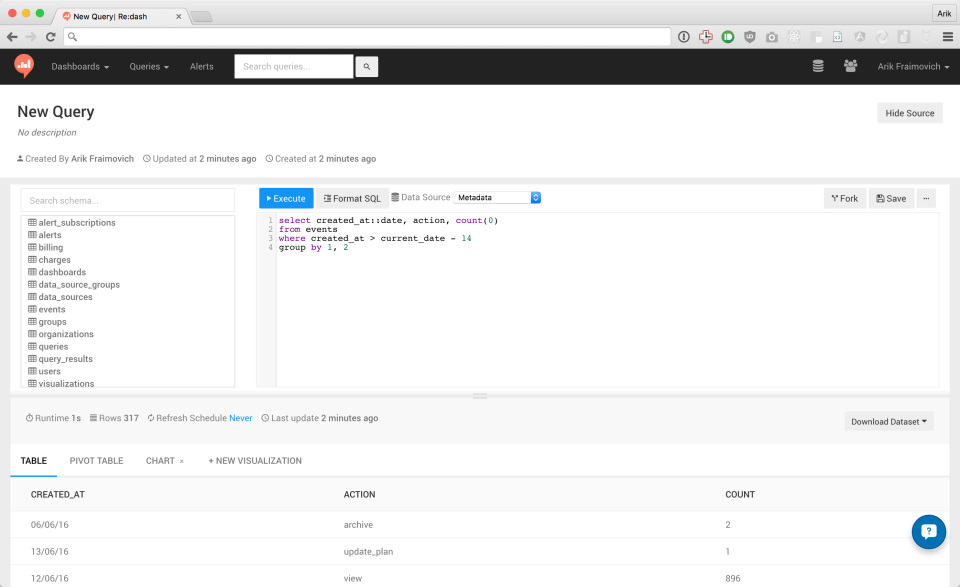
The core workflow in Redash is the query editor. You pick a data source, write SQL, run it, see the result set, and save the query. You can parameterize queries with dropdowns, dates, and free-text inputs, schedule refreshes from one minute to days, and chain queries together using the Query Results data source.
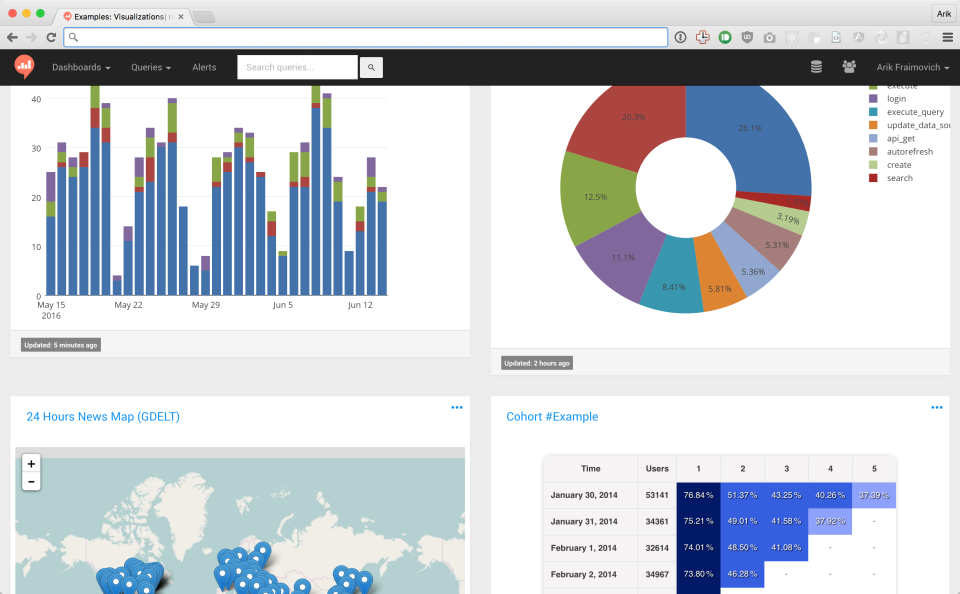
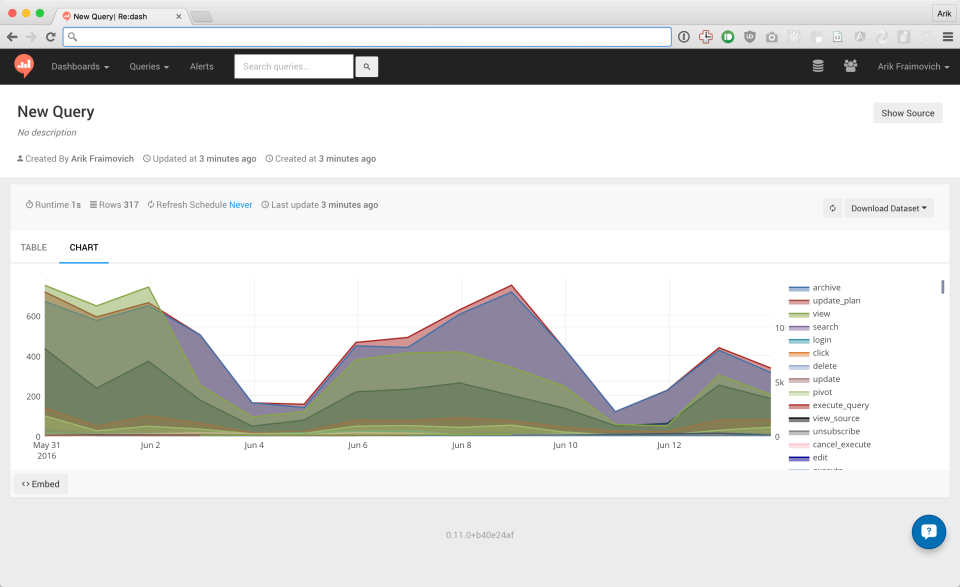
Visualizations sit on top of saved queries. The built-in chart types cover line, bar, area, pie, scatter, box plot, funnel, cohort, sankey, sunburst, choropleth map, and pivot table. You drag visualizations onto dashboards, set filter parameters at the dashboard level, and share via public link or signed-in user permissions.
Alerts are query-based. You define a SQL query, a condition like "value greater than 100", and a destination such as Slack, email, PagerDuty, or a webhook. The alerting layer is simple but reliable, and many teams treat it as their poor-man's monitoring tool for business metrics.
What is missing in 2026 and unlikely to land soon: dashboard version control, a proper visual query builder, native row-level security, certified dataset workflows, and an AI assistant. Capterra reviewers call these out repeatedly.
Self-Hosting and Deployment
The standard install path is Docker Compose. The official repo ships a docker-compose.yml that brings up the Redash web app, a Postgres metadata store, a Redis queue, and a worker pool. A small team can be running on a single VM inside an hour. Larger deployments split workers across machines and put the metadata store on managed Postgres.
The reference setup runs comfortably on a 4-vCPU, 8 GB VM for a team of 20 to 50 analysts. The two scaling pressure points are worker concurrency, which you tune via the REDASH_WORKERS_COUNT environment variable, and metadata Postgres, which fills up if you keep long query history.
Kubernetes deployments are common but not officially documented. The community maintains an unofficial Helm chart on GitHub, and many teams run their own Kustomize overlays. Compare this to managed BI like Amazon QuickSight or Holistics, where there is nothing to operate, but you also do not control the rollout.
How Much Does Redash Cost
Self-hosted Redash is free under the BSD-2-Clause license. There is no seat cap, no feature gate, and no telemetry that calls home. You pay for the infrastructure you run it on, and for the time it takes your team to operate it.
The hosted SaaS plans that used to live at redash.io are sunset for new customers. If you came here looking for a managed Redash subscription, that product no longer exists. Databricks SQL is the commercial successor and is priced as part of the Databricks Lakehouse platform, with consumption-based serverless SQL warehouses and a separate compute cost. For most teams evaluating BI today, that means Redash is a free self-host story or nothing.
If you want managed BI with a published seat price and a vendor on the other end of a support ticket, Metabase Cloud, Looker Studio, and Zoho Analytics are better fits.
Hidden Costs and Contract Gotchas
Redash is free at the source-code level, but running it carries real costs:
- Self-hosting infrastructure. A production Redash on AWS or DigitalOcean runs $80 to $400 per month in compute, RDS, and backup; budget more if you scale to multi-tenant.
- Engineering time. Maintenance mode means no vendor support; expect 8 to 20 engineering hours per month for patches, dependency upgrades, and incident response.
- No SLA. If Redash goes down, you fix it. Plan a runbook before you deploy.
- Future migration. Because the project is no longer actively developed, every dashboard you build today becomes migration debt for tomorrow.
Implementation Plan: Rolling Out Redash
Self-hosted Redash deploys faster than commercial BI, but planning still matters:
- Week 1: infrastructure. Stand up Docker or Kubernetes Redash, point at Postgres metadata DB, configure SSO via SAML or Google OAuth.
- Week 2: data sources. Connect warehouses, transactional databases, and APIs; test query performance.
- Weeks 3 to 4: starter dashboards and alerts. Build a first wave of queries and dashboards, configure email and Slack alerts.
- Weeks 5 to 6: user onboarding and access controls. Train analysts and viewers, set group-level permissions, document the maintenance runbook.
What Real Buyers Report
Capterra holds Redash at 4.6 out of 5 across 15 reviews, with ease of use scored 4.5 and customer support 4.0. Reviewers consistently praise three things: the speed of getting from SQL to a shareable chart, the breadth of data source support, and what one reviewer called "incredibly fair value for cost" given the free license.
The complaints are also consistent. Non-technical users get stuck because everything requires SQL. There is no native version control on dashboards, so when someone edits a chart the previous version is gone. The visualization library, while broad, is shallow compared to Tableau or QlikView. Support has slowed since maintenance mode began, since the volunteer maintainers triage GitHub issues on their own time.
G2 reviews skew positive but the sample size is small. Most recent G2 entries are five-star and emphasize the same SQL-first workflow strengths.
Security and Compliance
Redash itself does not publish SOC 2, GDPR, or HIPAA badges on redash.io. Because the open-source project is self-hosted, your compliance posture is whatever you build around it. The codebase supports Google OAuth and SAML single sign-on, group-based permissions, and per-data-source query permissions, which gives you the building blocks for most internal-tool deployments.
For regulated workloads like healthcare or finance, you typically run Redash inside a VPC, terminate TLS at a load balancer, hand off authentication to your IdP, and rely on database-level row-level security rather than anything in the BI layer. Teams that need vendor-attested compliance out of the box should look at IBM Cognos Analytics, MicroStrategy, or Microsoft Power BI.
Redash Alternatives
The 2026 conversation in the open-source BI community is straightforward. For new deployments, Superset and Metabase get the recommendation more often than Redash. Metabase has 47k GitHub stars versus Redash's 28.6k, ships a question builder for non-SQL users, and is backed by a funded company with full-time engineers. Apache Superset has stronger enterprise governance features and a richer visualization library.
Where Redash still wins:
- You already have Redash and a library of hundreds of saved queries. Migration cost is real.
- You want the simplest possible "SQL in, chart out" surface with no abstractions in the way.
- You need the Python and shell data sources as part of an analyst workflow.
- You are already a Databricks customer and want the open-source companion to Databricks SQL.
Where you should pick something else:
- Self-serve for business users. Pick Metabase, Sigma Computing, or Tellius.
- Enterprise governance and lineage. Pick Tableau or Microsoft Power BI.
- Embedded analytics in a SaaS product. Look at the broader business intelligence category for embed-first tools.
Pros and Cons of Redash
Pros
- Free, open-source, and self-hostable, so license cost is zero at any scale.
- Familiar SQL-first authoring surface that data engineers and analysts pick up in hours, not weeks.
- Strong data-source coverage across warehouses, transactional databases, and APIs.
- Lightweight dashboards and email or Slack alerts work for most operational use cases.
Cons
- Maintenance mode after the Databricks acquisition means feature investment has effectively stopped.
- No vendor support; outages and patches sit on your engineering team.
- UI and dashboarding feel dated against modern BI tools like Sigma or Holistics.
- No governed semantic layer, so metric definitions drift across queries.
Bottom Line
Redash is a still-useful but maintenance-mode tool. The open-source self-host stays free, the connector list is broad, and the SQL-first workflow is genuinely fast for analysts who know their warehouse. The product no longer has a full-time vendor behind it, the hosted plans are gone, and major new features are not on the roadmap.
If you are migrating off Redash, Databricks SQL is the official upgrade path and a community-led move to Metabase or Superset is the most common alternative. If you are starting fresh in 2026 and your priority is a modern open-source BI tool with active development, start with Metabase or Superset and revisit Redash only if their model does not fit. If you already run Redash and it works, the project is stable enough to keep running while you plan your next move.
Frequently Asked Questions
How much does Redash cost in 2026?
Is Redash still maintained?
How does Redash relate to Databricks?
How does Redash compare to Metabase?
Is Redash HIPAA or SOC 2 compliant?
What data sources does Redash support?
Does Redash have a mobile app?
How long does Redash take to deploy?
Should I migrate from Redash to Databricks SQL?
Is Redash production-ready in 2026?
Find Your Perfect Software
See how it can transform your workflow
- Personalized for your needs Tailored recommendations based on your unique requirements.
- Save time & resources Streamline your workflow and boost team productivity.
- Trusted by thousands Join 10,000+ businesses already growing with SaaSrat.
You're all set! 🎉
A specialist for will reach out within 1 business day with tailored recommendations for your needs.