

Domo
by Domo • Founded 2011
What is Domo?
Get Best Quote for Domo
Connect with SaaSrat experts to get the best quote for your business.
You're all set!
A specialist for Domo will reach out within 1 business day.
Domo Features
Cloud-native architecture
Consumption-based credit pricing
Domo Magic ETL
Domo Workbench (on-prem connector)
Domo AI plus Domo.AI agents
1
View All 28 Features
Domo Pricing Plans
Standard (Verified Mid-Market)
- Verified buyer ranges USD 20,000 to USD 50,000 per year
- Consumption-based credits since mid-2023
- Typical mid-market deployment
- Magic ETL plus 1,000 plus connectors
- Mobile apps included
Growth (50 Users plus 250M Rows)
- Verified buyer ranges USD 75,000 to USD 85,000 per year
- 50 users plus 250 million rows
- Federated queries
- Beast Mode calculated fields
- Personalized Data Permissions (PDP)
Enterprise
- Starts USD 100,000 plus per year
- Unlimited users
- Domo.AI agents
- Domo Everywhere embedded
- Dedicated success team
- Annual prepay discount
Domo Resources
Domo Screenshots
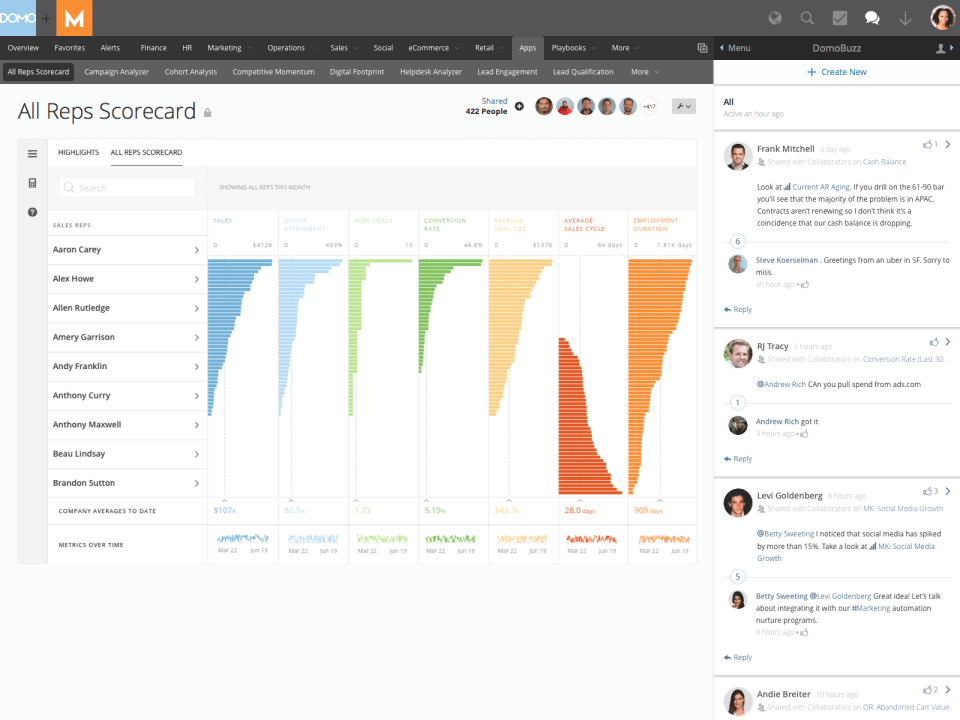
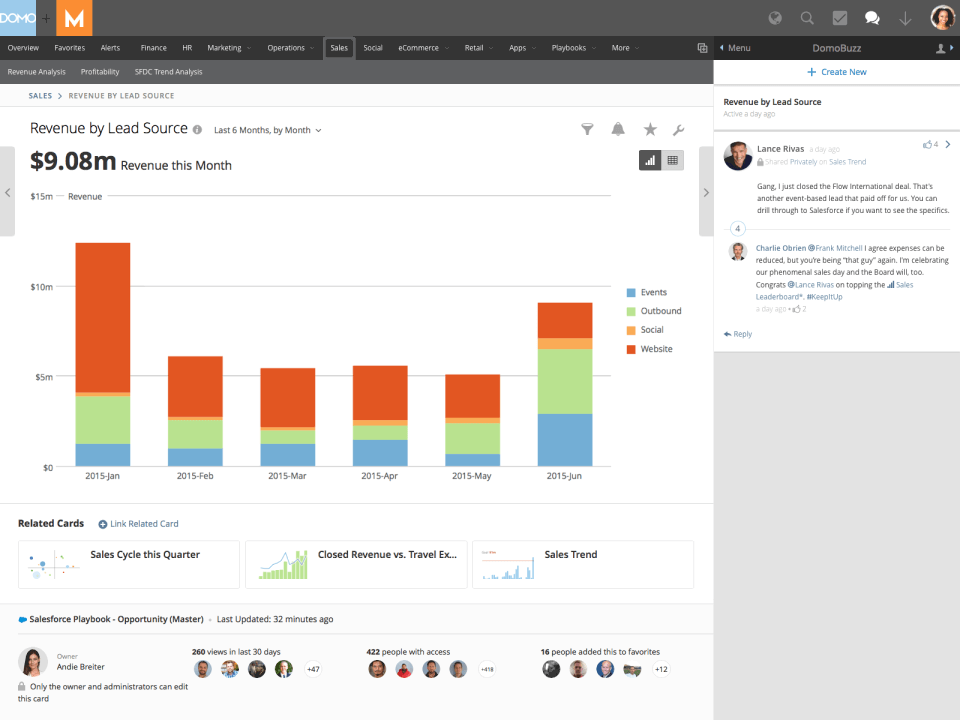
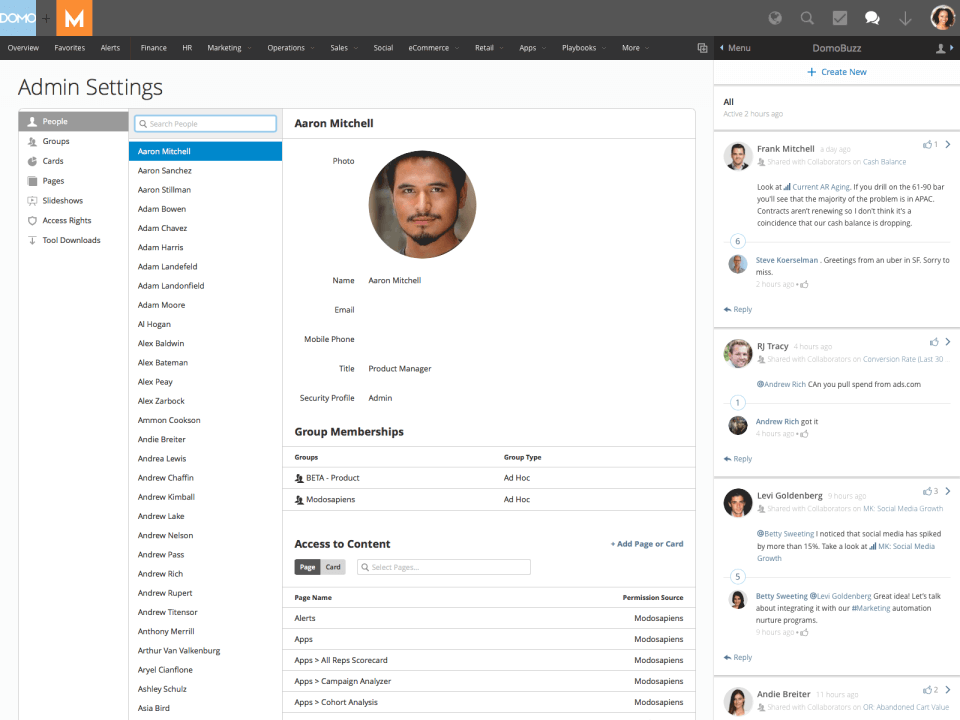
Description
Domo at a Glance
| Best fit for | Mid-market and enterprise organisations of 500 to 50,000 plus employees that want end-to-end BI covering data integration, modelling, visualisation, and action, with consumption-based pricing that scales with usage rather than per-seat licences |
|---|---|
| Pricing model | Consumption-based credit pricing (shifted from per-user mid-2023). Standard, Enterprise, and Business Critical tiers all on the credit model. Typical mid-market annual spend USD 20,000 to USD 50,000; 50 users plus 250 million rows lands USD 75,000 to USD 85,000; enterprise USD 100,000 plus. |
| Core platform | Cloud-native data integration plus Magic ETL plus modelling plus visualisation plus AI insights plus mobile-first consumption inside a single platform; designed as a "data BI cloud" rather than just a dashboard layer |
| Free trial | 30-day free trial available |
| Founded and HQ | Domo, Inc. founded 2010 by Josh James (prior co-founder of Omniture, acquired by Adobe 2009). HQ American Fork, Utah (772 East Utah Valley Drive) |
| Public company | NASDAQ: DOMO. IPO June 29, 2018 at USD 21.00 per share (9.2 million shares) |
| Native integrations | 1,000 plus pre-built cloud connectors covering Salesforce, Snowflake, NetSuite, BigQuery, Google Analytics, Workday, ServiceNow, SAP, Oracle, AWS, plus DBs and SaaS APIs; vendor-managed connector updates when third-party APIs change |
| Compliance | SOC 2 Type II, HIPAA, GDPR, ISO/IEC 27001, ISO/IEC 27018, HITRUST (Risk-based, 2-year). FedRAMP not vendor-confirmed in current 2026 attestation review. |
| Mobile experience | Domo native iOS app (iOS 16.4 plus) and Android app (Android 10 plus). Mobile-first design is a core Domo differentiator versus Power BI Desktop-first authoring. |
| Trust signals | Customers include UnitedHealth Group, Comcast, Target, Deutsche Post (DHL), Cisco Systems, and Regional One Health. Vendor reports 25 percent plus of Fortune 50 use Domo across 21 plus industries. |
Pros and Cons of Domo
Where Domo wins:
- End-to-end platform consolidation. Data integration plus Magic ETL plus modelling plus visualisation plus mobile delivery in one product reduces the BI tool sprawl that Tableau, Microsoft Power BI, and Looker Studio typically pair with separate ETL, semantic layer, and mobile tools.
- Consumption-based credit pricing aligns cost with value. Buyers no longer pay per-seat for casual viewers; usage-driven pricing scales with how much data the organisation actually moves.
- 1,000 plus pre-built connectors with vendor-managed updates remove the operational tax of broken connectors when SaaS APIs change. This is genuinely better than peer BI platforms that push connector maintenance onto customers.
- Mobile-first design ships native iOS plus Android apps with executive dashboards, alerts, push notifications, and offline access. Field workforce and executive consumption beat the responsive-web-only experiences from Looker Studio and Metabase.
- Customer base includes 25 percent plus of Fortune 50 (UnitedHealth, Comcast, Target, DHL, Cisco). Vendor stability and roadmap signal are material trust factors for enterprise procurement.
Where Domo falls short:
- Consumption-based credit pricing has no automatic spend cap. Over-consumption triggers quarterly true-up bills; buyers commonly report unexpected USD 20,000 to USD 100,000 plus invoices. Negotiate explicit caps and alerting upfront.
- Vendor pages frequently return empty content to scraping (Cloudflare bot protection), making procurement-side fact verification harder. Plan for direct vendor calls during diligence.
- NASDAQ public company status with USD 21 IPO price now trading meaningfully lower has prompted ongoing strategic questions; track Domo's quarterly earnings during multi-year contract negotiation.
- Magic ETL is powerful but proprietary. Teams that prefer SQL-first transformation may find Domo's visual ETL paradigm constraining versus Metabase plus dbt.
- FedRAMP is not in Domo's current attestation list; US federal agencies should evaluate Microsoft Power BI or Amazon QuickSight instead.
Who Should Use Domo
Domo is the right pick for mid-market and enterprise organisations of 500 to 50,000 plus employees that want end-to-end BI covering data integration, modelling, visualisation, and mobile-first consumption inside a single consumption-billed platform. Best fit for retail, healthcare, financial services, manufacturing, and consumer brands with 50 plus business users, 100 plus data sources, and an executive plus field workforce that consumes dashboards on mobile.
Skip Domo if you are SMB under 100 employees (try Zoho Analytics or Looker Studio Pro), if you need FedRAMP attestation for US federal agencies (try Microsoft Power BI), if you want per-seat predictable BI pricing rather than consumption (try Tableau or Microsoft Power BI), or if SQL-first transformation is the team's preference (try Metabase plus dbt).
Domo Product Suite
Domo ships as a unified cloud data BI platform with multiple capability modules under credit-based consumption pricing. Core capabilities buyers care about:
- Data integration with 1,000 plus pre-built cloud connectors covering Salesforce, Snowflake, NetSuite, BigQuery, Google Analytics, Workday, ServiceNow, SAP, Oracle, AWS, plus vendor-managed connector updates.
- Magic ETL visual drag-and-drop data transformation with credit-based billing on input plus output rows.
- Dataflows for SQL-based transformations and complex modelling for technical users.
- Beast Modes for inline metric calculations across dashboards.
- Domo AI with conversational analytics, anomaly detection, AI-generated narratives, and AI-powered automation.
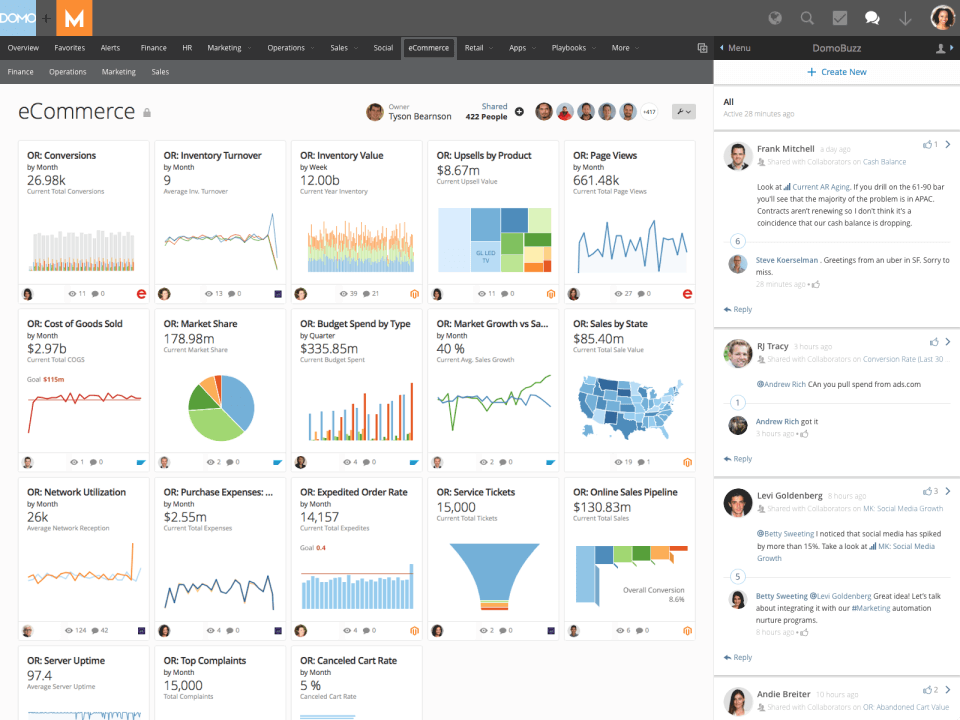
- Dashboards and cards with hundreds of chart types, drill paths, alerts, and embedded analytics.
- Domo Mobile native iOS plus Android apps with push notifications, alerts, executive briefing experiences, and offline access.
- Domo Workflows for triggered actions, approval flows, and write-back to source systems.
- Domo Everywhere for embedded analytics inside customer-facing SaaS products.
- Domo App Studio for low-code application building on top of data assets.
- Auto-ML and predictive analytics for forecasting and classification.
- BYOK encryption, SAML SSO, MFA across all tiers; HITRUST plus SOC 2 Type II plus HIPAA plus GDPR plus ISO 27001 attestations.
How Much Does Domo Cost
Domo moved to consumption-based credit pricing in mid-2023. Buyer-disclosed ranges across G2, Capterra, Holistics, and BlazeSQL community pricing reports:
- Free Trial: 30 days, no credit card.
- Standard tier: Entry consumption-credit pricing for SMB and lower mid-market. Typical mid-market organisations land USD 20,000 to USD 50,000 per year.
- Enterprise tier: Consumption-credit pricing with advanced governance, SAML SSO, audit logs, and more credits. Typical configurations with 50 users plus 250 million rows land USD 75,000 to USD 85,000 per year.
- Business Critical tier: Consumption-credit pricing with HIPAA plus HITRUST plus advanced security, dedicated success management. Enterprise deployments commonly land USD 100,000 plus per year.
- Credit math: Roughly 1 credit per million materialised storage rows per month; 1 credit per 2 million virtual rows per month. Magic ETL bills on both input plus output rows, which can drive consumption faster than expected.
- Implementation services: Roughly USD 10,000 to USD 75,000 depending on integration depth and content build.
Notable gotcha: there is no automatic spend cap. Quarterly true-up invoices can land unexpectedly when consumption spikes. Negotiate explicit caps, alerting thresholds, and quarterly review cadence before signing.
Hidden Costs and Contract Gotchas
Domo contracts have meaningful all-in cost beyond the headline consumption commitment. Buyers should budget for:
- Quarterly consumption true-up. Over-consumption surfaces as unexpected invoices. Negotiate caps, alerts, and review cadence upfront.
- Magic ETL credit doubling. Input plus output billing means data transformations consume credits twice; complex pipelines can outpace storage credits.
- Implementation services at USD 10,000 to USD 75,000 depending on connector setup, data modelling, and content build.
- Domo Everywhere embedded pricing. Customer-facing dashboards scale separately by end-user counts; reconcile your pricing model against your customer count.
- Premium support tier for dedicated success manager access during enterprise rollouts.
- Annual contract auto-renewal. Calendar a 60 day reminder before renewal to negotiate.
- Public company financial monitoring. Track Domo's quarterly NASDAQ filings during multi-year contract negotiation.
Implementation Plan: Rolling Out Domo
Domo deployments scale with platform breadth. Single-team rollout runs 2 to 6 weeks; enterprise multi-team rollout with custom data integration runs 3 to 12 months.
- Phase 1 (2 to 4 weeks): Tenant setup, SSO, user provisioning, first connectors (Salesforce, NetSuite, Google Analytics), first dashboards.
- Phase 2 (1 to 3 months): Magic ETL pipelines, dataflows for SQL transformations, semantic modelling, dashboard governance.
- Phase 3 (3 to 6 months): Domo AI rollout, Domo Workflows for triggered actions, Domo Mobile for executive consumption, embedded analytics if customer-facing.
- Phase 4 (6 to 12 months): Advanced governance (audit logs, RLS, content certification), Domo Everywhere for customer dashboards, App Studio for custom applications.
Pilot one business unit for 30 to 60 days before company-wide rollout. Validate credit consumption patterns against contract commitment before scaling beyond 50 users. Establish quarterly cost review cadence with finance.
Domo Alternatives
Domo competes in the mid-market and enterprise BI segment with adjacencies into data integration platforms. Common alternatives buyers shortlist:
- Tableau for visualisation-first analyst teams with predictable per-user pricing.
- Microsoft Power BI for Microsoft 365 shops at USD 14 per user per month Pro.
- Looker Studio for free Google-ecosystem dashboards.
- Sisense for embedded analytics and SaaS dashboards.
- Qlik Sense for associative-engine analytics.
- Zoho Analytics for SMB and lower mid-market wanting bundled cross-functional analytics.
- Amazon QuickSight for AWS-native shops with pay-per-session economics.
- MicroStrategy (Strategy) for governance-heavy enterprise BI.
Compare prices, features, and reviews across the full business intelligence software category to see how Domo lines up against modern, enterprise, and embedded BI competitors.
What Real Buyers Report
Mid-market and enterprise BI leaders evaluating Domo in 2026 commonly highlight three patterns in customer reviews and forum threads:
- Platform consolidation pays back at scale. Customers running Domo for integration plus ETL plus visualisation report 25 to 40 percent reduction in data tooling spend versus separate stacks (Fivetran plus dbt plus Looker, for example).
- Consumption pricing requires governance. Teams without credit monitoring discipline see surprise true-up invoices. Buyers who set up alerts, monthly review cadence, and credit budgets stay within commitment; teams that don't pay more.
- Mobile experience is the executive lock-in. Domo's native iOS plus Android apps drive senior leadership consumption in ways desktop-first BI tools cannot match. Executive sponsorship correlates with continued investment in Domo.
Common complaints in 2025 to 2026 reviews: consumption-cost predictability, Magic ETL credit doubling, NASDAQ stock-price-driven uncertainty, lack of FedRAMP, vendor-page bot protection making procurement diligence harder.
What G2 and Capterra Reviewers Actually Say About Domo
G2 rates Domo 4.3 of 5 across 986 reviews with 60 percent 5-star and 33 percent 4-star scoring. Capterra rates Domo 4.3 of 5 across 327 reviews. Verified production customers include UnitedHealth Group, Comcast, Target, Deutsche Post (DHL), Cisco Systems, and Regional One Health, with vendor reporting 25 percent plus of Fortune 50 use Domo. Buyer themes positioning Domo against peers: end-to-end platform versus dashboard-only tools like Tableau, native mobile versus responsive-only competitors, and consumption pricing versus per-user. Domo's 2024 pivot to consumption-based credit pricing is the dominant procurement conversation topic in 2026; buyers who manage credit consumption tightly report strong ROI, while teams without governance discipline cite surprise true-up bills. Pricing leaks across BlazeSQL, Holistics, and Toucan Toco community reports place mid-market deployments at USD 20,000 to USD 50,000 per year, 50-user plus 250M-row configurations at USD 75,000 to USD 85,000, and enterprise at USD 100,000 plus.
Bottom Line
Domo is the right pick for mid-market and enterprise organisations that want end-to-end BI covering data integration, modelling, visualisation, and mobile-first consumption inside one consumption-billed platform. The UnitedHealth, Comcast, Target, DHL, Cisco reference set plus 25 percent plus Fortune 50 customer base plus 1,000 plus connectors plus native iOS plus Android apps make it a defensible default for organisations consolidating data tool sprawl. Skip Domo if you are SMB, if you need FedRAMP attestation, if you want predictable per-seat pricing, or if SQL-first transformation is the team's preference. Negotiate explicit credit consumption caps and alerting upfront, scope a 30 to 60 day pilot validating consumption patterns, and establish quarterly cost review cadence before signing a multi-year contract.
Frequently Asked Questions
How much does Domo cost in 2026?
How does Domo consumption pricing work?
How does Domo compare to Microsoft Power BI?
Is Domo HIPAA compliant?
Does Domo have a mobile app?
What data sources does Domo support?
What is Domo.AI?
How long does Domo take to deploy?
Can Domo embed dashboards in customer-facing apps?
Is Domo still a viable choice in 2026?
Find Your Perfect Software
See how it can transform your workflow
- Personalized for your needs Tailored recommendations based on your unique requirements.
- Save time & resources Streamline your workflow and boost team productivity.
- Trusted by thousands Join 10,000+ businesses already growing with SaaSrat.
You're all set! 🎉
A specialist for will reach out within 1 business day with tailored recommendations for your needs.