

Sisense
by Sisense Inc. • Founded 2004
What is Sisense?
Get Best Quote for Sisense
Connect with SaaSrat experts to get the best quote for your business.
You're all set!
A specialist for Sisense will reach out within 1 business day.
Sisense Features
Embedded analytics SDK
In-Chip technology (ElastiCube)
Live data connections
400 plus connectors
Sisense Fusion platform
Sisense Intelligence (AI plus ML)
View All 27 Features
Sisense Pricing Plans
Launch
- USD 399 per month
- Small teams getting started
- Core dashboards plus connectors
- Basic embedded features
- Standard support
Grow
- USD 1,299 per month
- Mid-market scale
- Sisense Intelligence AI
- Advanced embedded SDK
- Multi-tenancy basics
- Priority support
Scale (Enterprise)
- Vendr average USD 137,000 per year across 97 deals
- Unlimited dashboards plus users
- Full embedded SDK and white-label
- Multi-tenant row-level security
- Custom add-ons
- Dedicated success team
Sisense Resources
Sisense Screenshots
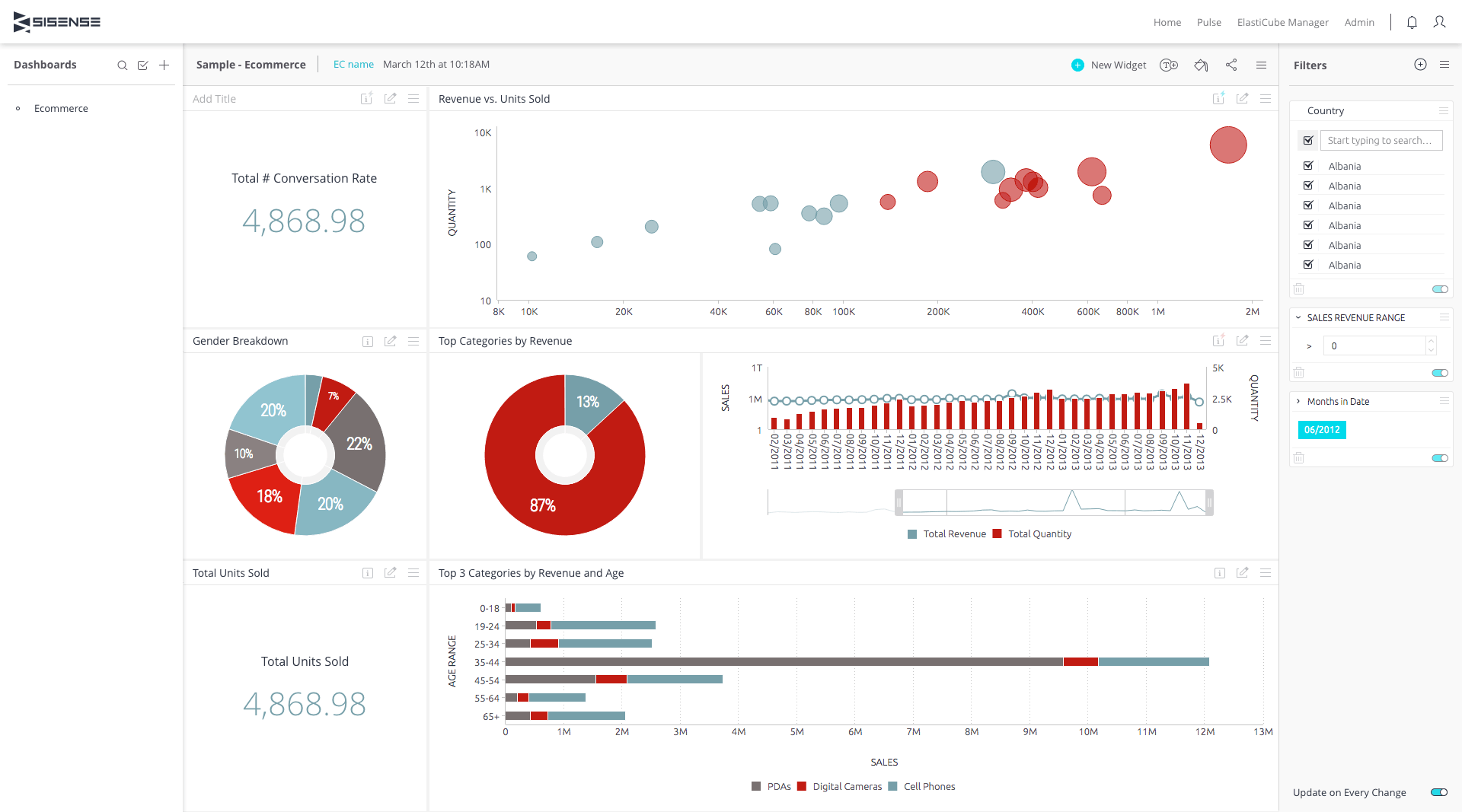
Description
Sisense at a Glance
Sisense is an embedded analytics and BI platform built for product teams and ISVs who want to ship customer-facing dashboards without building a viz layer from scratch. It tilts more toward developers and OEM use cases than toward general business dashboarding, which puts it in a different lane from Tableau or Microsoft Power BI.
| Attribute | Detail |
|---|---|
| Best fit for | SaaS vendors and mid-market product teams embedding analytics into their own apps |
| Pricing model | Tiered subscription starting at $399 per month, custom quotes at the Scale tier |
| Core platform | Embedded analytics, white-label dashboards, Compose SDK, Embed SDK, Sisense Intelligence AI assistant |
| Free trial | 7 days, self-serve |
| Founded and HQ | 2004, New York City with R&D in Tel Aviv |
| Native integrations | 400+ data connectors (Snowflake, Redshift, BigQuery, Postgres, MySQL, Salesforce, and others) |
| Compliance | SOC 2 Type II, ISO 27001, ISO 27701 (HIPAA, GDPR, and FedRAMP not vendor-confirmed at time of writing) |
| Funding and ownership | Private, VC-backed. $276M total raised. Series F of $100M in January 2020 led by Insight Partners |
| Trust signals | 2,000+ organizations including PagerDuty, Philips, Skullcandy, Seismic, USA Swimming, Air Canada, Nasdaq, GE, Rolls-Royce, GitLab, and UiPath |
Pros and Cons of Sisense
Pros
- Embedded-first design with Compose SDK and Embed SDK means you can ship native-feeling charts inside your own product, not just iframe a dashboard
- Sisense Intelligence adds an AI assistant, conversational analytics, and AI-assisted data modeling, with MCP connectivity for agent workflows
- 400+ pre-built data connectors cover most modern warehouses and SaaS sources without custom ETL work
- White-label theming is genuinely deep, customers like Skullcandy and Seismic ship Sisense dashboards under their own brand
- Strong enterprise references in regulated and high-volume environments (Nasdaq, GE, Rolls-Royce, Air Canada)
Cons
- HIPAA, GDPR, and FedRAMP attestations are not published on the vendor's trust pages, so healthcare and US public-sector buyers will need to confirm directly
- List price starts at $399 per month for Launch but Vendr data shows the average deal lands at $137K per year, the gap between sticker and real spend is wide
- Internal-only BI teams will find Tableau, Power BI, or Looker Studio more familiar for ad-hoc dashboarding
- Designer and viewer seat math (2 designers + 50 viewers at Launch, 5 + 100 at Grow) trips up teams that expected unlimited internal users
- Implementation complexity for embedded use cases is real, most Compose SDK rollouts need 6 to 10 weeks of developer time
Who Should Use Sisense
Sisense is built for SaaS companies and product teams who need to put analytics inside their own application. If you are a vertical SaaS vendor (healthtech, logistics, fintech, HR tech) and your customers expect dashboards as part of your product, Sisense gives you a faster path than building a charting library in-house. The Compose SDK in particular is aimed at engineering teams who want API-first control over how charts render, not click-and-drag dashboard building. Mid-market and enterprise buyers with 50+ customer-facing dashboards in scope tend to get the most value. Reference customers like PagerDuty, GitLab, Skullcandy, and Seismic all use Sisense in this embedded mode, with dashboards baked into their own product UI rather than served as a standalone analytics portal.
Skip Sisense if your use case is internal BI for a finance, ops, or marketing team. For that lane, Microsoft Power BI, Tableau, or even free options like Metabase and Looker Studio deliver faster time to value at a fraction of the cost. Also skip if HIPAA or FedRAMP attestation is a hard procurement gate, since those certifications are not publicly listed. Small teams under 25 people with a single warehouse and a handful of analysts will almost always be better served by a cheaper warehouse-native tool. Sisense rewards scale, not minimal viable deployments.
Sisense Product Suite
- Sisense Fusion, the core analytics platform with dashboards, pixel-perfect reports, and data modeling
- Compose SDK, an API-first toolkit for engineers who want to render Sisense queries as native React or Vue components
- Embed SDK, an iframe-based embedding layer for faster rollouts that do not need component-level control
- Sisense Intelligence, the AI layer covering natural language Q&A, AI-assisted data modeling, and forecasting
- MCP server connectivity so Sisense data can feed into agent-based workflows and tools like Claude or other LLM clients
- ElastiCube, the in-chip data engine that caches and joins data for sub-second query response
- Live connections for direct-query mode against Snowflake, BigQuery, Redshift, and other warehouses
- White-label theming with full control over colors, fonts, logos, and chart styling
- Row-level security and object-level permissions tied to your app's user identity
- Pulse alerts and scheduled email reports for proactive monitoring
- 400+ data connectors spanning warehouses, SaaS apps, file formats, and REST APIs
- Sisense AI Assistant for end users to ask conversational questions against governed datasets
How Much Does Sisense Cost
- Launch: $399 per month, includes 20GB of data, 20K AI credits, 2 designer seats, and 50 viewer seats
- Grow: $1,299 per month, includes 80GB of data, 50K AI credits, 5 designer seats, and 100 viewer seats
- Scale: custom pricing, the tier most enterprise and embedded buyers end up on
- Free trial: 7 days, self-serve on the Sisense website
- Vendr benchmark: $137K per year average across 97 deals, range $21K to $4.4M per year
Hidden Costs and Contract Gotchas
- Designer and viewer seat caps are tight on Launch and Grow, plan to move to Scale if you need more than 5 BI authors
- AI credits are metered, conversational queries and AI-assisted modeling consume the 20K or 50K monthly allowance faster than buyers expect
- Data volume tiers (20GB, 80GB) refer to ingested ElastiCube data, large warehouse-native deployments still count against the cap
- Embedded deployments often need a separate OEM agreement layered on top of standard pricing
- Implementation and professional services are typically quoted separately, budget 15-25% of year-one ACV for partner-led rollouts
- Compliance gaps (no public HIPAA, GDPR, or FedRAMP attestation) can trigger custom legal review that adds 4 to 8 weeks to procurement
- Renewal uplifts of 7-12% are common on multi-year Scale deals, lock the cap in writing during the first negotiation
Implementation Plan: Rolling Out Sisense
A typical Sisense rollout splits into two tracks. Embedded analytics deployments usually run 8 to 12 weeks from kickoff to first production dashboard, internal BI rollouts can land in 4 to 6 weeks. Plan for a dedicated engineering owner on the embedded side, since Compose SDK work is real React or Vue development, not configuration.
- Weeks 1-2: Data source discovery, ElastiCube modeling, and security model (row-level, object-level)
- Weeks 3-5: First dashboard build, white-label theming, and stakeholder review
- Weeks 6-8: SDK integration for embedded use cases, single sign-on wiring, and load testing
- Weeks 9-10: User acceptance testing with a small customer cohort, alert tuning, and documentation
- Week 11+: Phased rollout to remaining customers or internal teams, plus a 30-day post-launch review
Sisense Alternatives
- Tableau, the dashboarding leader for internal BI teams, weaker on embedded
- Microsoft Power BI, the default for Microsoft-stack companies, cheaper per seat
- Looker Studio, free Google option for marketing and ops dashboards
- Metabase, open-source BI that internal teams can self-host
- Domo, cloud-first BI with strong data app and ETL features
- Sigma Computing, spreadsheet-style BI on top of cloud warehouses
- Cumul.io, embedded-analytics specialist that competes head-on with Sisense Compose SDK
- Holistics, modeling-first BI for data teams who want as-code workflows
For a wider shortlist see the full business intelligence category page, which also covers Zoho Analytics, Amazon QuickSight, and QlikView.
What Real Buyers Report
- Embedded-first buyers cite Compose SDK as the deciding factor over Tableau and Power BI, both of which they describe as iframe-only embedding stories. Engineering teams want native React components, not portals.
- Total cost surprises are the most common complaint. The $399 sticker price implies a self-serve SaaS tool, but the $137K Vendr average and $4.4M ceiling tell a different story once seat counts, AI credits, and OEM rights are stacked on.
- Healthcare and public-sector procurement teams report friction on the compliance side. Without published HIPAA or FedRAMP attestations, deals require custom BAAs or end up routed to alternatives like IBM Cognos Analytics or MicroStrategy.
What G2/Capterra/Vendr Reviewers Actually Say About Sisense
G2 and Vendr reviewers consistently praise Sisense for embedded analytics depth, white-label flexibility, and the Compose SDK's developer ergonomics. Customers like PagerDuty, GitLab, and Seismic appear in published case studies, and Vendr data shows 97 deals at a $137K average annual contract value. The recurring criticisms are pricing opacity above the Launch tier, AI credit consumption that ramps faster than expected, and a learning curve for ElastiCube data modeling. Reviewers comparing Sisense to Tableau or Tellius note that Sisense wins on embedding but loses on out-of-the-box ad-hoc analysis for non-technical business users.
Bottom Line
Sisense earns its seat at the table for SaaS vendors and product teams shipping customer-facing analytics, especially when Compose SDK fits the engineering stack. It is harder to justify for internal-only BI work, where Power BI, Tableau, or Metabase will land faster and cheaper. Get a written quote at the Scale tier before signing, confirm AI credit limits in the order form, and validate compliance gaps with your security team if HIPAA or FedRAMP is in scope. If you are deciding between Sisense and a pure embedded specialist like Cumul.io, run a 30-day proof of concept on both with your actual production data model before locking in a multi-year contract.
Frequently Asked Questions
How much does Sisense cost in 2026?
Is Sisense better for embedded analytics than Power BI?
Is Sisense HIPAA compliant?
Who owns Sisense?
What is the Sisense ElastiCube?
What data sources does Sisense support?
Does Sisense have a mobile app?
How does Sisense Intelligence AI work?
How long does Sisense take to deploy?
How does Sisense compare to Tableau Embedded?
Find Your Perfect Software
See how it can transform your workflow
- Personalized for your needs Tailored recommendations based on your unique requirements.
- Save time & resources Streamline your workflow and boost team productivity.
- Trusted by thousands Join 10,000+ businesses already growing with SaaSrat.
You're all set! 🎉
A specialist for will reach out within 1 business day with tailored recommendations for your needs.