
Airtable
by Airtable
What is Airtable?
Get Best Quote for Airtable
Connect with SaaSrat experts to get the best quote for your business.
You're all set!
A specialist for Airtable will reach out within 1 business day.
Airtable Features
Relational database with linked records and lookup fields
Spreadsheet-like grid view plus Kanban
Calendar
Gallery
Gantt
Timeline views
View All 35 Features
Airtable Pricing Plans
Free
- Up to 5 users
- 1,000 records per base, unlimited bases
- Interface designer
- Automations (100 runs/month)
- Free forever - verified at airtable.com/pricing on 2026-05-30 (full-page screenshot retained)
Team
- $20/user/mo annual (or $24/user/mo monthly billing)
- 50,000 records per base
- Standard sync integrations
- 25,000 automation runs/month
- Verified at airtable.com/pricing on 2026-05-30 (full-page screenshot retained)
Business
- $45/user/mo annual (or $54/user/mo monthly billing)
- 125,000 records per base
- Premium sync (Salesforce, Jira, GitHub)
- AI fields, admin controls, SSO
- Verified at airtable.com/pricing on 2026-05-30 (full-page screenshot retained)
Airtable Screenshots
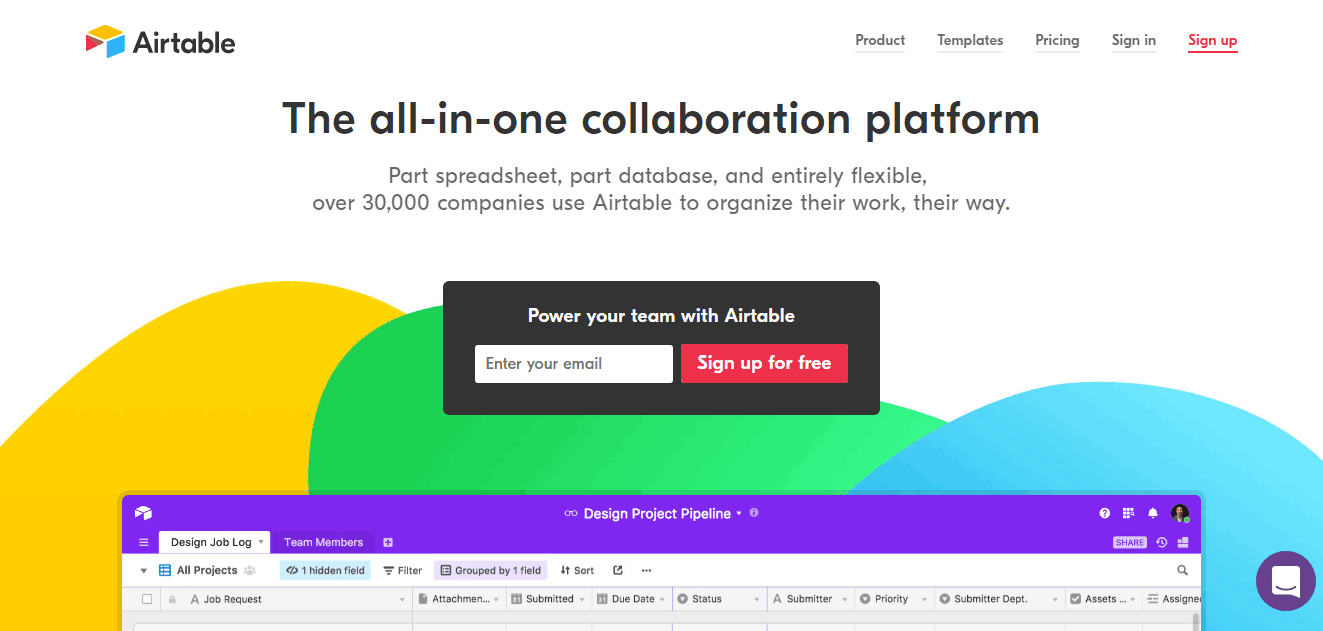
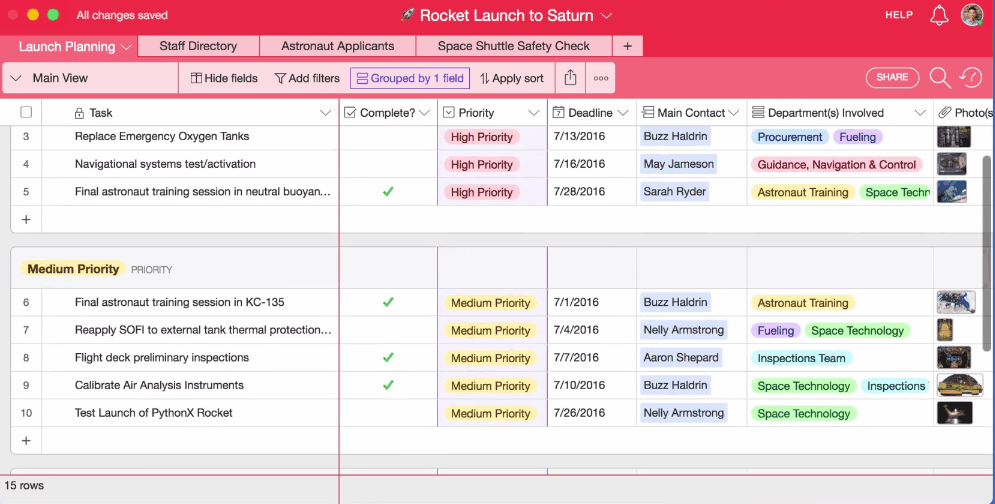
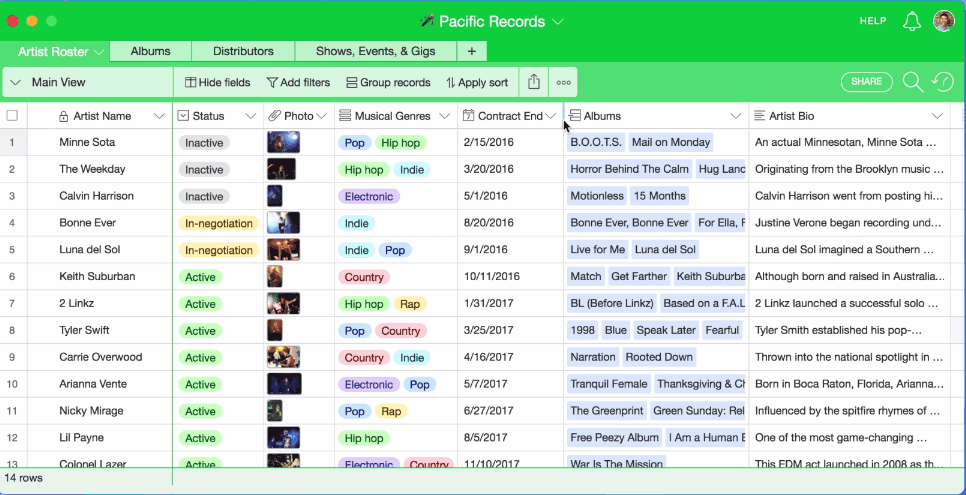
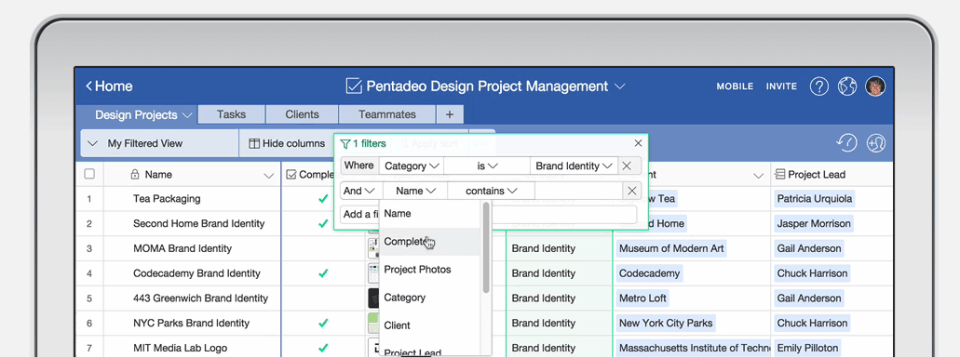
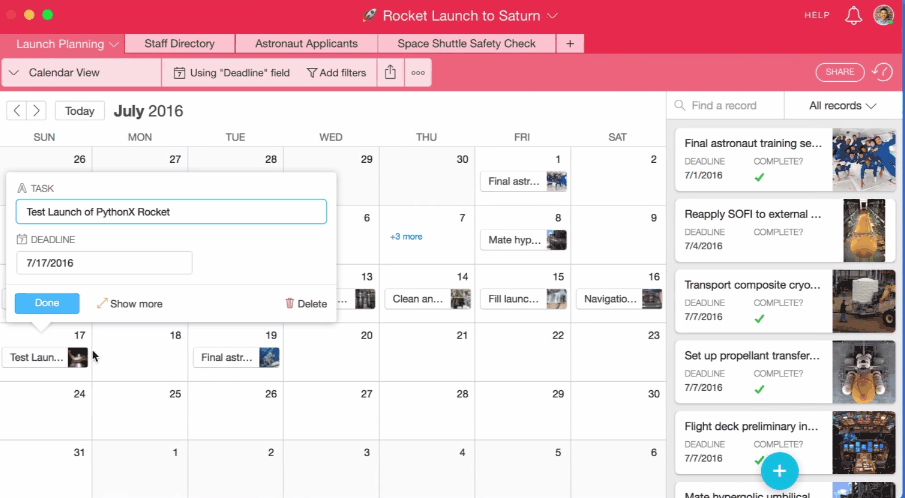
Description
Who Airtable Is Right For
Airtable is built for teams (1-10,000+ users) that want flexibility to build their own CRM and operations system from a relational database rather than adopting a fixed-schema CRM. The sweet spot is startups, agencies, marketing teams, partnerships teams, and operations-led organisations where workflows extend beyond standard sales pipelines into project tracking, content calendars, asset management, and customer onboarding.
If you are a sales-focused team wanting CRM-specific features, HubSpot CRM or Pipedrive fit better out of the box. If you are an enterprise wanting deepest CRM ecosystem, Salesforce wins on scale. If you want modern startup CRM with similar flexibility, Attio or Twenty are closer alternatives.
Airtable Pricing in 2026
| Plan | Annual price | Best for |
|---|---|---|
| Free | $0 | Individual users and small teams with lightweight needs |
| Team | $20/user/month | Teams needing more capacity, automations, Interfaces, sync between bases |
| Business | $45/user/month | Larger teams adding admin controls, sync from external sources, SAML SSO, premium support |
| Enterprise Scale | Custom quote | Enterprises wanting unlimited org units, workspaces, bases, advanced governance, customer success |
Pricing verified on the official Airtable pricing page on 2026-06-15. Plans charged per seat based on edit permissions. Read-only collaborators, form submissions, and share links incur no charges. Mid-month additions prorated. Enterprise accepts PO, ACH, wire, check.
Airtable Hidden Costs and Negotiation Levers
Per-edit-seat pricing scales with editors. Read-only viewers are free - control collaborator permissions carefully. Records-per-base and attachment-storage limits trigger upgrades. AI features may add usage-based costs at higher volumes. Multi-year Enterprise commitments typically unlock 10-25% off list. Negotiate via Airtable account team with concurrent Slack or Atlassian renewals for stack consolidation leverage.
Airtable vs HubSpot CRM vs Notion vs monday Sales CRM
| Dimension | Airtable | HubSpot CRM | Notion | monday Sales CRM |
|---|---|---|---|---|
| Starting price (annual) | Free; paid from $20/user/mo | Free; paid from $20/user/mo | Free; paid from $10/user/mo | $12/seat/mo (3-seat min) |
| Best for | Database-style CRM and operations flexibility | Marketing-led SMB sales | Documents plus light database | Work OS with CRM |
| Relational database | Native deep | Sales pipeline focused | Light database via tables | Highly customisable boards |
| Pre-built CRM | Templates | Native CRM | Templates | Native CRM |
| Native API and webhooks | Strong REST API + webhooks | REST API tiered | API available | REST API tiered |
Airtable Integrations
Productivity: Microsoft 365 Outlook, Google Workspace Gmail, Google Drive, Microsoft Teams, Slack, Zoom, Calendly.
CRM and sales: Salesforce, HubSpot, Pipedrive, Microsoft Dynamics 365.
Marketing and content: Mailchimp, Marketo, HubSpot Marketing Hub, Adobe Creative Cloud, Loom.
Engineering and project: GitHub, Jira, Linear, Asana, Trello.
Open REST API plus webhooks. Make and Zapier connectors for 5,000+ no-code integrations. Airtable Marketplace for custom apps.
Airtable Pros and Cons
Pros: Relational database flexibility lets teams build CRM and operations systems matched to their workflow rather than fitting workflow to a fixed CRM. Pre-built templates for common CRM use cases. Strong REST API and webhooks included on every plan. Interfaces feature lets non-technical users consume databases. Modern UX competitive with newer CRMs.
Cons: CRM-specific features (sales sequences, automated lead scoring, native dialer) lighter than dedicated CRMs. Setup complexity higher than fixed-schema CRMs - teams need to build their own structure. Records-per-base and attachment limits scale with usage. Sync between bases requires Team tier; sync from external sources requires Business tier.
What Real Airtable Buyers Say
On r/Airtable and r/CRM discussion threads, teams cite Airtable's flexibility and Interfaces feature as deciding factor over fixed-schema CRMs. Buyers picking Airtable over HubSpot cite database flexibility; buyers picking HubSpot cite native CRM workflow depth.
On LinkedIn Airtable posts, themes include marketing operations productivity gains and partnerships management workflows.
On r/startups, Airtable surfaces as the database-style CRM choice for early-stage teams running cross-functional ops alongside sales.
Airtable Field Guide
| Best fit for | Teams of all sizes (1-10,000+ users) wanting database-style CRM and operations flexibility |
|---|---|
| Industries | Tech startups, agencies, marketing operations, partnerships teams, content creators, ecommerce ops, professional services, media and publishing, nonprofit, education |
| Core capability | Relational database with spreadsheet UX, multiple views (grid, kanban, calendar, gantt), automations, Interfaces for non-technical users, AI features |
| Pricing | Free, Team $20/user/mo, Business $45/user/mo, Enterprise Scale custom (annual billing) |
| Differentiator | Database flexibility plus spreadsheet UX plus Interfaces plus pre-built CRM templates - teams build CRM matched to workflow vs fitting workflow to fixed CRM |
| Deployment | Cloud SaaS only; web browser, desktop apps (macOS, Windows), iOS and Android mobile apps |
| Headquarters | San Francisco, California, United States |
| Vendor URL | airtable.com |
Airtable Buyer Action Plan
Step 1: Start Free plan. Step 2: Choose pre-built CRM template or build from scratch. Step 3: Add custom fields and configure views (grid, kanban, calendar). Step 4: Build Interfaces for non-technical users. Step 5: Upgrade to Team ($20), Business ($45), or Enterprise based on automation, sync, and admin needs.
Airtable 2026 Updates
AI features expanded across base operations, including AI-generated summaries, lookup, classification. Cobuilder for app generation. Mobile app refresh. Interfaces enhanced for dashboards. Enterprise Scale tier launched for largest org rollouts.
Airtable Security and Compliance
SOC 2 Type II certified. ISO 27001 certified. GDPR and CCPA compliant. HIPAA available on Business+. SSO via SAML on Business+. Two-factor authentication. AES-256 encryption at rest, TLS 1.3 in transit. Audit logs (Business+). Data residency US and EU. Regular third-party security audits.
Airtable Customer Support
Free and Team: community support, knowledge base, email support. Business: priority support. Enterprise Scale: dedicated customer success manager, 24x7 critical issue coverage, premium support. Airtable Academy training. Active customer community.
Who Can Use Airtable
Airtable serves customers globally. Industries: tech startups, agencies, marketing operations, partnerships, content creators, ecommerce ops, professional services, media, nonprofit, education, healthcare, financial services. Team sizes: solos through 10,000+ user enterprises.
Airtable Mobile App
Native iOS and Android Airtable apps for base access, view editing, automations. Push notifications. App store ratings sit in 4.4-4.7 range across both platforms as of 2026-06-15. Apple App Store: Airtable iOS. Google Play: Airtable Android.
How to Get Started with Airtable
Step 1: Visit airtable.com sign up Free plan. Step 2: Choose CRM template (Sales CRM, Marketing CRM, Partnership CRM) or start blank. Step 3: Customise fields and views. Step 4: Build automations and Interfaces. Step 5: Upgrade plan as team or feature needs grow.
Top Airtable Alternatives
HubSpot CRM for marketing-led SMBs wanting native CRM workflow depth.
Notion for teams wanting docs plus light database.
monday Sales CRM for teams wanting Work OS with native CRM.
SmartSuite for teams wanting Airtable-like database with more business templates.
Attio for modern startup CRM with similar flexibility.
Coda for teams wanting docs plus database hybrid.
How to Cancel Airtable
Cancellation self-serve via Account Settings. Monthly plans cancel end of current cycle. Annual plans cancel at annual term end; mid-term forfeits prepaid. Data export via CSV or API. Account deletion within 30 days per privacy policy.
Bottom Line on Airtable
Airtable is the right call when a team (1-10,000+ users) wants database flexibility plus spreadsheet UX plus Interfaces for non-technical users to build CRM and operations systems matched to their workflow. The Free + Team $20 + Business $45 + Enterprise Scale pricing serves all team sizes. Sales-focused teams should pick HubSpot or Pipedrive. Enterprise CRM should pick Salesforce. Work OS buyers should pick monday Sales CRM. Modern startup CRM seekers should pick Attio. Airtable wins the database-flexibility-as-CRM lane.
Verified on 2026-06-15 by the SaaSRat Editorial Team. Vendor facts cross-checked against airtable.com/pricing, Apple App Store, Google Play, and 2026 vendor public documentation. About our methodology.
Frequently Asked Questions
How much does Airtable cost in 2026?
Can Airtable be used as a CRM?
Who is Airtable right for?
Does Airtable have an API?
Airtable vs Notion - which should I pick?
Does Airtable have a mobile app?
Is Airtable SOC 2 certified?
Where is Airtable headquartered?
What is the Free plan?
Can I cancel Airtable mid-term?
Find Your Perfect Software
See how it can transform your workflow
- Personalized for your needs Tailored recommendations based on your unique requirements.
- Save time & resources Streamline your workflow and boost team productivity.
- Trusted by thousands Join 10,000+ businesses already growing with SaaSrat.
You're all set! 🎉
A specialist for will reach out within 1 business day with tailored recommendations for your needs.