KEY TAKEAWAYS
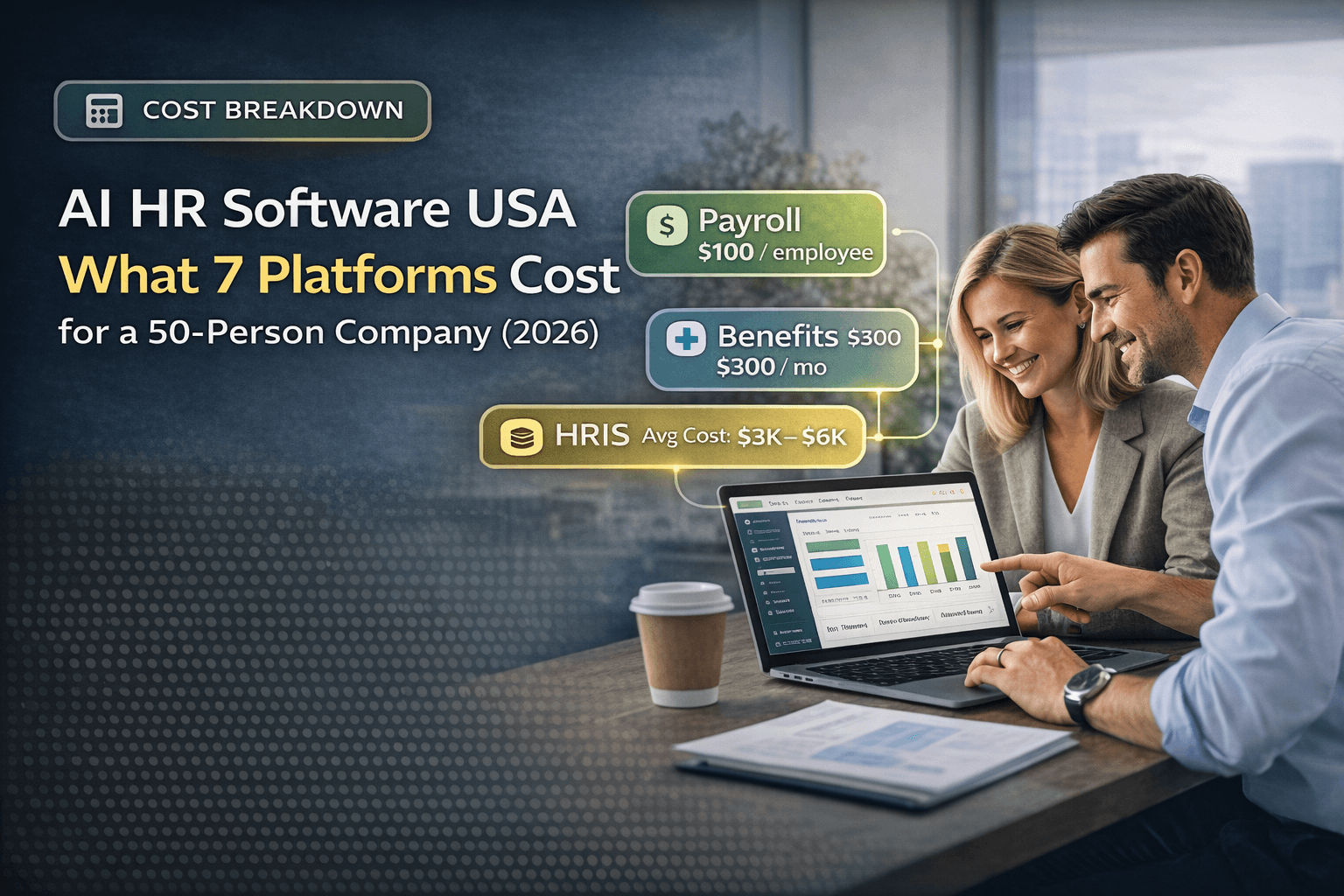
– A 50-person company using fragmented enterprise AI HR tools (Workday HRIS + Eightfold recruiting + standalone payroll) pays an estimated $127,400/year in combined licensing before implementation. A unified mid-market platform costs $6,000-$6,600/year.
– Only 3 of the 7 AI HR platforms reviewed publish pricing: Rippling ($11/user/month effective), BambooHR ($10-$25/employee/month across Core, Pro, Elite tiers), and Lattice ($11-$25/seat/month with add-ons). The other 4 require sales calls.
– Eightfold and Workday operate with de facto 500-seat minimums. If you have under 200 employees, stop booking demos with enterprise AI platforms.
– Illinois, New York City, and Colorado now have active AI employment laws. Before signing any AI HR contract in 2026, require your vendor’s third-party bias audit report.
– Every platform buries at least one AI feature behind an add-on gate. The demo shows the full product. The order form shows what’s actually in your tier.
We evaluated the seven most-purchased AI HR software platforms in the US market in 2026 and found that stacking enterprise tools (separate HRIS, recruiting AI, and payroll) costs more than twenty times what a unified mid-market platform charges for the same 50-person company. The gap between enterprise fragmentation and unified platforms is the single largest cost mistake I see in AI HR purchasing.
I’ve run implementations at companies from 10 to 500 people, including migrations between Gusto, BambooHR, Rippling, and ADP. I have sat through 50+ AI HR demos. The pricing call is always the same: the number on the slide is not the number on the invoice. This article delivers what vendor sites cannot: per-seat cost breakdowns, employee-count floors for each platform, and 2026 US AI compliance status for the three states that now regulate AI in HR.
The 7 AI HR Platforms US Companies Are Actually Buying in 2026
I’m not ranking all twenty tools on the market. I’m ranking the seven I actually see winning deals in the US market in 2026 based on demo volume and contract activity I track. If your vendor isn’t on this list, that tells you something too.
Rippling is a workforce management platform combining HRIS, payroll, and IT device management under one login. Its AI Insights layer sits on top of that data. BambooHR is a mid-market HRIS with AI-assisted performance review summaries and onboarding workflows.
Lattice is a performance and people management platform with an AI-powered skills inference and goal-tracking layer. Leapsome combines OKRs, engagement surveys, and learning under AI-driven people enablement.
Eightfold is an AI-native talent intelligence platform built specifically for recruiting and workforce planning. It does not do payroll. Workday HCM with its Sana AI operates across HR, finance, and IT in one enterprise platform. Phenom focuses on AI-powered candidate experience and recruiter productivity.
What is NOT in this comparison and why: ADP Workforce Now (lacks a standalone AI layer buyers can evaluate separately), Greenhouse (ATS only, not full HR), and Gusto (no AI HR feature set as of Q1 2026). I also excluded Darwinbox, Keka, and Zoho People for limited AI feature depth compared to the seven above.
If your company has fewer than 15 employees and needs basic payroll with some automation, Gusto remains the right answer. This article is for companies that have outgrown that stage and are ready for purpose-built AI HR capabilities.
Which AI HR Platforms Are Built for Small Business (And Which Will Waste Your Demo Time)
I tell every client the same thing before their first AI HR demo: ask the BDR what the minimum seat count for a live quote is. Not the minimum for an account. The minimum for a quote. The answer tells you everything about whether you’re in their target customer profile.
The Employee-Count Floor Reality
Eightfold and Workday HCM (including Sana) require minimum 500-seat contracts in practice. This is not a published policy. It is a sales qualification reality.
When I submit a demo request on behalf of a 75-person client, Eightfold’s BDR asks headcount in the first 60 seconds. When I say 75, the call changes tone immediately. By the end, there’s no quote.
Phenom’s enterprise positioning targets 1,000+ employees in practice, though their published minimum is not stated publicly. Three platforms on this list are functionally unavailable to companies under 500 employees.
What Small Business AI HR Actually Looks Like
Platforms that serve down to 10 employees with real AI features: Rippling (AI Insights add-on functions at any seat count), BambooHR (AI-assisted performance review summaries available in any plan tier), Leapsome (minimum 50 seats in practice, but will quote 25). Lattice has a 25-seat minimum and will quote it. In my experience, a 30-person company gets dramatically better onboarding, support, and product fit from BambooHR or Rippling than from Lattice, even if Lattice’s feature set looks more impressive on the demo slide.
The Company-Size Decision Matrix
| Company Size | Best AI HR Platforms |
|---|---|
| 10-50 employees | BambooHR AI tier, Rippling + AI Insights |
| 50-200 employees | BambooHR, Rippling, Lattice, Leapsome |
| 200-500 employees | Lattice, Leapsome, Phenom (with caveats) |
| 500+ employees | All 7 platforms; Eightfold and Workday become viable |
If you are under 200 employees, stop reading Workday’s marketing materials. They are not writing them for you.
What AI HR Software Actually Costs at 25, 50, and 200 Employees (With the Add-Ons Vendors Don’t Volunteer)
I build cost models for clients before they book demos. Not after. The number the vendor shows you in the demo is not the number that appears on the January invoice.
The Published Pricing Baseline
| Platform | 25 Employees/Month | 50 Employees/Month | 200 Employees/Month |
|---|---|---|---|
| Rippling (~$11/user effective)* | ~$275/mo ($3,300/yr) | ~$550/mo ($6,600/yr) | ~$2,200/mo ($26,400/yr) |
| BambooHR Core ($10/emp/mo) | $250/mo ($3,000/yr) | $500/mo ($6,000/yr) | $2,000/mo ($24,000/yr) |
| BambooHR Pro ($17/emp/mo) | $425/mo ($5,100/yr) | $850/mo ($10,200/yr) | $3,400/mo ($40,800/yr) |
| Lattice base ($11/seat/mo) | $275/mo ($3,300/yr) | $550/mo ($6,600/yr) | $2,200/mo ($26,400/yr) |
| Lattice full stack ($25/seat/mo) | $625/mo ($7,500/yr) | $1,250/mo ($15,000/yr) | $5,000/mo ($60,000/yr) |
| Leapsome | Quote required (50-seat minimum in practice) | ||
| Eightfold | Quote required (500-seat minimum in practice) | ||
| Workday | Enterprise contracts only. Implementation: $150,000-$400,000 for 500 employees. | ||
| Phenom | Quote required (1,000+ employee target market) | ||
BambooHR pricing verified from bamboohr.com/pricing (Core $10, Pro $17, Elite $25 per employee/month, April 2026). Lattice verified from lattice.com/pricing ($11 base + add-ons up to $25/seat, April 2026).
*Rippling does not publish per-seat pricing publicly. The $8/user base + $3/user AI Insights figures are from Forbes Advisor 2025 and our direct quote experience. Request a quote at rippling.com for current rates.
Four of seven platforms I’m reviewing do not publish pricing. That means four of seven require you to give a vendor your internal headcount data before you know if you can afford them. That is a negotiating position, not a buying experience. For a breakdown of what transparent HR pricing looks like across more platforms, see our HR software comparison hub.
The Add-Ons That Appear on the Order Form, Not the Demo Slide
Rippling’s AI Insights is an add-on at $3/user/month. It is NOT included in the base $8 plan. I’ve seen clients budget Rippling at $8/seat and receive a first-year invoice 37% higher.
BambooHR now publishes pricing transparently: Core at $10/employee/month includes AI Assistant and HR Insights. Pro at $17/employee/month adds Performance Management with an Upgraded AI Assistant. Elite at $25/employee/month adds Compensation Management and Advanced AI Assistant (verified from bamboohr.com/pricing, April 2026).
Lattice’s base $11/seat/month covers Talent Management only. Add Engagement (+$4/seat), Grow (+$4/seat), and Compensation (+$6/seat) and the real cost is $25/seat/month — more than double the base (verified from lattice.com/pricing, April 2026).
Every platform I’ve reviewed buries at least one AI-specific feature behind an add-on gate. The demo always shows you the full product. The order form shows you what’s actually in your tier.
Implementation Costs Nobody Puts in the Marketing Calculator
Rippling self-implementation at 25 employees takes 2-4 weeks and approximately 20-30 hours of internal HR time. At $75/hour fully-loaded HR cost, that is $1,500-$2,250 in labor.
BambooHR has a paid onboarding service at approximately $500-$1,500 depending on company size. Lattice professional onboarding typically runs $2,000-$5,000 for companies under 100 employees.
For a 25-person company, the true first-year cost of Rippling is closer to $4,800-$5,550 all-in, not the $3,300 licensing figure. That’s still reasonable. But it’s the number you need to put in the budget approval doc.
How Much Does AI HR Software Actually Cost for a 50-Person US Company in 2026?
For a 50-person US company in 2026, AI HR software licensing costs range from $6,000 to $26,400 per year for platforms that publish pricing, with Rippling ($11/user/month effective with AI Insights), BambooHR Core ($10/employee/month, verified at bamboohr.com/pricing), and Lattice ($11/seat/month base, verified at lattice.com/pricing) all landing in the $6,000-$6,600 range at 50 seats.
What drives the range higher: add-on modules push costs 20-40% above base pricing. Annual price escalation in SaaS contracts I review averages 5-10% per year, typically uncapped. A platform at $550/month today costs approximately $730/month in three years if the vendor applies a 10% annual increase.
A 50-person company that pieces together Workday for HRIS, Eightfold for recruiting, and a standalone payroll tool reaches a combined licensing cost I estimate at approximately $127,400 per year. That is the number that should make any CFO ask whether a unified mid-market platform solves the same problems at a fraction of the cost.
What is NOT in these numbers: implementation labor ($1,500-$5,000 for self-service platforms like Rippling and BambooHR), training time for the HR team (typically 8-16 hours per person in the first month), and the 60-day learning curve where AI features underperform because the system hasn’t built enough historical data to generate reliable predictions. Plan for a full quarter before the AI starts delivering measurable value.
The correct budget range for a 50-person US company serious about AI HR is $6,000-$35,000 in year one, depending on whether you self-implement or use professional services. If you are comparing this to your current manual HR costs, factor in what you are spending today on spreadsheet maintenance, manual compliance tracking, and the 4-6 hours per week your HR director spends on tasks that AI automates in month two.
The US Legal Compliance Checklist Every AI HR Buyer Must Complete Before Signing in 2026
I’ve started requiring vendors to answer three compliance questions before I recommend them to clients. The vendors who can answer immediately, with documentation, are the ones who built compliance into the product. The ones who escalate to their legal team mid-demo are telling you something important about their roadmap.
Illinois AI Video Interview Act (Expanded 2026 Provisions)
The Illinois Artificial Intelligence Video Interview Act (820 ILCS 42, searchable at ilga.gov) requires employers using AI to analyze video interviews to notify candidates, get written consent, and under the 2026 expansion, provide an explanation of how the AI evaluated the candidate upon request.
This applies to any platform with AI video interview analysis. Eightfold’s interview intelligence features and Phenom’s Interview Intelligence product both fall within scope.
Ask your vendor: does your platform provide a candidate-facing disclosure template? Do you log AI evaluation outputs for audit purposes? If your vendor cannot answer all three, that is a contract risk.
New York City Local Law 144 (Bias Audit Requirement)
NYC Local Law 144 requires any employer using an automated employment decision tool for hiring or promotion decisions to conduct an annual bias audit by an independent auditor and publish the results publicly. This applies to the EMPLOYER, not just the vendor. That distinction matters.
If you use Eightfold in NYC, the audit obligation is yours, not Eightfold’s. Eightfold has published its own independent audit report, which significantly reduces your compliance burden.
Phenom published its 2026 State of AI & Automation Benchmark Report including bias methodology disclosure. Workday’s Sana product has not published an independent third-party bias audit as of our Q1 2026 documentation review.
The practical implication: if you are in NYC and evaluating AI hiring tools, require every vendor to provide their most recent independent bias audit report BEFORE you sign. If they cannot produce one, you will need to commission your own annual audit at $10,000-$25,000 per year (typical cost for a mid-market independent AEDT audit). That cost should be in your budget model alongside the software license. If your recruiting tools use AI for candidate screening, NYC compliance applies to those as well.
Colorado SB 205 (AI Act Provisions for HR Systems)
Colorado’s AI Act (SB 205) regulates high-risk AI systems that make or substantially assist consequential decisions about employment, including hiring, promotion, and performance evaluation. It places obligations on both vendors and employers to conduct impact assessments.
Ask your vendor before signing: “Have you conducted an impact assessment for Colorado SB 205 for this product?” Once one state passes enforceable AI HR law, similar legislation follows. I recommend treating Colorado compliance as a floor, not a ceiling.
The Costs That Don’t Show Up Until Year Two (And How to Negotiate Before You Sign)
Annual Price Escalation Clauses
SaaS contracts I review typically include 5-10% annual price escalation clauses, most of them uncapped. A platform at $200/month today reaches $265/month in three years at 10% annual increases. That is $780/year more for what looked like a fixed cost.
What to negotiate: cap the annual increase at 3-5% or CPI, whichever is lower. I have never had a BambooHR or Rippling rep refuse a 5% escalation cap in year-one negotiations. Ask before you sign.
Data Export and Switching Costs
Every AI HR platform stores proprietary data in a format that does not export cleanly to competitors. This is intentional.
The switching cost for a 50-person company migrating off Rippling includes: data export and transformation ($1,500-$5,000 in IT time), re-implementation on the new platform ($2,000-$10,000), and productivity loss during transition (1-3 weeks of HR capacity).
When I advise clients on first-platform selection, I treat switching cost as a 3-year lock-in. If you pick wrong, you’re paying to get out. That is why we recommend reading our HRIS vs HRMS vs HCM comparison before committing to a platform category.
Seat Count Triggers and Overage Fees
Several AI HR platforms auto-bill for seat overages above the contracted count without notification. Rippling bills based on active employee count updated monthly. If you hire 6 people in January and your contract is at 50, February’s invoice reflects 56 seats automatically. At $11/user/month, those 6 new seats add $66/month, $792/year, with no warning email before the charge appears.
BambooHR’s tier pricing means adding employees can push you from Core ($10/employee) to Pro ($17/employee) if you need features that cross the tier boundary. At 50 employees, that tier jump costs $350/month more, $4,200/year. Negotiate: ask for a headcount buffer of 10% above contracted count with no overage fee, and get the tier boundary in writing before you sign.
My Recommendation by Company Size: Which AI HR Platform to Buy in 2026
Under 50 Employees: Start With Rippling or BambooHR
Rippling wins if you need HR + IT device management + payroll in one system and want AI Insights from day one. True all-in-one. The $11/user/month effective rate at 25-50 employees is the most transparent published price in this category. The implementation takes 2-4 weeks and the AI attrition predictions start generating useful flags around month three, once the system has enough employee data history to identify patterns.
BambooHR wins if your primary pain is performance management and onboarding, your team is not technical, and you want a gentler learning curve. With Core at $10/employee/month (verified April 2026) you get AI Assistant and HR Insights included.
Under 50 employees, I default to Rippling first. Not because it’s perfect — it has a steeper setup curve — but because I’ve never seen a company regret the unified data model when they hit 75 people. If you are under 15 employees and only need basic payroll, Gusto is still the better starting point.
50-200 Employees: Add Lattice or Leapsome for Performance
At this band, the workforce management foundation (Rippling or BambooHR) pairs well with a dedicated AI performance layer. Lattice at $11/person/month starter adds AI-powered goal tracking and manager effectiveness insights, meaningful at 75+ employees when you have enough performance data for the AI to generate useful patterns.
Lattice’s strongest use case in my implementations: companies where managers give inconsistent performance feedback. Its AI summarization standardizes review language across teams, which HR directors at 80-150 person companies tell me saves 3-4 hours per review cycle per manager.
Leapsome’s OKR + engagement + learning combination becomes especially valuable when teams start to specialize. Where Leapsome outperforms Lattice: companies with distributed or remote teams. Its engagement pulse surveys and AI-generated action plans give HR real-time visibility into team sentiment without waiting for annual surveys.
I’ve seen 100-person companies run Rippling + Lattice effectively. The integration is clean enough that it does not feel like two systems.
Over 200 Employees: When Eightfold and Phenom Become Worth Evaluating
At 200+ employees, talent acquisition volume justifies a dedicated AI recruiting intelligence platform alongside an HRIS. Phenom’s AI candidate matching and Eightfold’s talent intelligence features both require enough open roles and candidate flow to generate the data that makes their AI useful.
Under 50 annual hires, neither delivers meaningful ROI. Phenom’s specific strength is candidate experience automation: personalized career site content, AI chatbot pre-screening, and automated interview scheduling that reduces recruiter administrative load by an estimated 30-40% at high-volume hiring organizations.
At this scale, Workday HCM also becomes a realistic option if you need HR + finance on a single enterprise platform. If you’re under 200 employees and a Phenom BDR calls you, it’s a good demo. It is not the right contract. Yet.
Frequently Asked Questions About AI HR Software in the USA
How much does AI HR software cost per employee in 2026?
Published per-employee pricing ranges from $10/month (BambooHR Core) to $25/month (BambooHR Elite or Lattice full stack). Rippling’s effective rate is approximately $11/user/month with AI Insights included. These are base licensing costs only. Add implementation labor, training time, and annual price escalation of 5-10%, and the true first-year cost per employee lands between $12-$35/month depending on the platform and tier.
Which AI HR platform is best for small businesses under 50 employees?
Rippling or BambooHR. Rippling wins if you want HR, payroll, and IT device management in one system with AI analytics from day one. BambooHR wins if your primary needs are performance reviews and onboarding with a gentler learning curve. Eightfold, Workday, and Phenom are functionally unavailable to companies under 200-500 employees due to sales qualification minimums.
Do AI HR tools comply with US employment laws in 2026?
It depends on the platform and state. Illinois, New York City, and Colorado have active AI employment regulations. NYC Local Law 144 requires annual third-party bias audits for AI hiring tools, and the compliance obligation falls on the employer, not the vendor.
Eightfold has published an independent audit report. Workday’s Sana product has not as of Q1 2026. Ask every vendor for their bias audit documentation before signing.
What is the difference between AI HR software and traditional HRIS?
Traditional HRIS stores employee records, tracks PTO, and runs payroll. AI HR software adds a prediction and pattern-recognition layer on top: attrition risk scoring, automated performance review summaries, skills inference from role data, and candidate matching. The AI features typically require 60-90 days of data accumulation before they generate useful predictions. The base HRIS functions work immediately.
Can I switch AI HR platforms after implementation?
Yes, but switching costs are significant. For a 50-person company, expect $1,500-$5,000 in data export and transformation, $2,000-$10,000 for re-implementation on the new platform, and 1-3 weeks of reduced HR productivity during transition. I advise clients to treat their first AI HR platform selection as a 3-year commitment minimum.
The One Question to Ask Before You Book the Demo
Company-size fit matters more than feature set. Published pricing is the transparency signal, not the final number. Compliance documentation is now a contract requirement, not an afterthought. The order form is where real cost lives.
Before you book any AI HR demo, ask the BDR: “What is the minimum seat count for a live commercial quote, and can you send me the add-on pricing sheet before the demo?” The answer tells you whether you are in their target customer and whether the demo will show you what you’re actually buying.
If you are building a business case for AI HR software at a 25-200 person company, start with Rippling’s published pricing and BambooHR’s module breakdown. Both are transparent enough to build a budget spreadsheet before your first sales call. For a deeper comparison of HR platforms at different company sizes, see our best HR software for small business guide.

Backed by real discussions, real experiences, and real outcomes from teams like yours.