

Workday
by Workday, Inc
What is Workday?
Get Best Quote for Workday
Connect with SaaSrat experts to get the best quote for your business.
You're all set!
A specialist for Workday will reach out within 1 business day.
Workday Features
Core HCM with global payroll and benefits
Talent acquisition recruiting and onboarding
Talent management with goals reviews and learning
Workday Adaptive Planning for FP&A and workforce planning
Financial management with general ledger AP AR and consolidations
Procurement and spend management
View All 15 Features
Workday Pricing Plans
Mid-Market (1,000-2,500 employees)
- $90-$130 per employee per year ($7.50-$10.83 PEPM). Quote-based covering Core HCM. Implementation typically 100-150% of annual subscription in year one. Subscription is roughly 40-45% of first-year investment.
Upper Mid-Market (2,500-7,500)
- $70-$110 per employee per year ($5.83-$9.17 PEPM). Volume discount at scale. Additional modules (Financial Management, Adaptive Planning, Procurement) layer on top of Core HCM.
Enterprise (7,500-25,000)
- $50-$90 per employee per year ($4.17-$7.50 PEPM). Per-employee economics improve significantly at this scale. Typical full-suite deployments include HCM, Talent, Financials, and Adaptive Planning.
Large Enterprise (25,000+)
- $35-$70 per employee per year ($2.92-$5.83 PEPM). Largest-scale deployments. Multi-year contracts (3-year typical) carry 10-20% discounts. Implementation through Workday Services or certified partners (Deloitte, Accenture, PwC, Alight, KPMG, IBM).
Implementation (one-time)
- Implementation typically equals 100-150% of annual subscription fees in year one. Quote-based on scope, modules, countries, and customizations. Through Workday Services or certified partner ecosystem.
Workday Resources
Workday Screenshots
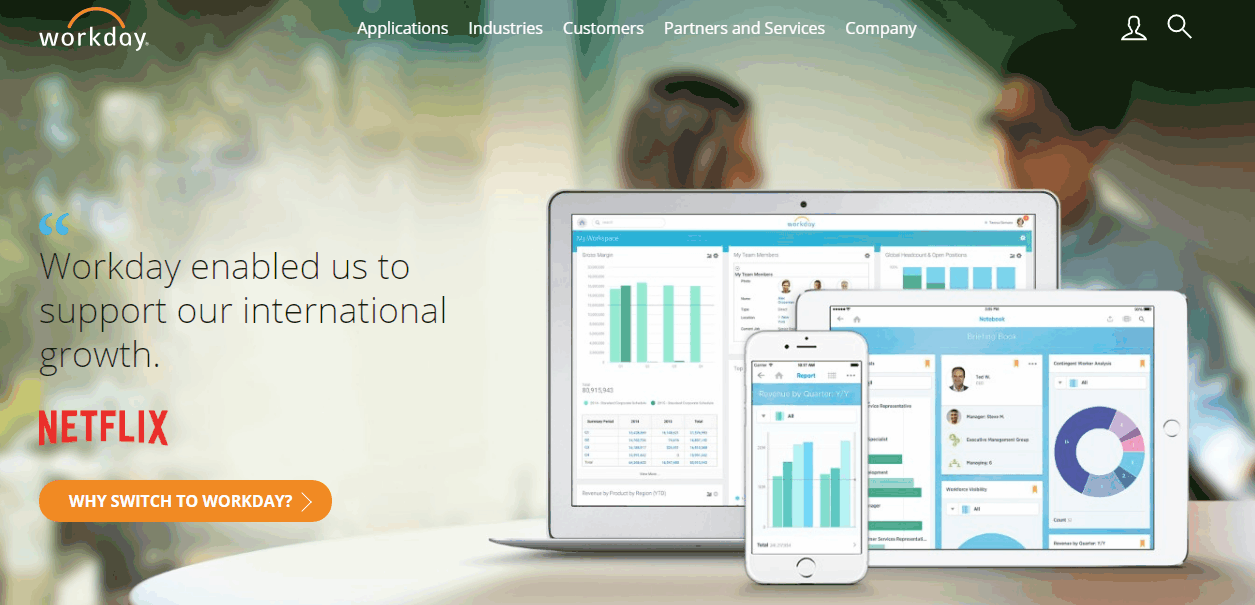
Description
Workday at a Glance
| Company | Workday, Inc. |
|---|---|
| HQ | Pleasanton, CA, US |
| Category | Enterprise AI Platform for HR, Finance, and IT |
| Core products | HCM, Financial Management, Spend Management, Adaptive Planning, Payroll, Contract Lifecycle, Workforce Management, Data Cloud, Workday Extend |
| AI positioning | AI agents that can act instead of just assist |
| AI interface | Sana conversational AI |
| HCM scope | Core HR, talent, recruiting, learning |
| Financials | Accounting, budgeting, reporting |
| Global payroll | Local and global payroll processing |
| Extend platform | Workday Extend for custom app development |
| Named results | 7-Eleven 40,000+ hours saved/week, Medtronic 80 percent HR automation, Cognizant payroll 9 to 2 days, Chipotle 75 percent time-to-hire reduction, Great Wolf Lodge 700K USD saved, NetApp 2.5M+ USD saved |
| Industries | Financial services, healthcare, manufacturing, retail, public sector, higher education, technology |
| Best fit | Large enterprises wanting unified HCM plus Financials cloud platform with AI agents on Workday |
Workday Overview
Workday is an Enterprise AI Platform for HR, Finance, and IT by Workday, Inc. headquartered in Pleasanton, CA delivering integrated Human Capital Management (HCM), Financial Management, Spend Management, Adaptive Planning, Payroll, Contract Lifecycle Management, Workforce Management, Data Cloud, and Workday Extend across large enterprises spanning financial services, healthcare, manufacturing, retail, public sector, higher education, and technology.
The distinctive commercial angle is AI agents that can act instead of just assist positioning combined with unified HCM-plus-Financials architecture. Where alternative enterprise software vendors deliver HR and Financials on separate platforms with integration friction (SAP SuccessFactors + SAP S/4HANA, Oracle HCM + Oracle Financials), Workday operates HCM and Financials on one unified cloud platform enabling integrated workforce and financial planning through Adaptive Planning and shared Data Cloud analytics.
The product covers Human Capital Management (HCM) for core HR, talent management, recruiting, and learning, Financial Management for accounting, budgeting, and reporting, Spend Management for procurement and expense, Adaptive Planning for financial and workforce planning, Payroll for local and global payroll processing, Contract Lifecycle Management, Workforce Management for scheduling and time tracking, Data Cloud for unified analytics across HCM and Financials, and Workday Extend as an app development platform for custom Workday applications. Sana provides conversational AI interface across the platform. Named customer results include 7-Eleven saving over 40,000 hours per week for store leaders, Medtronic automating 80 percent of HR processes, Cognizant cutting payroll processing from 9 days to 2 days, Chipotle reducing time-to-hire by 75 percent, Great Wolf Lodge saving 700,000 USD annually by automating 90 percent of hiring, and NetApp saving over 2.5M USD through contract automation.
Capabilities and Named Features
Workday delivers a full Enterprise AI Platform workflow across HR, Finance, and IT scenarios for large enterprises. Human Capital Management (HCM) covers core HR (employee records, org structure, benefits), talent management (performance, succession, compensation), recruiting (candidate pipeline, offer management), and learning (LMS, career development) on one unified HR data model. Financial Management delivers accounting (general ledger, AP, AR), budgeting, financial reporting, and financial close acceleration on the same platform as HCM enabling integrated financial and workforce planning. Spend Management handles procurement, expense management, and supplier relationships. Adaptive Planning provides financial and workforce planning with driver-based modeling, scenario planning, and continuous forecasting across HR and Finance data sources on unified Data Cloud. Payroll processes local and global payroll across 150+ countries (via Ramco Payce partnership for global and native Workday Payroll for select countries) with tax filing and compliance. Contract Lifecycle Management automates contract authoring, approval, and renewal workflows. Workforce Management delivers scheduling, time tracking, and labor forecasting for frontline workforce. Data Cloud unifies HCM and Financials data with analytics and AI-ready data foundation. Workday Extend is the app development platform letting customers build custom Workday applications on the Workday platform without separate integration architecture. Sana conversational AI provides natural language interface across the platform. AI agents that can act (not just assist) automate workflows across HR and Finance rather than only surfacing suggestions. Named customer results validate enterprise scale: 7-Eleven saved store leaders over 40,000 hours per week, Medtronic automated 80 percent of HR processes, Cognizant cut payroll processing from 9 days to 2, Chipotle reduced time-to-hire by 75 percent, Great Wolf Lodge saved 700,000 USD annually by automating 90 percent of hiring, and NetApp saved over 2.5M USD through contract automation.
Named feature list
- Human Capital Management (HCM)
- Financial Management
- Spend Management
- Adaptive Planning (financial and workforce)
- Payroll (local and global)
- Contract Lifecycle Management
- Workforce Management
- Data Cloud unified analytics
- Workday Extend app development platform
- Sana conversational AI interface
- AI agents that act instead of just assist
- Core HR with employee records and org structure
- Talent management with performance and succession
- Recruiting with candidate pipeline
- Learning management (LMS)
Pricing and Plans
Workday pricing is not disclosed on the corporate site. Enterprise contracts are quoted per organization based on module selection (HCM, Financials, Adaptive Planning, Payroll, Extend), user counts, industry, and deployment scope. Public benchmarks for enterprise HCM-plus-Financials platforms typically range 500,000-5,000,000+ USD per year for large enterprise deployments depending on module scope, headcount, and geographic coverage.
| Tier | Price | What is included |
|---|---|---|
| HCM | Contact Workday | Core HR, talent, recruiting, learning | Priced per employee per year |
| Financial Management | Contact Workday | Accounting, budgeting, reporting | Priced per organization |
| Adaptive Planning | Contact Workday | Financial and workforce planning with driver-based modeling and scenario planning |
| Payroll (Local and Global) | Contact Workday | Local and global payroll with tax filing and compliance | Priced per employee per country |
| Enterprise Bundle | Contact Workday | Full platform across HCM, Financials, Adaptive Planning, Payroll, Extend with dedicated CSM |
Pros
- Unified HCM-plus-Financials cloud platform on one data model eliminates HR-Finance integration friction common in fragmented enterprise vendor stacks
- AI agents that can act (not just assist) automate workflows across HR and Finance beyond suggestion-only alternatives
- Sana conversational AI provides natural language interface across the platform
- Named enterprise customer results (7-Eleven 40,000+ hours saved, Medtronic 80 percent HR automation, Cognizant 9-to-2-day payroll, Chipotle 75 percent time-to-hire reduction) validate outcomes
- Workday Extend app development platform enables custom Workday applications without separate integration architecture
- Adaptive Planning integrates financial and workforce planning on unified Data Cloud
- Global payroll across 150+ countries via native Workday Payroll and Ramco Payce partnership
Cons and Trade-offs
- Enterprise pricing not disclosed on corporate site; requires Workday sales conversation
- Enterprise deployment complexity requires system integrator partnership for large multi-country rollouts
- Pricing tier typically requires large enterprise commitment; SMB and mid-market buyers may find alternatives more accessible
- AI agent capabilities are new positioning; production maturity varies by module and industry
- Workday Extend platform requires developer resources to build custom applications
Workday vs Alternatives
| Vendor | Best for | Unified HCM + Financials |
|---|---|---|
| Workday | Large enterprises wanting unified HCM plus Financials cloud with AI agents | Yes, unified |
| SAP SuccessFactors + S/4HANA | SAP customers with HCM plus Financials on separate SAP platforms | Separate platforms |
| Oracle HCM Cloud + Oracle Financials | Oracle customers with HCM plus Financials on separate Oracle platforms | Separate platforms |
| UKG Pro | Enterprise HCM (formerly Ultimate Kronos) | HCM-only |
| ADP Workforce Now | Mid-market HCM and payroll | HCM-only |
Who Should Choose Workday
Workday fits large enterprises across financial services, healthcare, manufacturing, retail, public sector, higher education, and technology wanting unified HCM plus Financials cloud platform with AI agents. The strongest fit is Fortune 500 and Global 2000 enterprises with 5,000+ employees needing integrated HR and Finance on one platform (7-Eleven, Medtronic, Cognizant, Chipotle, Great Wolf Lodge, NetApp are named customers), organizations valuing AI agents that act on workflows rather than only assist, enterprises with global operations needing Ramco Payce partnership for 150+ country global payroll, and organizations wanting Workday Extend to build custom Workday applications without separate integration architecture. SAP customers may prefer SAP SuccessFactors plus SAP S/4HANA for SAP-native HCM and Financials. Oracle customers may prefer Oracle HCM Cloud plus Oracle Financials. Enterprise HCM-only buyers may prefer UKG Pro. Mid-market HCM and payroll buyers may prefer ADP Workforce Now.
Named Alternatives to Workday
- SAP SuccessFactors + S/4HANA. SAP customers with HCM plus Financials on separate SAP platforms
- Oracle HCM Cloud + Oracle Financials. Oracle customers with HCM plus Financials on separate Oracle platforms
- UKG Pro. Enterprise HCM (formerly Ultimate Kronos)
- ADP Workforce Now. Mid-market HCM and payroll
Implementation and Deployment
Workday rollouts typically run 12-36 months for large enterprise deployments depending on module scope, geographic coverage, and integration complexity. Standard phases: enterprise discovery for HCM, Financials, Adaptive Planning, Payroll requirements, system integrator selection (Deloitte, Accenture, DXC Technology, Kainos, and other Workday partners), current-state assessment of existing HR and Finance systems, data migration from legacy HCM and ERP systems, business process configuration across HR and Finance workflows, integration with existing Workday and third-party systems, Sana conversational AI configuration, Workday Extend custom app development if applicable, user training across HR, Finance, IT, and business teams, pilot deployment with one business unit or country, and full enterprise rollout across geographies and business units.
What Real Buyers Say About Workday
Enterprise HR and Finance leaders on LinkedIn and enterprise ERP publications describe Workday as a distinctive unified HCM-plus-Financials cloud platform alternative to SAP SuccessFactors plus SAP S/4HANA, Oracle HCM plus Oracle Financials, UKG Pro, and ADP Workforce Now. Buyers cite the unified HCM-plus-Financials on one data model, AI agents that can act (not just assist), Sana conversational AI, named enterprise customer results (7-Eleven 40,000+ hours saved, Medtronic 80 percent HR automation, Cognizant 9-to-2-day payroll, Chipotle 75 percent time-to-hire reduction, Great Wolf Lodge 700K USD saved, NetApp 2.5M+ USD saved), and Workday Extend as decisive versus separate HR and Financials platform alternatives. Common friction: enterprise pricing not disclosed on corporate site, enterprise deployment complexity requires system integrator partnership, and pricing typically requires large enterprise commitment limiting SMB and mid-market accessibility.
Vendor references: Workday corporate homepage, Workday customer stories, Workday product portfolio.
Related Category Guides on SaaSRat
Prospective Workday evaluators may find related buyer guidance on SaaSRat useful. See our category coverage for HR, financials, payroll for adjacent software category evaluation.
Additional Context from Buyer Communities
Broader discussion of this category can be found in buyer communities and professional publications. Relevant threads include Workday HR discussion on LinkedIn and Enterprise HCM thread on Reddit.
The Bottom Line on Workday
Workday is an Enterprise AI Platform for HR, Finance, and IT by Workday, Inc. headquartered in Pleasanton CA delivering unified Human Capital Management, Financial Management, Spend Management, Adaptive Planning, Payroll, Contract Lifecycle Management, Workforce Management, Data Cloud, and Workday Extend with AI agents that can act instead of just assist and Sana conversational AI serving 7-Eleven, Medtronic, Cognizant, Chipotle, Great Wolf Lodge, and NetApp across financial services, healthcare, manufacturing, retail, public sector, higher education, and technology.
Choose Workday if you are a Fortune 500 or Global 2000 enterprise with 5,000+ employees wanting unified HCM plus Financials cloud platform with AI agents that act on workflows, you value integrated workforce and financial planning via Adaptive Planning on unified Data Cloud, or you need Workday Extend to build custom applications without separate integration architecture.
Skip it if you are an SAP customer wanting SAP-native HCM and Financials (SAP SuccessFactors plus S/4HANA fit better), an Oracle customer (Oracle HCM Cloud plus Oracle Financials fit better), an enterprise HCM-only buyer (UKG Pro fits better), or a mid-market HCM and payroll buyer (ADP Workforce Now fits better).
The competitors to shortlist alongside Workday are SAP SuccessFactors + SAP S/4HANA, Oracle HCM Cloud + Oracle Financials, UKG Pro, and ADP Workforce Now for enterprise HCM and Financials platforms.
Verified on 2026-08-04 against vendor website.
Frequently Asked Questions
What is Workday?
Who owns Workday?
How much does Workday cost?
What is unified HCM plus Financials?
Which enterprises use Workday?
What is Sana in Workday?
What is Workday Extend?
Does Workday support global payroll?
How long does Workday implementation take?
Where is Workday headquartered?
Find Your Perfect Software
See how it can transform your workflow
- Personalized for your needs Tailored recommendations based on your unique requirements.
- Save time & resources Streamline your workflow and boost team productivity.
- Trusted by thousands Join 10,000+ businesses already growing with SaaSrat.
You're all set! 🎉
A specialist for will reach out within 1 business day with tailored recommendations for your needs.