

Floqast
by FloQast • Founded 2013
What is Floqast?
FloQast is an accounting close management platform that helps accounting teams automate and track the month-end close process. It integrates with existing ERP and accounting systems rather than replacing them, and is used by mid-market and enterprise companies to reduce close cycle times.
Get Best Quote for Floqast
Connect with SaaSrat experts to get the best quote for your business.
You're all set!
A specialist for Floqast will reach out within 1 business day.
Floqast Features
Close management
Reconciliation management
Task management
Workflow automation
Collaboration tools
Document management
View All 25 Features
Floqast Pricing Plans
Corporate
- Collaborative Checklist
- Review Notes
- Reconciliations Management
- Reporting
- Single Sign-On Integration (SSO)
- Premium Support (extra cost)
- Close Analytics
- Audit Users
Floqast Resources
Floqast Screenshots
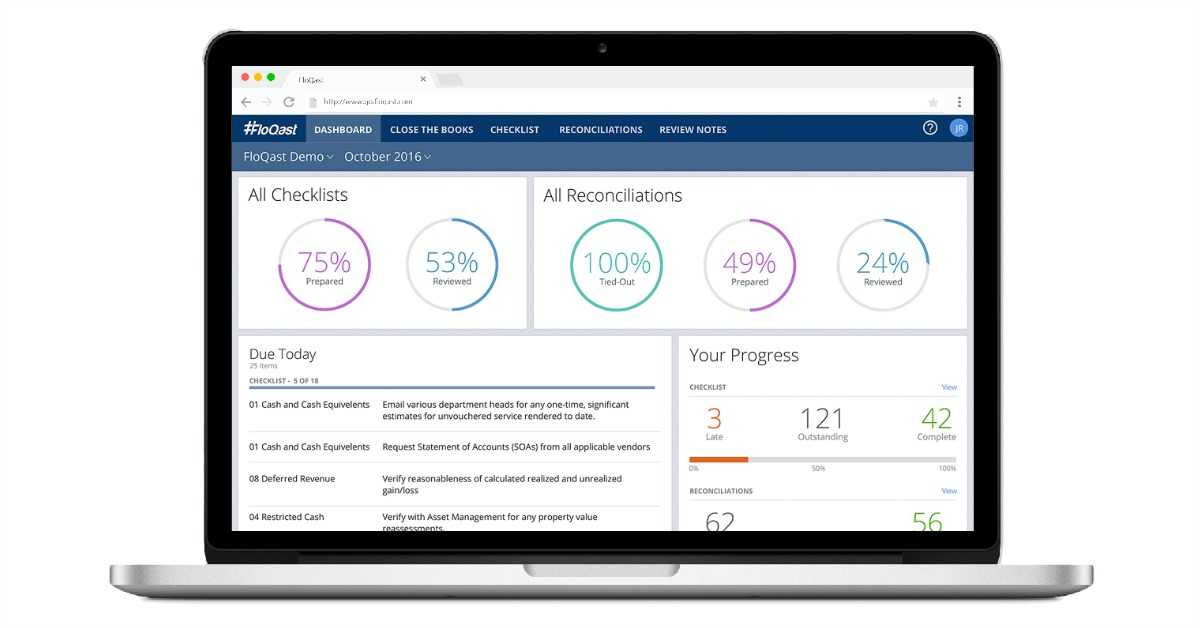
Description
FloQast at a Glance
| Best fit for | Mid-market and enterprise accounting teams that want to reduce month-end close time, improve reconciliation accuracy, and track close status across the team |
|---|---|
| Industries | Technology/SaaS, financial services, healthcare, retail, manufacturing, and any sector with complex multi-person month-end close workflows |
| Core platform | Close checklist management, reconciliation workflow, flux analysis, journal entry management, audit trail, and reporting on close cycle performance |
| What it is NOT | FloQast is not a general ledger or accounting system. It integrates with your existing ERP (NetSuite, QuickBooks, SAP, Sage Intacct, Microsoft Dynamics) and does not replace it. |
| Pricing model | Annual subscription; pricing is not published and requires a sales demo and quote |
| Indicative pricing | Typically $1,200 to $3,600+/user/year depending on team size and modules; most mid-market teams spend $20,000 to $80,000/year total |
| Mobile app | Yes, iOS and Android for task approval and status review |
| Integrations | NetSuite, QuickBooks Online, Sage Intacct, SAP, Microsoft Dynamics, Xero, Excel, and Google Sheets |
| Compliance | SOC 2 Type II, GDPR, role-based access controls, full audit trail |
FloQast Pros and Cons in 2026
Where FloQast Stands Out
Directly reduces month-end close cycle time. FloQast customers report reducing their close cycle from 10 to 12 days down to 6 to 8 days on average. The platform does this by replacing spreadsheet-based close checklists with a centralized task management system, giving each accountant visibility into what is complete, in review, or blocked. The reduction in emailing status updates and chasing sign-offs is where most of the time savings come from.
Deep ERP and accounting system integrations. FloQast pulls trial balance data directly from NetSuite, QuickBooks Online, Sage Intacct, SAP, and Microsoft Dynamics. Reconciliations auto-populate with current period balances from the general ledger, eliminating manual data entry. This integration quality is the main reason FloQast is trusted in mid-market and enterprise accounting departments rather than being replaced by a simple project management tool.
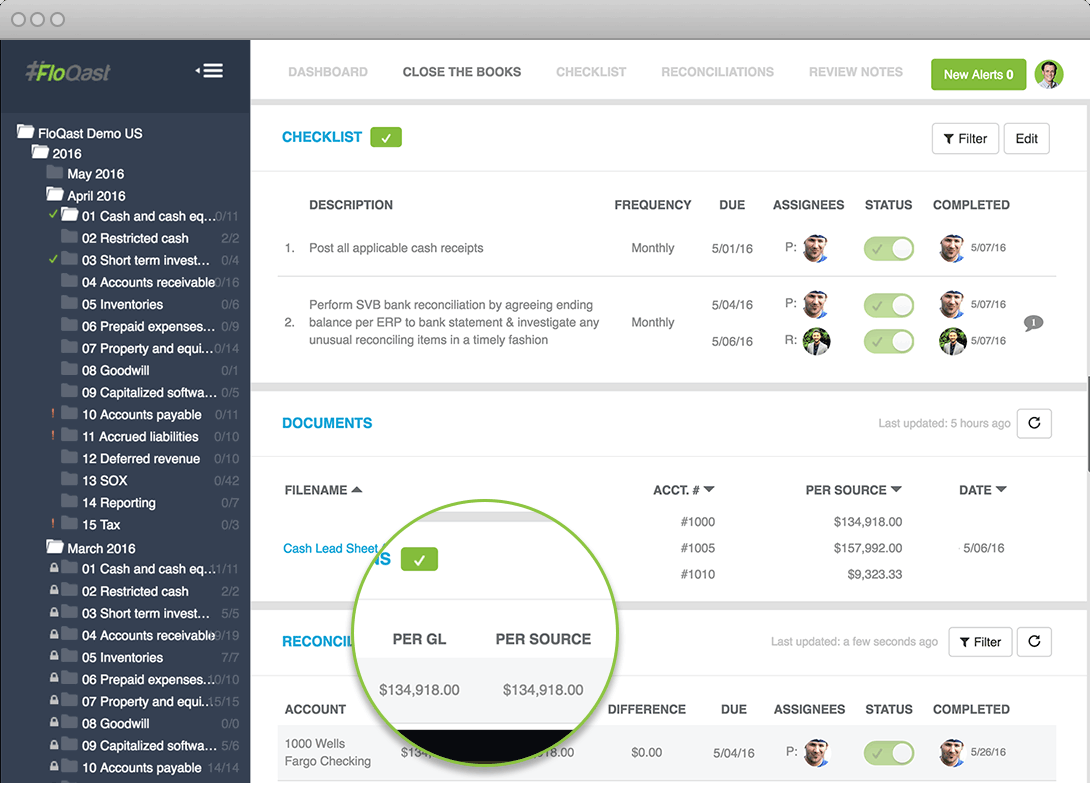
Reconciliation management with auto-certification. FloQast's reconciliation module connects each balance sheet account to its supporting schedules. When the GL balance matches the supporting detail within defined thresholds, the reconciliation auto-certifies. Reviewers see the balance, the support, and the match status in one place instead of hunting through shared drives for the right version of a spreadsheet.
Flux analysis built in. The flux analysis module automatically highlights accounts with material period-over-period or budget-versus-actual variances. Accountants assign explanations to flagged variances, and reviewers see explanations alongside the numbers. This replaces what most teams do manually in Excel and reduces the risk of material variances going unreviewed.
Designed by accountants for accountants. FloQast was founded by former Big Four accountants and has been built with accounting team workflows at the center. The interface matches how accounting teams actually work during close, which reduces training time and adoption friction compared to generic project management tools repurposed for close management.
Where FloQast Falls Short
Not a replacement for your accounting system. FloQast requires an existing ERP or accounting system to pull data from. It is a layer on top of NetSuite, QuickBooks, or SAP, not a standalone system. Companies that do not already have a solid accounting system get limited value from FloQast before that foundation is in place.
Pricing is not transparent and scales with team size. FloQast does not publish pricing. For small accounting teams of three to five people, the cost per user can be high relative to the time saved. Most of FloQast's value is realized in teams of 10 or more accountants where coordinating close across multiple people is the primary problem.
Requires change management to achieve full adoption. FloQast only works if every member of the accounting team logs tasks and updates status consistently. Teams that have one or two holdouts who prefer their own spreadsheets reduce the visibility benefit for everyone. Implementation success depends on having a controller or CAO who enforces adoption.
Limited workflow beyond the close. FloQast is purpose-built for financial close. It does not replace AP automation, expense management, or financial planning tools. Companies looking for a single platform that handles close management plus broader accounting operations will need to integrate FloQast with other tools.
Who Should Use FloQast?
FloQast is the right fit for accounting teams of 8 or more people at mid-market and enterprise companies where the month-end close involves multiple preparers, multiple reviewers, and coordination across departments. It works best when your team is losing time to status-update emails, when reconciliation sign-off is manual and inconsistent, or when auditors are asking for evidence of your close process and controls. Technology and SaaS companies, financial services firms, and healthcare organizations with complex accrual schedules get particular value from the reconciliation auto-certification and flux analysis modules.
FloQast is the wrong fit for small businesses with accounting teams of one to three people, companies that do not yet have a stable ERP or accounting system as a foundation, or teams looking to replace their general ledger. If your primary goal is finding accounting software rather than improving a close process you already have, see our accounting software guide for general ledger options. For enterprise companies evaluating full financial close automation including consolidation and reporting, compare FloQast against Workiva and BlackLine.
FloQast Product Features
Close Checklist and Task Management
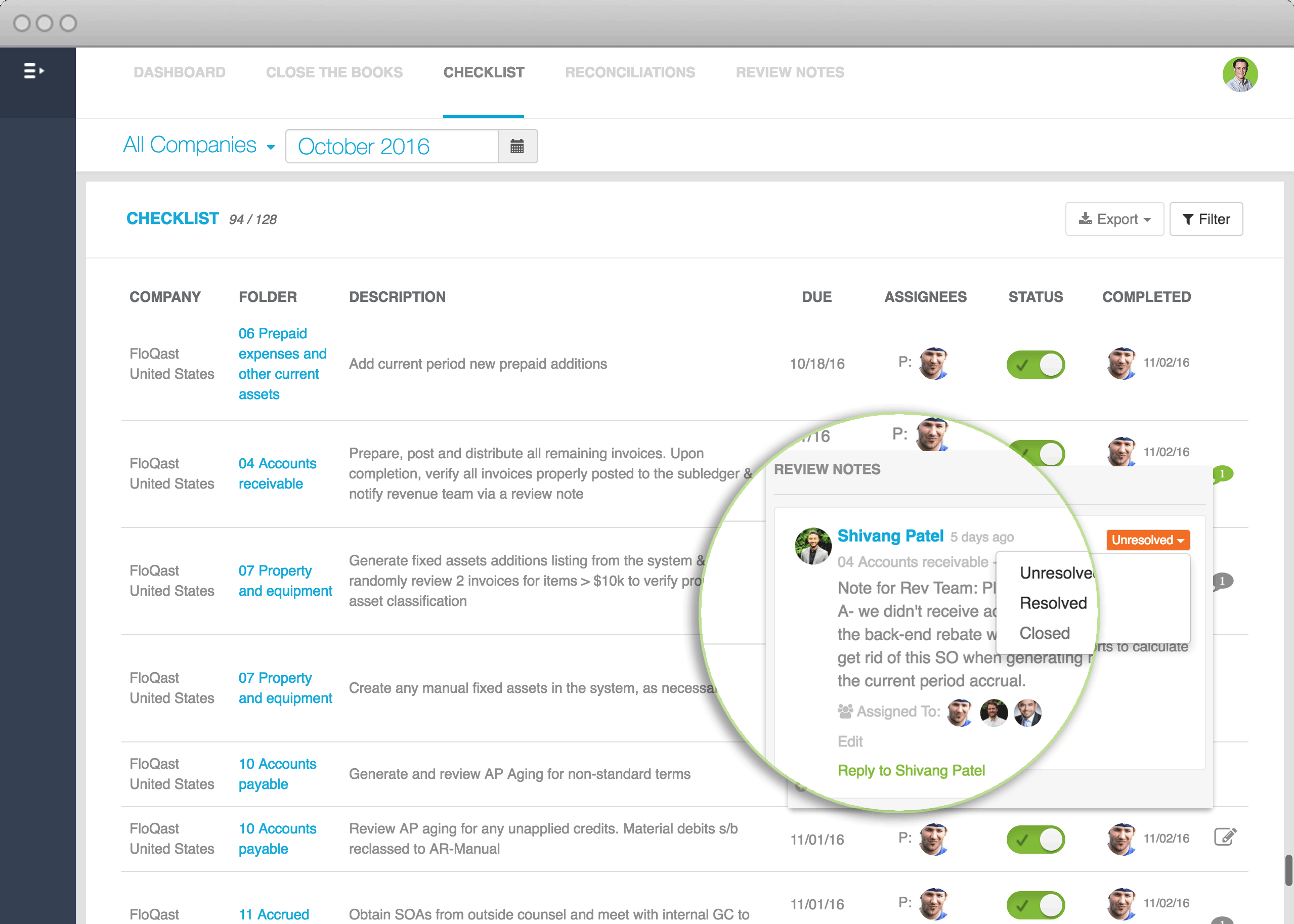
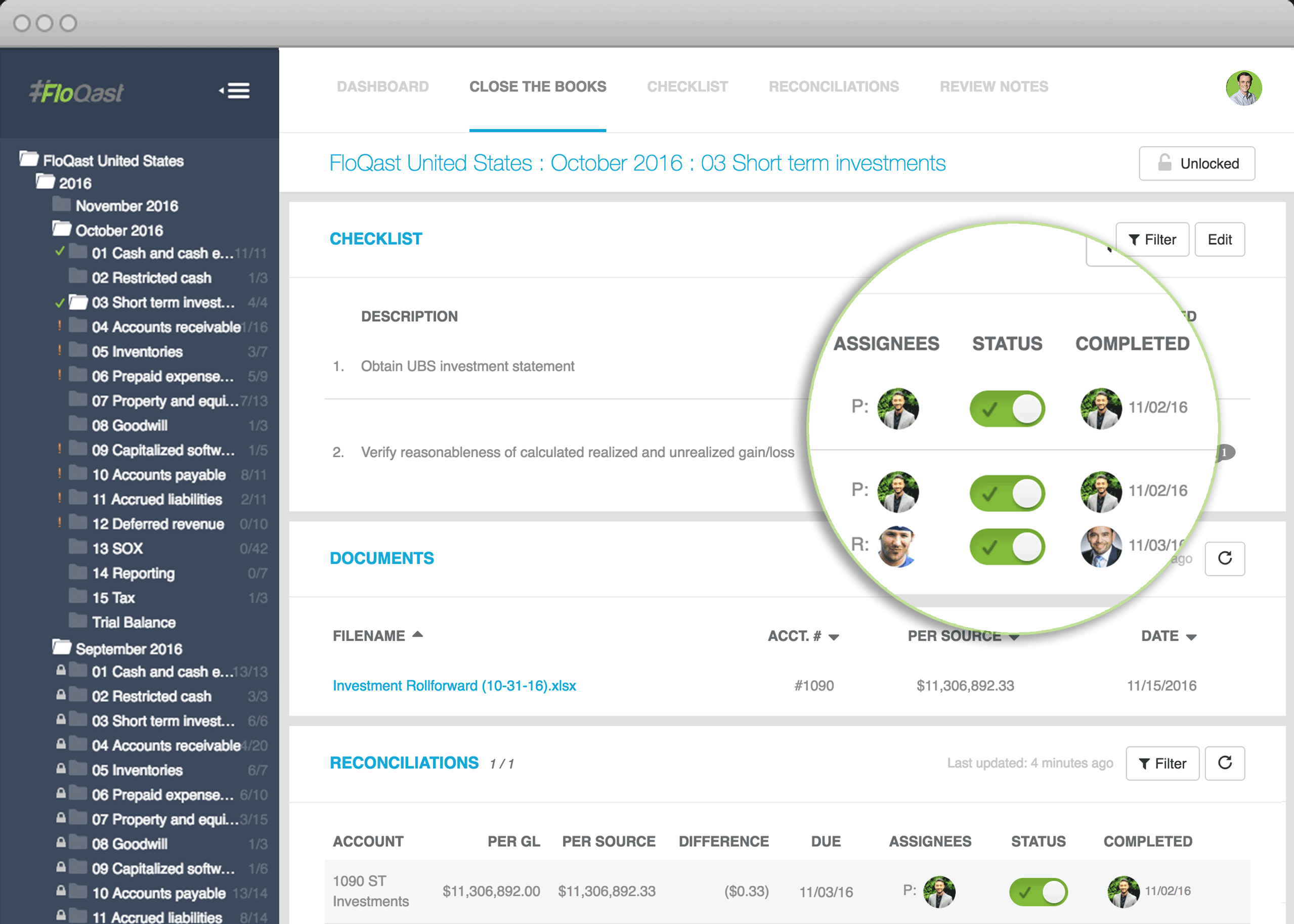
Replace email chains and shared spreadsheets with a centralized close checklist where every task has an owner, a due date, a status, and a reviewer. Tasks can be assigned by account, entity, or department. Status rolls up into a close completion dashboard that gives the controller and CFO real-time visibility into close progress without manual status calls. Recurring tasks auto-populate from prior periods.
Reconciliation Management
Connect each balance sheet account to its supporting reconciliation schedule. FloQast pulls the current GL balance from the integrated ERP and compares it to the support file. When they match within tolerance, the reconciliation auto-certifies. Reviewers see the GL balance, the support, and the match result in one place. Variance explanations and reviewer sign-offs are stored in the platform with timestamps for audit evidence.
Flux Analysis
Automatic period-over-period and budget-versus-actual variance calculation for every account in the trial balance. Material variances are flagged for explanation. Accountants type explanations directly in FloQast, which stores them alongside the numbers. Reviewers see flagged accounts, explanations, and approval status without jumping between spreadsheets. Flux commentary is available as an export for board and audit committee reporting.
Journal Entry Management
Create, review, and post journal entries within FloQast with supporting documentation attached. Approval workflows route entries to the appropriate reviewer before posting. The complete history of each journal entry including who prepared it, who reviewed it, and when it posted is stored as an audit trail. Reduces the risk of unapproved or unsupported journal entries that auditors flag during the year-end audit.
Reporting and Analytics
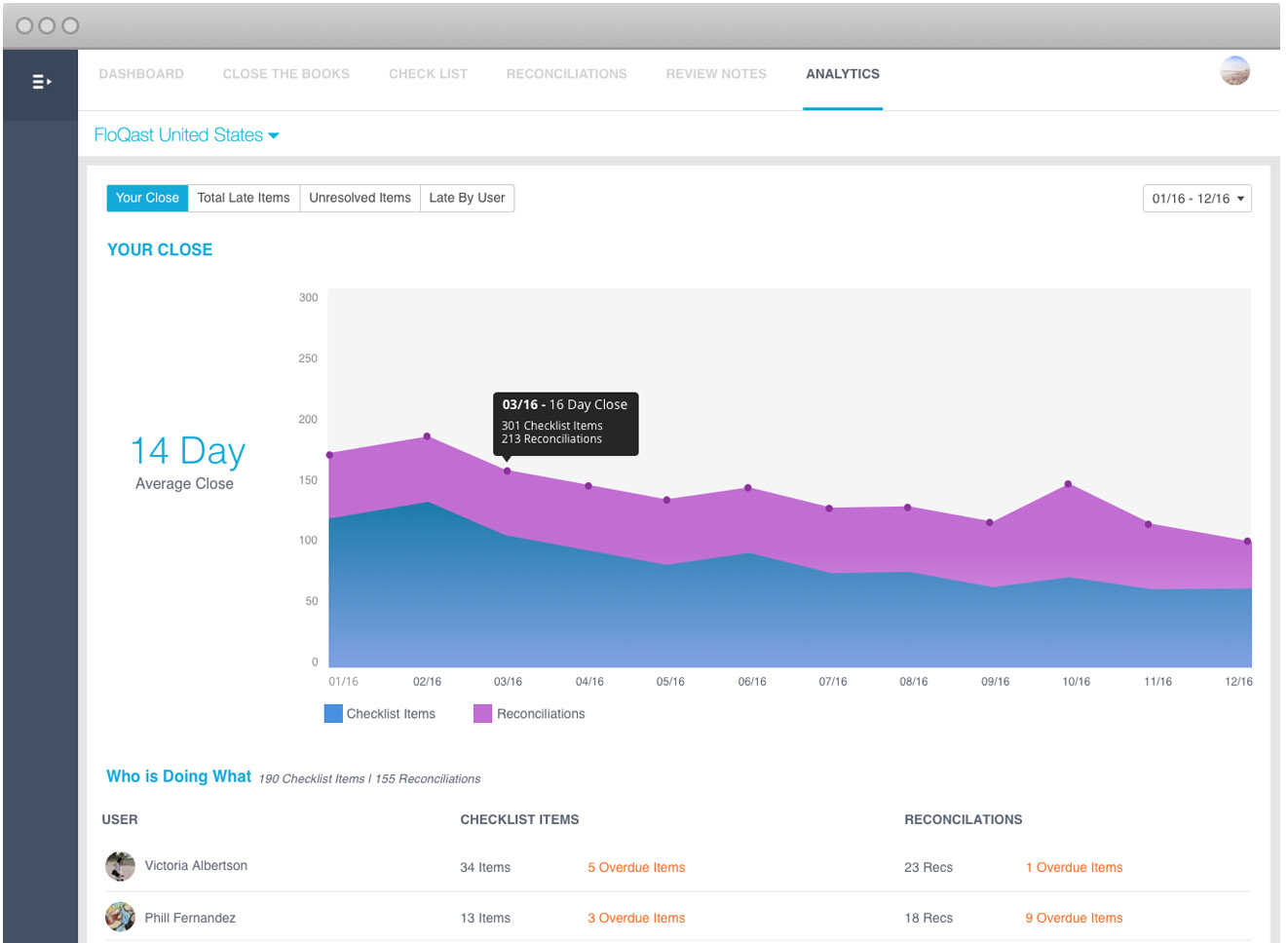
Close cycle performance dashboards show average close days, on-time completion rates by team member, and recurring bottlenecks. Trend reporting compares close performance across months and quarters. Data can be exported to Excel or shared with CFO and audit committee. The reporting module helps controllers identify where the close process slows down and make targeted improvements each cycle.
Audit Trail and Evidence Package
Every action in FloQast is logged with a user, timestamp, and details. Reconciliation support, journal entry approvals, flux commentary, and task sign-offs are stored in the platform and can be exported as an organized evidence package for external auditors. Reduces the time spent pulling audit evidence from email threads and shared drives during the annual audit.
How Much Does FloQast Cost in 2026?
FloQast does not publish pricing. All contracts are annual and require a sales demo followed by a proposal. The figures below are based on publicly available customer estimates and ERP research firm surveys.
| Team Size | Indicative Annual Cost | Notes |
|---|---|---|
| Small team (5 to 10 users) | $20,000 to $40,000/year | Close management and reconciliation modules; smaller teams may not see full ROI |
| Mid-market team (10 to 30 users) | $40,000 to $100,000/year | Standard configuration with ERP integration; best cost-to-value ratio |
| Enterprise (30+ users, multiple entities) | $100,000 to $300,000+/year | Multi-entity, advanced flux analysis, and custom integrations |
FloQast frequently offers multi-year contract discounts. If you are comparing FloQast against BlackLine (typically priced higher) or Trintech Cadency, negotiate on multi-year terms before accepting the first proposal.
Hidden Costs to Watch For
- Implementation and onboarding. FloQast offers implementation support packages but onboarding a team of 15+ people across multiple entities takes real time. Budget for internal project management and change management effort, not just the software cost.
- ERP integration setup. If your ERP connection requires custom field mapping or the ERP version is older, integration setup may involve consulting fees from FloQast's professional services team or your ERP partner.
- Additional modules. Flux analysis and journal entry management are sometimes priced as add-ons to the core close checklist and reconciliation package. Get explicit module pricing in the initial proposal.
- Annual renewal increases. FloQast contracts typically increase 5 to 10% at renewal. Multi-year contracts lock in the current rate. If you are satisfied after year one, negotiate a two or three-year renewal before your first renewal date.
FloQast vs the Alternatives
BlackLine is FloQast's primary enterprise competitor. BlackLine is larger, has more modules (including intercompany hub and variance analysis), and is used by Fortune 500 companies. It is also significantly more expensive, with minimum contracts typically starting above $100,000 per year. For mid-market accounting teams, FloQast provides most of BlackLine's core close management functionality at a lower cost.
Trintech Cadency is another enterprise-focused close management platform with strong financial controls and compliance features. Cadency is preferred in heavily regulated industries. For mid-market companies without Big Four audit requirements, FloQast is simpler to implement and maintain.
Spreadsheets and project management tools (Asana, Monday.com, Notion) are what most accounting teams use before FloQast. The limitation is that they do not connect to the GL, do not auto-populate balances, and do not store reconciliation support in the same place as the checklist. FloQast replaces that workflow with a system purpose-built for accounting close.
Sage Intacct and NetSuite have built-in close checklists and reconciliation tools that may be sufficient for smaller teams. For accounting teams that already use these ERPs and have a close process under 7 days, the additional cost of FloQast may not be justified. FloQast's value is clearest when the built-in close tools in the ERP are not enough.
What Real Buyers Report About FloQast
Accounting teams that adopt FloQast consistently report two outcomes: faster close and better audit readiness. On G2, FloQast holds a 4.7 out of 5.0 rating from over 1,000 reviews, which is unusually high for accounting software. The most cited positive is the reconciliation module replacing a multi-folder, multi-version shared drive system with a single source of truth. Controllers report that external auditors ask fewer questions and evidence requests take hours instead of days after implementing FloQast.
The most common complaints are pricing opacity (teams cannot get a quote without going through a full sales process) and the need for strong internal adoption to see value. Teams that tried FloQast but saw limited results typically report that two or three team members never fully switched from their own spreadsheets, which undermined the visibility benefit for the rest of the team. Companies that see the best results are those where the controller mandated full adoption before the go-live date.
FloQast Integrations and App Ecosystem
FloQast integrates directly with the major ERP and accounting systems used by mid-market and enterprise accounting teams. The NetSuite integration pulls trial balance data via API and syncs in real time. The Sage Intacct, QuickBooks Online, Microsoft Dynamics 365, SAP S/4HANA, and Xero integrations similarly pull GL data for auto-populating reconciliations. For companies using Excel or Google Sheets as their primary reconciliation format, FloQast can connect to those files directly.
For identity management, FloQast supports SAML 2.0 single sign-on with Okta, Microsoft Azure AD, and Google Workspace. Document storage integrations connect with SharePoint, Google Drive, and Box for attaching reconciliation support files from existing document management systems. For companies using a dedicated document management platform, see our accounting software guide for tools with strong document workflows.
Security and Compliance
FloQast is SOC 2 Type II certified with annual independent audits covering security, availability, processing integrity, confidentiality, and privacy controls. GDPR compliance is supported for EU-based customers with data processing agreements available. Role-based access controls allow granular permissions by team member, with separate preparers and reviewers for each reconciliation or task. Every action in the platform generates an immutable audit log with user identity, timestamp, and change details. Data is encrypted in transit with TLS 1.2+ and at rest with AES-256. FloQast's infrastructure is hosted on AWS with geographic redundancy and 99.9% uptime commitments.
Bottom Line: Is FloQast Right for You?
FloQast is worth evaluating if your accounting team of 10 or more people is spending more than 8 working days on the monthly close and the primary bottleneck is coordination, reconciliation management, or reconciliation across accounts. The platform delivers the most value when there is a motivated controller who will drive adoption and when the team is willing to move from shared spreadsheets to a centralized system. For mid-market companies where auditors have commented on reconciliation documentation or close process controls, FloQast directly addresses those findings.
Do not buy FloQast if your accounting team has fewer than 5 people, if you do not yet have a stable ERP integration (NetSuite, Intacct, or similar), or if your close already runs in 5 days or fewer. At those scales, the cost does not match the benefit. Get a demo, ask to see the actual reconciliation and flux modules in a live environment, and request a reference from a company of similar size in your industry before committing to a contract. See our accounting software guide for broader accounting platform options.
Frequently Asked Questions
Is there a free plan or free trial for FloQast?
How much does FloQast cost?
What does FloQast integrate with?
Who is FloQast best for?
What are the best alternatives to FloQast?
Is FloQast GDPR / SOC 2 compliant?
Does FloQast have a mobile app?
What do real users say about FloQast?
How does FloQast compare to its top competitor?
Does FloQast offer customer support?
Find Your Perfect Software
See how it can transform your workflow
- Personalized for your needs Tailored recommendations based on your unique requirements.
- Save time & resources Streamline your workflow and boost team productivity.
- Trusted by thousands Join 10,000+ businesses already growing with SaaSrat.
You're all set! 🎉
A specialist for will reach out within 1 business day with tailored recommendations for your needs.