

NetSuite ERP
by NetSuite Inc. • Founded 1998
What is NetSuite ERP?
Get Best Quote for NetSuite ERP
Connect with SaaSrat experts to get the best quote for your business.
You're all set!
A specialist for NetSuite ERP will reach out within 1 business day.
NetSuite ERP Features
Financial Management
Order Management
Inventory and Supply Chain
CRM
SuiteCommerce Ecommerce
Manufacturing MRP
View All 13 Features
NetSuite ERP Pricing Plans
NetSuite ERP
- Financial Management (GL, AP, AR, fixed assets, cash management)
- Order Management and billing automation
- Inventory and supply chain management
- CRM (sales force automation, marketing, customer support)
- SuiteCommerce B2B and B2C ecommerce
- Manufacturing MRP and shop floor control
- Project accounting and PSA
- HR and payroll (SuitePeople)
- Real-time analytics and SuiteAnalytics dashboards
- SuiteCloud customization platform (SuiteScript, SuiteFlow, SuiteBuilder)
- NetSuite AI and analytics
- OneWorld multi-entity and multi-currency
- SuiteSuccess industry pre-configurations
NetSuite ERP Resources
NetSuite ERP Screenshots
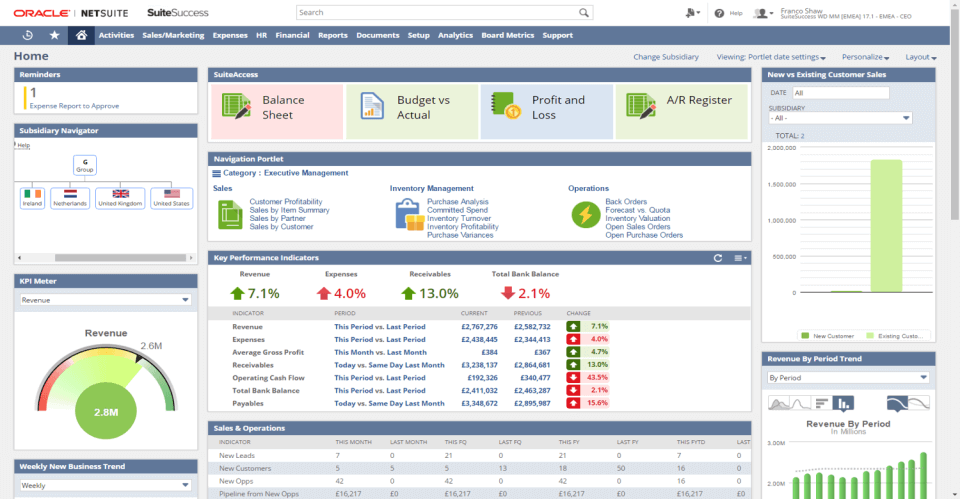
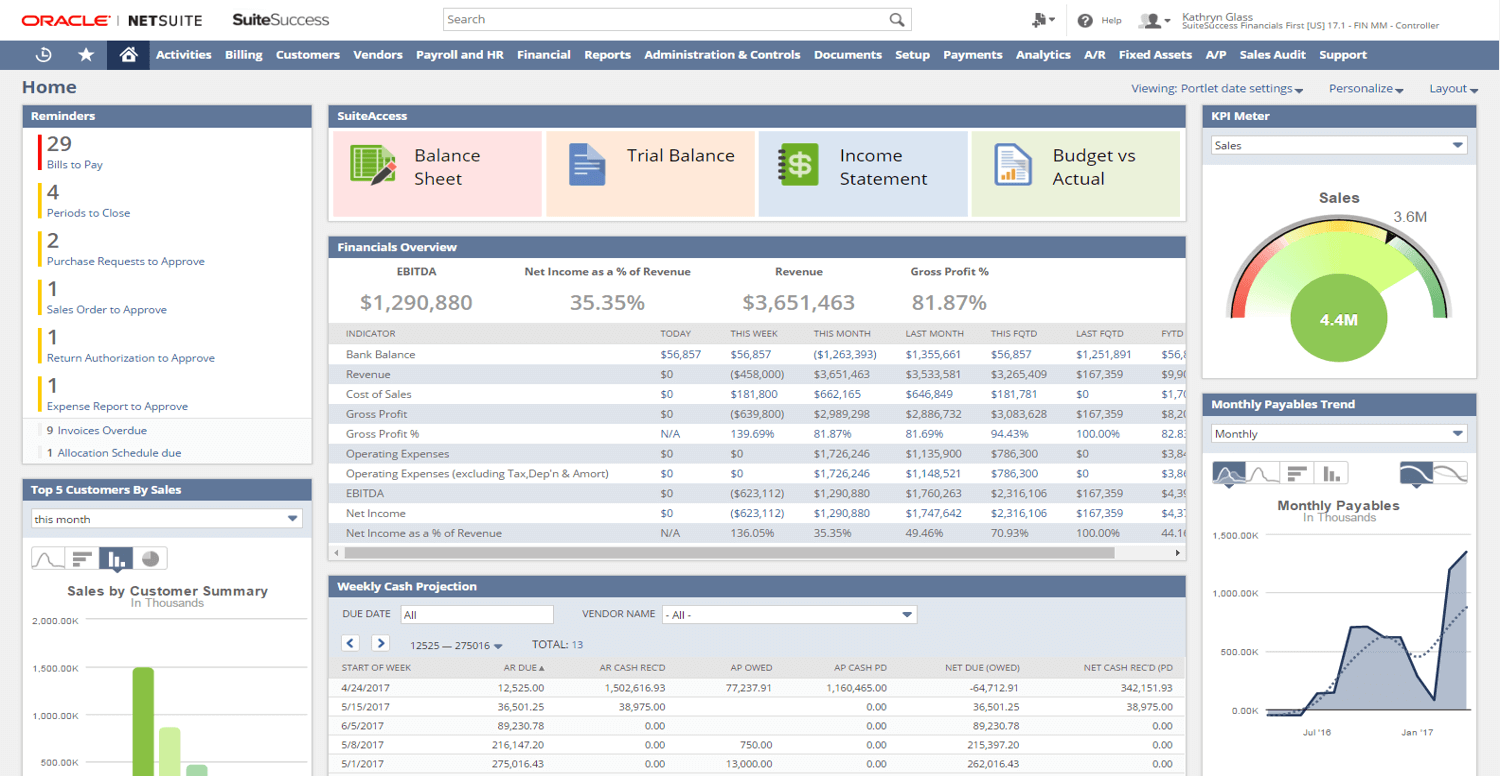
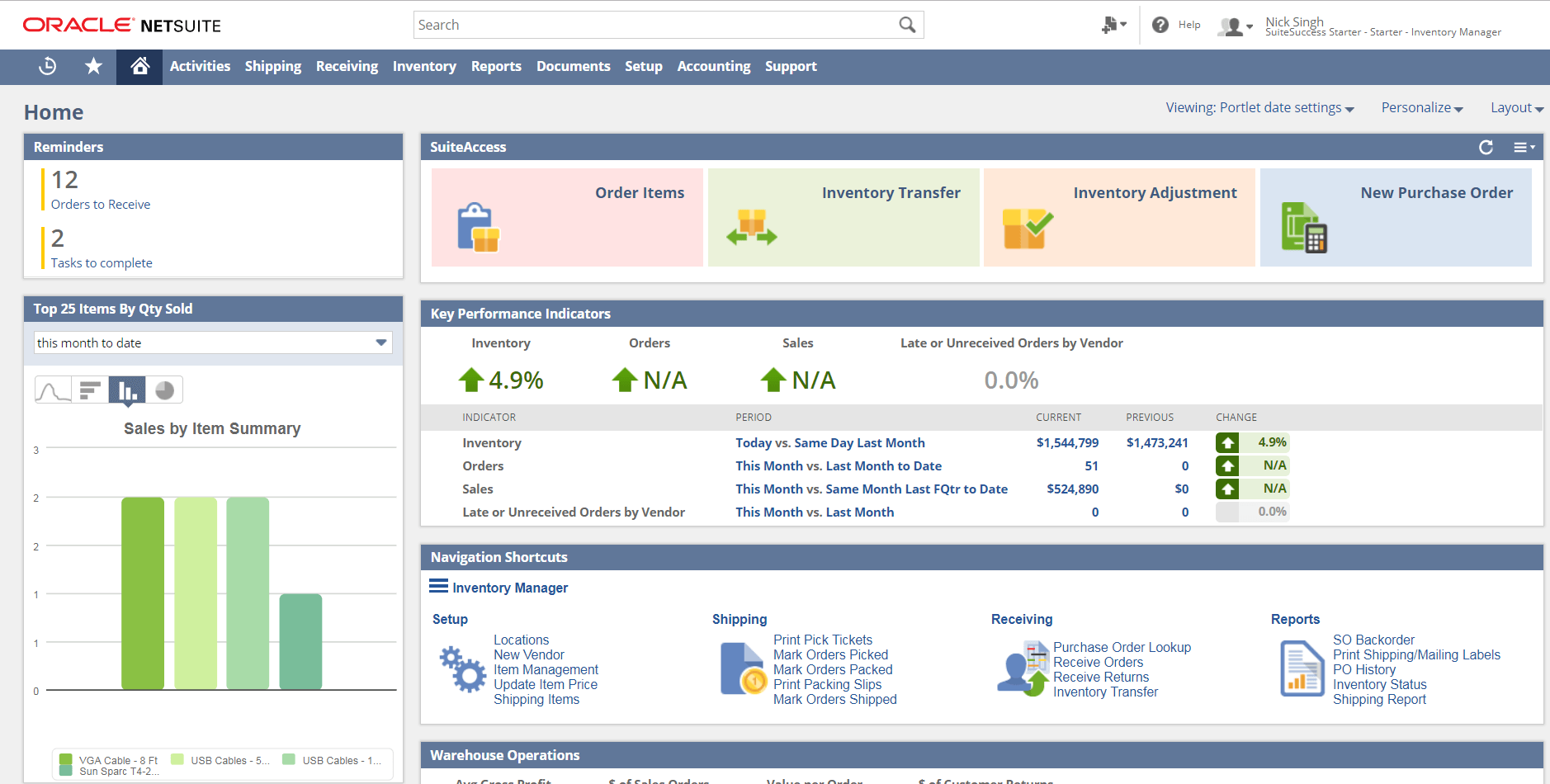
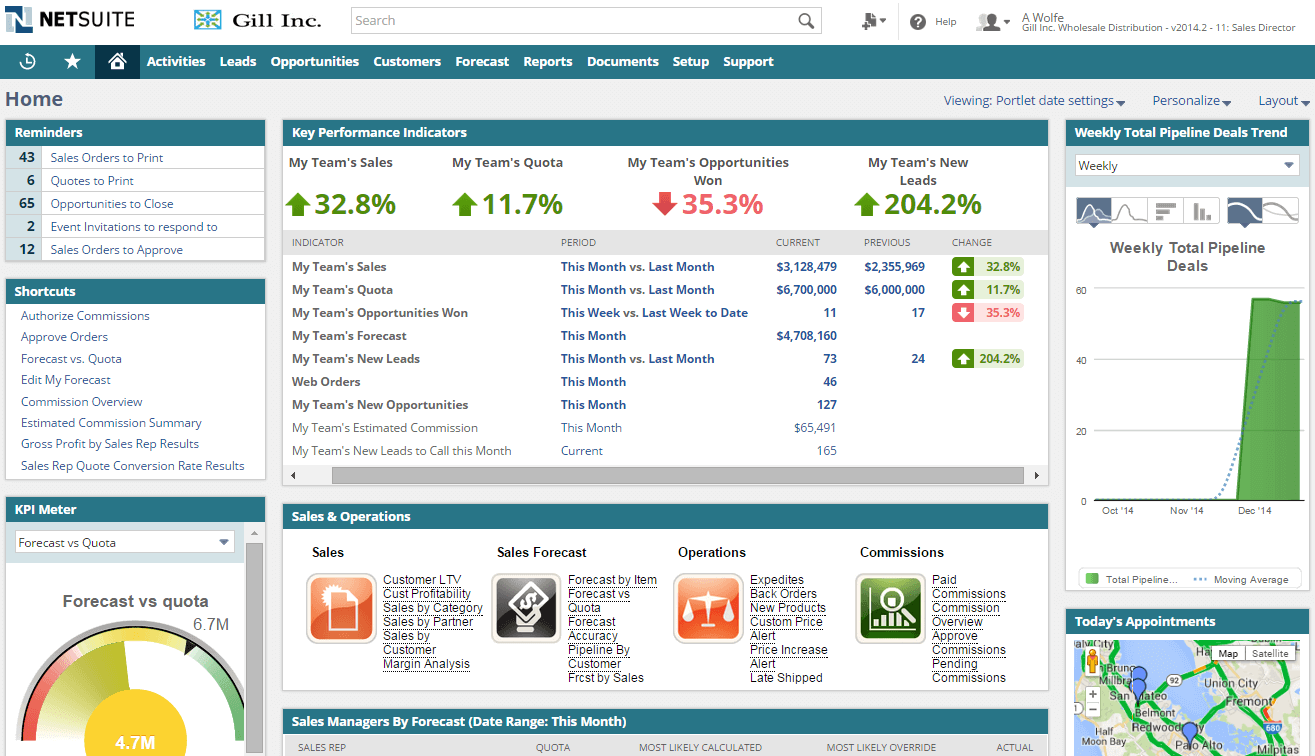
Description
NetSuite ERP is a cloud-based business management platform developed by Oracle that brings financial management, CRM, ecommerce, manufacturing, supply chain, and HR into a single system. More than 38,000 organizations in 219 countries and territories use NetSuite to run their core operations. Because NetSuite runs entirely in the cloud on Oracle's global infrastructure, there is no on-premise hardware to maintain and no annual upgrade projects to manage -- Oracle handles all of that automatically.
How NetSuite ERP Works
NetSuite is built on a single unified data model, which means every department -- finance, sales, purchasing, warehouse, HR -- works from the same database in real time. When a sales order is placed, it automatically triggers inventory checks, updates financial forecasts, and creates purchase orders if stock is low, all without manual handoffs between systems. The SuiteCloud platform sits underneath all of this, providing the customization layer where businesses can extend NetSuite with SuiteScript (API-based scripting), SuiteFlow (workflow automation), and SuiteBuilder (point-and-click configuration) without touching the core product code. This means upgrades apply cleanly without breaking customizations.
The platform is organized into functional modules that businesses can activate as they grow: Financial Management, Order Management, Inventory and Supply Chain, CRM, Ecommerce (SuiteCommerce), Manufacturing, Project Accounting, HR and Payroll, and Professional Services Automation. Each module connects natively, which eliminates the integration work that plagues businesses running separate accounting, CRM, and inventory tools.
NetSuite Key Features
- Unified financial management: General ledger, accounts payable, accounts receivable, fixed assets, cash management, and financial close automation in one system. Multi-currency and multi-subsidiary support for global operations.
- Real-time reporting and SuiteAnalytics: Customizable dashboards, KPI scorecards, saved searches, and drag-and-drop report builder. Every user sees role-specific data without needing a separate BI tool for standard operational reporting.
- SuiteCloud customization platform: SuiteScript for API-based development, SuiteFlow for no-code workflow automation, SuiteBuilder for custom fields and forms, and SuiteBundle for packaging and distributing customizations. Upgrade-safe by design.
- NetSuite OneWorld: Manage multiple legal entities, subsidiaries, and currencies from a single account. Consolidate financials, handle intercompany transactions, and meet local compliance requirements across countries.
- SuiteCommerce: Native B2B and B2C ecommerce built directly into the ERP. Product catalog, pricing, and customer data stay in sync with the back-office without third-party middleware.
- Manufacturing Resource Planning (MRP): Production scheduling, bill of materials, work orders, shop floor control, and demand planning for product-based businesses.
- Integrated CRM: Sales force automation, marketing campaign management, customer support case tracking, and 360-degree customer history -- all linked to the financial and order management system.
- NetSuite AI features: AI-powered cash flow forecasting, anomaly detection in financial data, intelligent order routing, and the NetSuite AI Connector for connecting GenAI workflows to ERP data.
- SuiteSuccess: Industry-specific pre-built configurations, workflows, and KPI dashboards for Software, Services, Manufacturing, Wholesale Distribution, Retail, Nonprofits, and more. Faster time-to-value than a blank-slate implementation.
- Mobile access: iOS and Android apps give employees access to dashboards, approvals, expense reporting, and customer data from any device.
Who Should Use NetSuite ERP?
NetSuite is built for mid-market businesses and growing companies that have outgrown entry-level accounting software and need an integrated platform to manage operations across multiple departments or locations. It fits best when:
- The business runs on multiple disconnected tools (separate accounting, CRM, inventory, ecommerce) and needs to consolidate
- Revenue is growing past the point where spreadsheets and QuickBooks can handle the complexity
- Multiple legal entities, subsidiaries, or countries need managing from one system
- The business sells direct-to-consumer or wholesale online and needs ecommerce natively connected to inventory and financials
- Manufacturing, distribution, or services businesses need to connect production or delivery data to financials in real time
- Professional services firms need project accounting and resource management alongside CRM and billing
NetSuite is not the right fit for very small businesses (under 10 employees or under $1M revenue) who need simple bookkeeping, or for large legacy enterprises already running SAP or Oracle Fusion at scale. The sweet spot is companies with $5M to $500M in revenue that need enterprise-grade capability without the cost and complexity of traditional large ERP systems. For simpler financial management needs, the billing software and expense management categories on SaaSRat cover lighter-weight tools.
Pros and Cons of NetSuite ERP
What works well:- Single platform for finance, CRM, inventory, ecommerce, and HR means one source of truth across the business -- no integration maintenance between separate systems
- SuiteCloud customization platform is genuinely upgrade-safe, which is rare in the ERP market. Customizations survive version upgrades automatically
- SuiteSuccess industry packs significantly reduce implementation time by providing pre-built configurations, workflows, and KPIs for the most common business models
- Multi-entity and multi-currency handling through NetSuite OneWorld makes it one of the few mid-market ERP systems that can genuinely support international operations
- Real-time consolidated reporting across subsidiaries and entities without manual consolidation work in spreadsheets
- Implementation cost and timeline are significant -- even with SuiteSuccess, most mid-market NetSuite implementations take 3 to 12 months and require a certified implementation partner
- Pricing is not transparent -- NetSuite does not publish per-user or per-module pricing publicly, which makes budgeting difficult without going through the sales process
- The platform's depth means a steep learning curve for non-finance users. Training investment is required across departments, not just for the finance team
- Some industry-specific requirements (particularly heavy manufacturing and regulated industries) may require third-party add-ons from the SuiteApp ecosystem, adding to total cost
- Customer support quality varies by account tier -- smaller customers on lower-tier support plans report slower response times for complex issues
NetSuite ERP Pricing
NetSuite does not publish fixed per-user or per-module pricing on its website. Pricing is based on a custom quote from an Oracle NetSuite sales representative or certified reseller, and is typically structured around:
- Annual license fee (base platform access)
- Per-user access fees (varies by user type: full access, limited, or employee self-service)
- Module fees (each additional module such as Manufacturing, SuiteCommerce, or Advanced Financials adds to the base cost)
- Implementation fees (separate from the license -- typically handled by certified NetSuite implementation partners)
Contact an Oracle NetSuite representative via netsuite.com for a quote specific to your business size, module requirements, and number of users. For businesses evaluating ERP software options, NetSuite offers a product demo through its website before any pricing commitment.
NetSuite vs. Alternatives
The primary ERP decision facing mid-market businesses is between cloud-native platforms like NetSuite and traditional on-premise or hybrid systems. NetSuite's main advantage in this comparison is the single unified platform -- finance, CRM, ecommerce, and supply chain all in one system with no integration layer to maintain. Its main disadvantage is implementation cost and time -- organizations with simpler needs often find lighter accounting software sufficient at lower cost.
For businesses in complex industries (discrete manufacturing, regulated sectors), alternatives like Infor CloudSuite Industrial or industry-specific platforms may offer deeper vertical functionality. For businesses where CRM or ecommerce are the primary drivers rather than ERP, standalone best-of-breed tools in those categories may be a better starting point before committing to a full ERP platform.
What Users Say
Finance and operations professionals who discuss NetSuite in LinkedIn groups and industry forums consistently raise two themes. The first is the ROI from consolidation: businesses that moved from five or six separate tools (QuickBooks, Salesforce, Shopify, a separate inventory system, a payroll tool) to NetSuite report significant reduction in manual data re-entry, reconciliation work, and end-of-month close time. The consolidation benefit is real, particularly for companies with monthly revenue reporting or investor requirements.
The second theme is implementation experience. NetSuite implementations vary widely depending on the quality of the implementation partner. Finance teams in professional communities consistently advise prospective buyers to spend as much time evaluating the implementation partner as the software itself. A poorly scoped implementation can double the timeline and cost. Organizations that invest in proper discovery, change management, and staff training typically report better long-term adoption and satisfaction.
NetSuite Integrations
NetSuite connects to hundreds of business applications through the SuiteApp ecosystem and native connectors:
- Ecommerce: Native SuiteCommerce, plus connectors for Shopify, Magento, WooCommerce, and Amazon Seller Central
- Payroll: SuitePeople Payroll (US), ADP, Ceridian, and other regional payroll providers via partner integrations
- Shipping and logistics: FedEx, UPS, USPS, ShipStation through SuiteApp integrations
- EDI: SuiteCloud for EDI with SPS Commerce, TrueCommerce, and B2BGateway
- Banking: Direct bank feed connections for automated transaction matching
- Document management: Native document storage plus document management software integrations
- Business intelligence: SuiteAnalytics built-in, plus connectors to BI platforms for advanced analytics
- Open API: REST API and SuiteScript for custom integrations with any system
Mobile Access
NetSuite provides a dedicated mobile application for iOS and Android. The NetSuite app (iOS App Store ID: 1449263734, Google Play: com.netsuite.nsforandroid.app, developed by Oracle America, Inc.) gives employees access to dashboards, approval workflows, expense reports, customer records, and key financial KPIs from any mobile device. Install links: NetSuite on App Store and NetSuite on Google Play.
Security and Compliance
NetSuite runs on Oracle's global data center infrastructure and maintains the following certifications (as documented in Oracle's cloud compliance disclosures):
- SOC 1 Type II: Controls relevant to user entity financial reporting verified by independent audit
- SOC 2 Type II: Security, availability, and confidentiality controls audited annually
- ISO/IEC 27001: Information security management system certified
- PCI DSS: Payment card industry compliance for businesses processing card transactions through SuiteCommerce
- GDPR: Data processing controls for EU-based customers and subsidiaries
NetSuite includes built-in role-based access controls, audit trails for all data changes, and field-level security to restrict access to sensitive financial and customer data.
Implementation and Onboarding
NetSuite implementations are delivered by Oracle's Professional Services team or by one of the 700-plus certified NetSuite implementation partners (Solution Providers and BPO partners). Implementation timelines vary by complexity:
- SuiteSuccess Starter editions for single-entity businesses: 3 to 6 months
- Mid-market implementations with multiple modules: 6 to 12 months
- Multi-subsidiary or global OneWorld implementations: 12 to 24 months
SuiteSuccess provides industry-specific pre-built configurations, workflows, and KPI dashboards that reduce the discovery and configuration work required to go live. NetSuite's Learning Cloud Support (LCS) provides on-demand training content for end users and administrators through the lifecycle of the implementation and beyond.
NetSuite ERP Support
Oracle NetSuite is headquartered in Austin, Texas, USA, and operates as a division of Oracle Corporation. Support is delivered through the NetSuite Support Center (online portal for case submission), phone support (available on Premium and Advanced Customer Support tiers), and the NetSuite User Community (community.netsuite.com). SuiteAnswers provides a searchable knowledge base for self-service issue resolution. Social: linkedin.com/company/netsuite, twitter.com/NetSuiteERP, facebook.com/NetSuiteERP.
What Real Buyers Report
Nirula Patel reviewed NetSuite ERP by examining the product documentation at netsuite.com, the SuiteSuccess industry edition pages, the SuiteCloud developer platform documentation, the SuiteApp marketplace, and the NetSuite YouTube channel's product demonstration library. The platform's standout characteristic is the genuine depth of native integration between modules. Unlike many ERP vendors that assemble functionality through acquisitions and connect separate products with middleware, NetSuite was architected as a single system from its foundation. This shows in practice: when a sales quote converts to an order, inventory adjusts, revenue recognition schedules update, and the CRM record logs the transaction without any manual steps or batch syncs.
The SuiteCloud customization layer is genuinely differentiated. The ability to add custom fields, forms, scripts, and workflows that survive automatic version upgrades without manual rework is a significant operational advantage over on-premise ERP systems where upgrades require months of retesting all customizations. For businesses that anticipate heavy customization requirements, this platform architecture is worth examining closely during the evaluation process.
Is NetSuite ERP Right for Your Business?
NetSuite is the strongest choice for mid-market businesses ($5M to $500M revenue) that have outgrown standalone accounting tools and need a single system to manage finance, operations, and customer relationships. It is particularly well-suited to product companies (manufacturers, wholesalers, distributors) and services businesses (consulting, software, professional services) that need project accounting, revenue recognition, and multi-entity consolidation built into their financial system.
For a full comparison of ERP software options across different business sizes and industries, the SaaSRat ERP category covers platforms from open-source community editions through enterprise-grade systems. Contact Oracle NetSuite via netsuite.com to schedule a product demo and receive a quote for your specific module and user requirements.
Verified on 2026-06-09 -- Content sourced from netsuite.com product pages, oracle.com/cloud/compliance, and the NetSuite YouTube channel (@NetSuite). Customer count (38,000+ organizations in 219 countries) from SuiteWorld 2024 announcements. Pricing is Contact Sales -- no public per-user or per-module price is listed on netsuite.com as of 2026-06-09. Certifications (SOC 1, SOC 2, ISO 27001, PCI DSS) from Oracle cloud compliance documentation.
Frequently Asked Questions
What is NetSuite ERP used for?
How much does NetSuite ERP cost?
Who uses NetSuite ERP?
What is the difference between NetSuite and QuickBooks?
Does NetSuite ERP have a mobile app?
Is NetSuite ERP cloud-based?
What is SuiteSuccess in NetSuite?
What certifications does NetSuite ERP hold?
How long does a NetSuite ERP implementation take?
What is the NetSuite SuiteCloud platform?
Find Your Perfect Software
See how it can transform your workflow
- Personalized for your needs Tailored recommendations based on your unique requirements.
- Save time & resources Streamline your workflow and boost team productivity.
- Trusted by thousands Join 10,000+ businesses already growing with SaaSrat.
You're all set! 🎉
A specialist for will reach out within 1 business day with tailored recommendations for your needs.