THE MATH
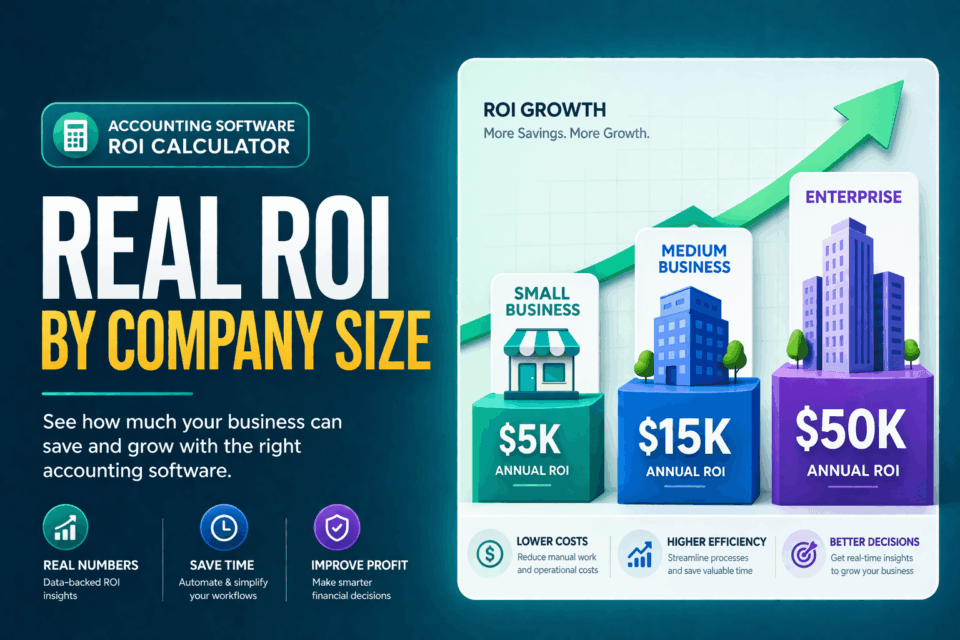
QuickBooks Advanced at 25 employees: $6,228-$6,828/year fully loaded. Measurable savings from AP automation, close-time reduction, and bookkeeping elimination: $18,000-$32,000/year. That’s 165-415% ROI. This article shows every line item so you can run the same calculation for your team size.
Your vendor’s ROI calculator uses one variable: hours saved times hourly rate. That produces a number that looks good in a demo and falls apart in a board meeting.
This model uses four variables. It produces a different number. A defensible one. Every figure comes from published 2026 vendor pricing or named third-party research. No vendor-supplied estimates. No unnamed studies. (For the full breakdown of where hidden costs come from, see our companion guide.)
Four platforms. Three company sizes. One formula. Run it yourself.
The 4-Line ROI Formula
Forget the single-variable calculator. Here are the four numbers that survive a board presentation.
Line 1: Hours eliminated. Webgility’s research: 10-15 hours/month of manual bookkeeping eliminated. At $25-$35/hour bookkeeper rate, that’s $3,000-$6,300/year for a 5-person company. Scales with headcount.
Line 2: AP automation. NetSuite’s AP guide: 78% reduction in per-invoice processing cost. A 25-person company at 100 invoices/month: $1,200/month manual vs $264/month automated. Annual AP savings: $11,232.
Line 3: Error recovery avoided. One reconciliation error: 4-8 hours to find and fix at $65/hour controller time. Two per month: $6,240-$12,480/year. Cloud accounting with automated bank feeds cuts these by 60-80%.
Line 4: Total cost of ownership. Not the monthly subscription. Base + payroll + integrations + implementation amortized + annual price increases. The full breakdown by size is in the next section.
ROI = (Line 1 + Line 2 + Line 3 – Line 4) / Line 4 x 100
Hard Dollars vs. Soft Dollars
Hard: hours eliminated, invoices automated, headcount avoided. Soft: errors avoided, audit prep, peace of mind. A board discounts soft dollars by 50% or more. Build your case on hard dollars. Save soft dollars for the backup slide.
What “Total Cost” Actually Includes
Not the subscription. It includes payroll modules ($45-$195/month), integration middleware like Zapier ($49-$99/month), implementation ($2,000-$5,000 for QuickBooks, $10,000-$30,000 for Sage Intacct), and training. Full numbers below.
What You Actually Pay: 5, 25, and 100 Employees
Published 2026 pricing. Verified April 2026. Not the homepage number.
5 Employees: QuickBooks Plus vs Xero
QuickBooks Online Plus: $115/month base. Payroll Core for 5 employees: $45 + $30 = $75/month. ProAdvisor setup: $2,000-$5,000 amortized to $556-$1,389/year. Year 1 fully loaded: $3,836-$5,669.
Xero Standard: $50/month. Payroll: $40 + $30 = $70/month. Base annual: $1,440 before setup.
At 5 people the gap is $1,000-$2,000/year. The deciding factor isn’t price. It’s whether you need US payroll tax compliance built in.
25 Employees: QuickBooks Advanced vs Xero vs Sage Intacct
This is the tier where most readers sit. Here’s the math.
| Line Item | QuickBooks Advanced | Xero + Payroll |
|---|---|---|
| Base subscription (annual) | $3,300 ($275/mo) | $1,080 ($90/mo) |
| Payroll (25 employees, annual) | $2,340 ($195/mo) | $2,280 ($190/mo) |
| Integration middleware (annual) | $588-$1,188 | $588-$1,188 |
| Annual total before implementation | $6,228-$6,828 | $3,948-$4,548 |
| Setup (amortized yr 1) | $2,000-$5,000 | $1,000-$3,000 |
| Year 1 fully loaded | $8,228-$11,828 | $4,948-$7,548 |
Sage Intacct at 25 employees: Year 1 fully loaded runs $34,800-$64,800 ($4,800 base + $10,000-$30,000 implementation + module fees). That is not a $400/month decision. It is a $35,000-$65,000 Year 1 decision.
100 Employees: When NetSuite Enters
At 100 employees, QuickBooks shows consolidation strain. Companies at this stage spend 40+ hours/month on manual consolidation (Jumpstart Partners CPA, January 2026). At $65/hour: $31,200/year in labor. NetSuite implementation: $25,000-$75,000 in professional services. By this size, the ROI question isn’t just about the GL, it’s about the full finance tech stack including FP&A, AP automation, and expense management layered on top.
| Company Size | Software | Year 1 Fully Loaded |
|---|---|---|
| 5 employees | QuickBooks Plus + Payroll | $3,836-$5,669 |
| 5 employees | Xero + Payroll | $1,440-$3,440 |
| 25 employees | QuickBooks Advanced + Payroll + Zapier | $6,228-$6,828 |
| 25 employees | Xero + Payroll + Zapier | $3,948-$4,548 |
| 25 employees | Sage Intacct | $34,800-$64,800 |
| 100 employees | NetSuite | $50,000-$100,000+ |
2026 published pricing. Implementation figures from partner estimates. Verify at vendor pricing pages before committing.
Three Costs That Kill Your ROI Model
Module Creep
QuickBooks charges separately for payroll, receipt capture, bill pay, and time tracking. Each is a separate SKU. A 25-person company that adds three add-ons in the first six months discovers $220/month in charges that weren’t in the original budget. Custom API integrations: $5,000-$25,000 in developer time.
Seat Expansion
QuickBooks Advanced caps at 25 users. Exceed it and pricing goes to a negotiated enterprise tier. Xero charges per-organization, not per-user at most tiers. Structural advantage for growing teams. Sage Intacct charges per-module AND per-user. Watch the overage clause.
Annual Price Increases
5-10% per year across 50+ contracts reviewed. Typically uncapped. $275/month becomes $366/month in three years at 10%. That’s $1,092/year on one line item. Run your 3-year model with 8% escalation, not flat pricing. The ROI difference over 3 years: $5,500-$11,000 for a 25-person company. Negotiate a cap or a 12-month lock.
Where the Savings Actually Come From
Not from a cheaper subscription. From labor hours eliminated and errors avoided.
AP Automation: $11,232/year
100 invoices/month. $12/invoice manual cost. 78% reduction automated. $1,200/month drops to $264/month. Annual savings: $11,232. This single line item often exceeds the entire software cost at the 25-person tier. If you’re evaluating AI accounting platforms, the AP gap between AI-native and traditional systems is where the ROI difference is most dramatic.
Month-End Close: $7,488-$12,480/year
Cloud migration typically cuts 2-3 days off close. Controller at $65/hour: 16 hours/month x 12 = 192 hours/year = $12,480. Discount 40% for conservatism: $7,488. Still moves the needle.
Bookkeeping Elimination: $3,000-$9,000/year
10-15 hours/month eliminated (Webgility). At $25-$35/hour: $3,000-$6,300 for a 5-person company. At owner opportunity cost ($50/hour): up to $9,000. For a company where the founder does the books, this is often the entire ROI justification. See our best accounting software guide for platform recommendations at this size.
The ROI Calculation: 25 Employees, 2026
For a 25-person US company switching from manual or legacy to properly configured QuickBooks Advanced or Xero: $18,000-$32,000/year in savings against $6,200-$6,800 annual software cost. First-year ROI: 165-415%.
The breakdown:
AP automation: $11,232/year.
Close-time reduction (40% discounted): $7,488/year.
Bookkeeping elimination: $3,000-$6,300/year.
Total savings: $21,720-$25,020.
Software cost: $6,200-$6,800.
Net gain: $14,920-$18,820. ROI: 219-304%.
This excludes error-recovery savings, audit prep, and consolidation gains. Conservative. Defensible. Run it with your own numbers.
When QuickBooks ROI Turns Negative
Four signals.
1. Close exceeds 7 business days. Your controller is spending more time on mechanics than analysis.
2. Two or more legal entities. QuickBooks handles multi-entity manually. Sage Intacct and NetSuite handle it natively. Labor difference: 5-10 hours/month at $65/hour.
3. Auditor flagged the same gap twice. Repeated findings signal a system limitation, not a process failure.
4. Controller spends 20%+ of time on consolidation. At a $95,000 salary, that’s $19,000/year on work an automated system eliminates in month one.
Companies at this stage spend 40+ hours/month on manual consolidation (Jumpstart Partners CPA, January 2026). At $65/hour: $31,200/year. Sage Intacct upgrade: $34,800-$64,800 Year 1. ROI: 89%. Break-even: 13 months.
According to G2’s 2026 Accounting Software Report, wrong-fit accounting software costs SMBs $8,000-$35,000 annually. The ROI of keeping the wrong system is almost always negative.
E-commerce sellers calculate ROI differently because marketplace fees, FBA reimbursements, and multi-state sales tax create cost categories generic SMB tools miss. Our ROI math for e-commerce accounting stacks walks through the numbers by revenue tier from $250K to $5M. Construction contractors calculate ROI differently still: change-order capture improvements average 8-12% after switching to construction-specific accounting (Software Advice case studies), which at $4M revenue means $35,000-$80,000 annually that QuickBooks-plus-Excel misses. Our construction accounting ROI breakdown covers the contractor-specific cost-benefit math at $1M, $4M, and $15M revenue tiers.
Frequently Asked Questions
How do you calculate ROI on accounting software?
Four inputs: (1) staff hours eliminated x rate, (2) AP automation savings (invoices x 78% cost reduction), (3) error-recovery avoided (reconciliation hours x controller rate), (4) total annual cost including payroll, integrations, and implementation. For 25 employees: $18,000-$32,000 savings against $6,200-$6,800 cost.
Is accounting software worth it for a small business?
At 5+ employees, yes. Webgility: 10-15 hours/month of bookkeeping eliminated. At $25-$35/hour: $3,000-$6,300/year against a QuickBooks Plus annual cost of $3,836-$5,669. Modest Year 1 ROI. Strengthens in Years 2-3 as setup costs amortize.
How much does accounting software save per year?
At 25 employees with proper AP automation: $18,000-$32,000/year combined. G2’s 2026 report puts wrong-fit software cost at $8,000-$35,000/year in workarounds. The gap between right and wrong tool: $26,000-$67,000/year.
What is the true cost of QuickBooks for 25 employees?
QuickBooks Advanced $275/month ($3,300/year). Payroll Core $195/month ($2,340/year). Zapier $49-$99/month ($588-$1,188/year). Total recurring: $6,228-$6,828/year. ProAdvisor setup: $2,000-$5,000. Year 1: $8,228-$11,828.
When should you upgrade from QuickBooks to Sage Intacct or NetSuite?
Four triggers: close exceeds 7 days, 2+ legal entities, auditor flagged the same gap twice, controller spends 20%+ on consolidation. At 40+ hours/month of manual consolidation ($31,200/year labor), Sage Intacct produces 89% Year 1 ROI with 13-month break-even.
The formula is at the top. The cost tables are above. Run it for your headcount, your invoice volume, and your controller rate. The number will either justify the investment or tell you to wait. Either answer saves you money.
Explore the full directory of accounting software tools on SaaSrat based on real user discussions.