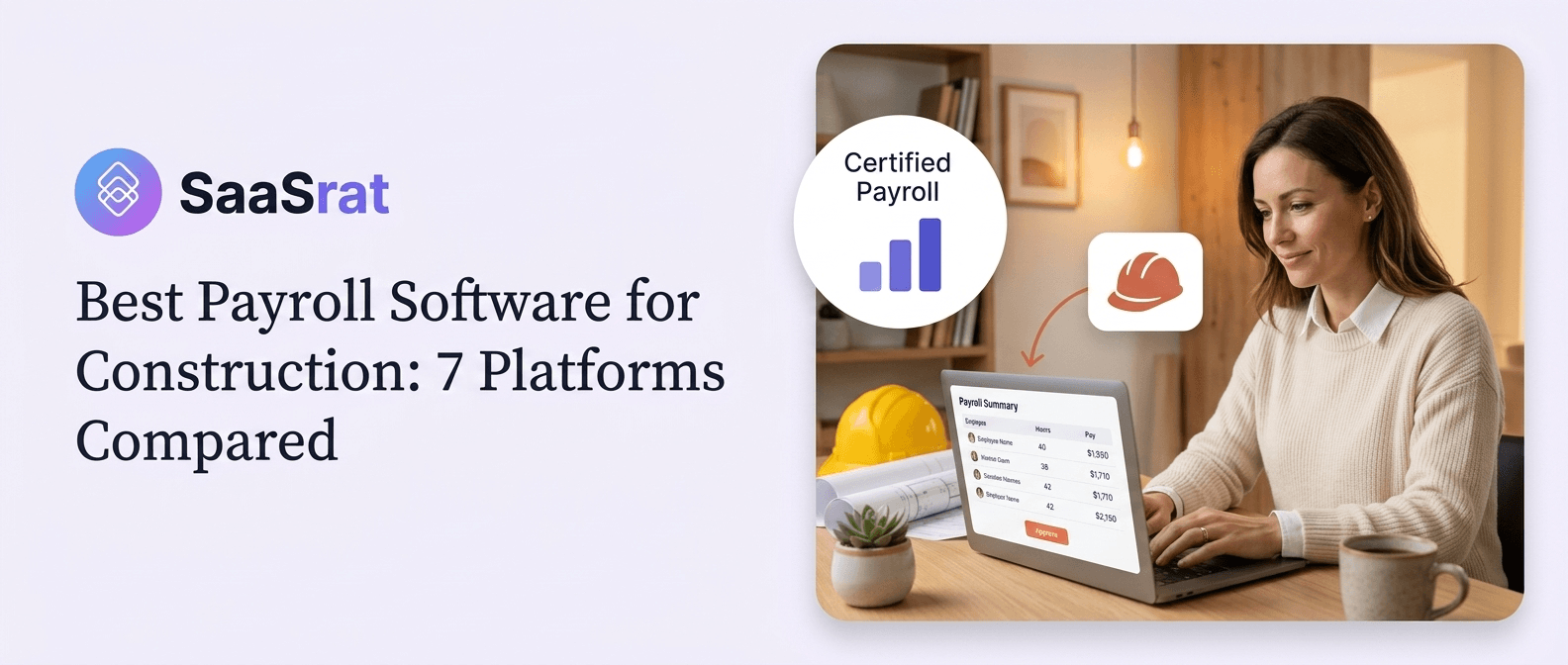
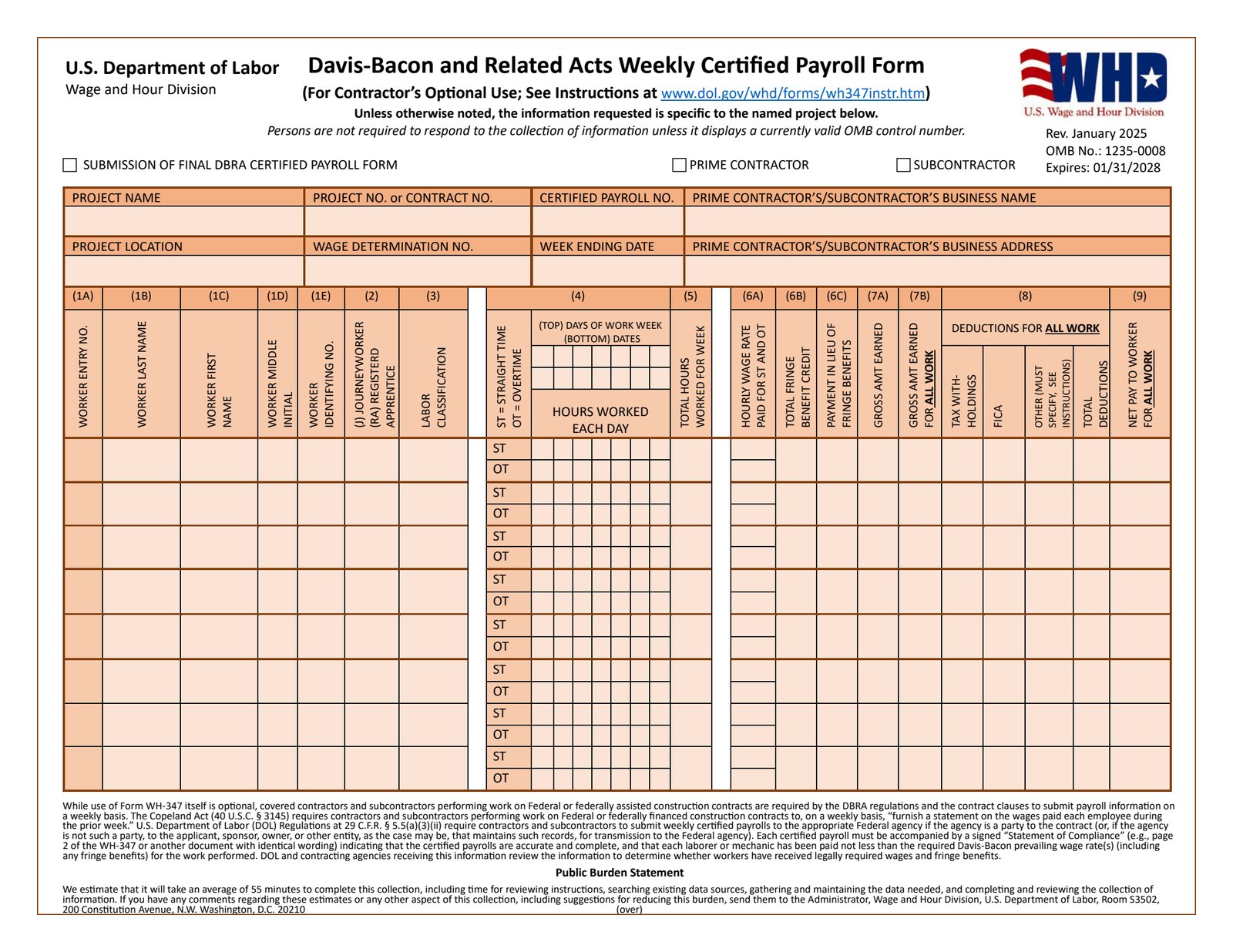
A $4M general contractor running 28 W-2 employees on a prevailing-wage school district project files WH-347 certified payroll reports manually every week and spends 18 to 22 hours per month on certified payroll alone using QuickBooks Payroll. The same contractor on Foundation Software or Sage 100 Contractor with Sage Payroll cuts that to 4 to 6 hours per month, with WH-347 reports generated audit-trail-ready on first run. Civil penalties for missed WH-347 filings now run $13,508 per violation under the January 2025 DOL enforcement schedule, so the labor-savings argument is only the start. The compliance-risk argument is the bigger one.
I have spent twelve years reviewing payroll software, most of it across hospitality, healthcare, and professional-services. Construction is where I have spent the most time in the last eighteen months. The buyer questions are different here. A restaurant operator wants to know which payroll handles tip credits without breaking; a construction operator wants to know which one will not get her audited. The DOL Wage and Hour Division opened more construction payroll investigations in FY2025 than any other industry vertical, and the contractors I have advised through that process all share one observation in common: they bought QuickBooks Payroll five years ago thinking it would scale, and it did not.
This guide gives you the side-by-side cost breakdown no other 2026 construction payroll comparison currently provides. Real monthly cost at three contractor sizes ($1M residential remodeler, $4M general contractor, $15M mid-market builder), the multi-state prevailing wage map that determines which platform will actually meet your state’s compliance requirements, and the payroll-to-accounting integration map that controls whether your books and pay records will ever reconcile cleanly. Pricing is aggregated from vendor pricing pages where published and third-party SaaS pricing aggregators (Vendr, G2, Software Advice, Capterra) verified in April 2026.
Key takeaways (60-second version)
- Residential remodeler under $1M revenue: Gusto Plus at $80/month base plus $12/employee/month. Total approximately $200 to $260/month for a 10 to 15-employee crew. Skip construction-specific payroll at this size unless you bid prevailing-wage work.
- $1M to $5M general contractor, low prevailing-wage exposure: Sage 100 Contractor with Sage Payroll, quote-based, typically $400 to $700/month for 15 to 30 employees. Integrated with the same Sage accounting platform most mid-market GCs already run.
- $1M to $15M contractor with significant Davis-Bacon work: Foundation Software (Foundation Payroll module), quote-based, typically $700 to $2,500/month. Certified payroll automation pays back the premium inside the first prevailing-wage project.
- Modern cloud-first contractor with mobile field crews: Miter Payroll, quote-based, typically $30 to $50 per active worker per month. Best-in-category mobile time entry and field-team adoption.
- $5M+ contractor wanting full HCM with construction features: Paycor with construction package, $19 to $27 PEPM (per employee per month) for the base platform plus add-ons. Strong for mid-market GCs that need ATS, performance management, and benefits alongside payroll.
- QuickBooks contractor who refuses to switch GLs: LCPtracker Pro or eBacon as a certified payroll add-on, quote-based, typically $200 to $600/month. Sits alongside QuickBooks Payroll to produce WH-347 reports.
- $5M+ contractor needing scale + compliance certainty: ADP Workforce Now, $23 to $30 PEPM. Best multi-state tax handling and audit-trail completeness in the category.
What 7 Payroll Platforms Actually Cost a Construction Contractor in 2026
The table below shows what each platform actually costs at three realistic US contractor revenue tiers: $1M (small residential remodeler or sub-contractor with 8 to 12 employees), $4M (established general contractor with 20 to 35 employees), and $15M (mid-market builder running 60 to 120 employees with multi-state work). Pricing reflects April 2026 vendor pages and third-party aggregator data.
| Platform | $1M contractor | $4M contractor | $15M contractor | Best for |
|---|---|---|---|---|
| Gusto Plus | $200/mo | $380/mo | Outgrown | Small residential remodelers, low Davis-Bacon |
| Sage 100 Contractor + Sage Payroll | Overkill | $500-$700/mo | $1,000-$1,500/mo | Mid-market GCs on the Sage 100 stack |
| Foundation Payroll | Overkill | $700-$1,200/mo | $1,500-$2,500/mo | Davis-Bacon / certified-payroll-heavy operators |
| Miter Payroll | $280-$420/mo | $700-$1,200/mo | $1,800-$3,500/mo | Cloud-first contractors, mobile field crews |
| Paycor (construction package) | Overkill | $700-$1,100/mo | $2,500-$4,000/mo | $5M+ GCs wanting full HCM |
| LCPtracker Pro (add-on) | Overkill | $300-$500/mo | $600-$1,200/mo | QuickBooks holdouts needing WH-347 |
| ADP Workforce Now | Overkill | $900-$1,300/mo | $2,500-$4,500/mo | $5M+ contractors needing scale + compliance |
2026 monthly cost estimates by US construction contractor revenue, aggregated from vendor pricing pages and third-party SaaS pricing aggregators through Q1 2026.
The numbers above assume you actually need construction-grade payroll capabilities. If you are a single-truck residential operator under $500K in revenue with no prevailing-wage exposure, you do not need any of these. Gusto Simple at $49/month plus $6/employee handles the basic W-2 payroll workflow at one-third the cost of this comparison. Our broader payroll software comparison across 7 platforms covers the general-purpose options that work at this size, and the parallel restaurant payroll comparison walks through a vertical with similar multi-state and tipped-wage complexity.
Feature Comparison Matrix: What Each Platform Actually Delivers for Contractors
Construction payroll has eight demands that generic payroll software either handles natively, handles with a paid add-on, or fails on entirely: WH-347 certified payroll, state-specific prevailing wage compliance, multi-state crew tax handling, union dues and fringe benefit allocation, apprenticeship ratio tracking, job-cost integration, mobile field-team time entry, and audit-trail completeness for DOL reviews. The matrix below tracks where each platform actually delivers.
| Capability | Gusto Plus | Sage Payroll | Foundation Payroll | Miter | Paycor | LCPtracker | ADP WFN |
|---|---|---|---|---|---|---|---|
| WH-347 certified payroll reports | No | Native | Native (best) | Native | Add-on | Native (specialist) | CPM add-on |
| State prevailing wage automation | No | Native | Native | Native | Add-on | Native | Add-on |
| Multi-state crew tax handling | Limited | Native | Native | Native | Native | N/A (add-on layer) | Native (best) |
| Union dues and fringe benefit allocation | No | Native | Native (best) | Native | Native | Native | Native |
| Apprenticeship ratio tracking | No | Native | Native | Native | Limited | Native | CPM add-on |
| Job-cost integration (GL) | QBO sync | Native (Sage 100) | Native (Foundation GL) | QBO and Sage sync | Custom build | Pushes to QBO, Sage | Custom build |
| Mobile field time entry | Gusto Wallet app | Sage Field Operations | Foundation Mobile | Native (best) | Paycor Mobile | Web only | ADP Mobile |
| DOL audit-trail completeness | Standard | Strong | Strong (best) | Strong | Standard | Strong | Strong |
Capability coverage across 7 US construction payroll platforms, April 2026.
Three outlier capabilities matter most. WH-347 reporting is non-negotiable for any contractor bidding federal Davis-Bacon work, and the platforms that produce it natively (Foundation, Sage Payroll, LCPtracker, Miter) save 12 to 18 hours per month per active prevailing-wage project versus manual WH-347 preparation. Industry-published Davis-Bacon employer guidance covers the full reporting workflow including the January 2025 WH-347 form revision. Union dues and fringe benefit allocation is the second outlier, critical for any unionized job in California, New York, Illinois, or any state with strong building trades councils. Mobile field time entry is the third, and it is increasingly where modern cloud platforms (Miter) beat the older incumbents (Sage Payroll, Foundation Payroll) on day-to-day adoption.
Construction Accounting Integration Map: Which Payroll Connects to Which GL
The single biggest workflow problem in construction payroll is keeping pay records in sync with job-cost reporting in the general ledger. Contractors that handle this manually lose 4 to 8 hours per pay period to reconciliation. The matrix below shows which payroll platforms integrate natively with which construction accounting systems.
| Accounting GL | Gusto | Sage Payroll | Foundation Payroll | Miter | Paycor | ADP WFN |
|---|---|---|---|---|---|---|
| Sage 100 Contractor | Limited (CSV import) | Native (unified) | Custom bridge | Native sync | Custom build | Custom build |
| Foundation Software GL | Custom build | Limited | Native (unified) | Limited | Limited | Limited |
| QuickBooks Online + Knowify | Native | Limited | Custom bridge | Native | Native | Native |
| Procore Financials | Limited | Procore-Sage Connector | Procore-Foundation Connector | Native | Custom build | Procore Connector |
| Sage Intacct Construction | Custom build | Sage HRMS bridge | Custom bridge | Native | Custom build | Native (Sage Intacct Cloud Payroll) |
| Jonas Construction | Limited | Limited | Limited | Custom build | Custom build | Custom build |
Construction payroll-to-accounting integration map, April 2026.
The native-unified options (Sage Payroll inside Sage 100 Contractor, Foundation Payroll inside the Foundation GL) win on day-to-day workflow because pay data and job-cost data share a single data layer. The native-sync options (Miter to QBO and Sage, Paycor to QBO, ADP to multiple GLs) require an integration but produce clean journal entries with proper cost coding. The custom-build options require either a CSV import workflow or a third-party connector (Workato, Boomi) and add 2 to 6 hours per pay period of reconciliation overhead. For contractors evaluating the accounting side specifically, our construction accounting software comparison covers the 7 GL platforms in detail.
How I Picked These 7 Platforms
This guide is built on three filters. First, the platform must serve US construction contractors as a primary segment, with native or first-party support for WH-347 certified payroll or a documented certified-payroll add-on path. That eliminated generic payroll platforms with no construction adaptation (Square Payroll, OnPay) and international-only platforms (Deel for US-only use cases).
Second, pricing had to be either publicly disclosed on vendor pages or consistently reported across multiple third-party SaaS pricing aggregators (Vendr, G2, Software Advice, Capterra). Gusto and Paycor publish public PEPM pricing. The other five (Sage Payroll, Foundation Payroll, Miter, LCPtracker, ADP Workforce Now) are quote-based, and the ranges shown reflect aggregated industry reporting through Q1 2026, not vendor marketing pages.
Third, the platform must serve a recognizable construction contractor buyer profile. Each of the 7 maps to a specific operator cluster: small residential remodeler (Gusto), mid-market GC integrated with Sage accounting (Sage Payroll), Davis-Bacon-heavy operator (Foundation), modern cloud-first contractor (Miter), $5M+ GC wanting full HCM (Paycor), QuickBooks holdout needing certified payroll only (LCPtracker), and $5M+ contractor wanting scale and compliance certainty (ADP Workforce Now). I cut platforms that overlapped meaningfully with one of these. Payroll4Construction overlaps with Foundation at the Davis-Bacon end. Rippling Payroll overlaps with Miter at the modern-cloud end. Sage HRMS overlaps with Sage Payroll for existing Sage 100 Contractor users.
Industry Data on US Construction Payroll in 2026
Three industry data points shape the recommendations in this guide. First, the US construction industry counted approximately 3.7 million total businesses with 814,557 having employees as of the most recent 2023 County Business Patterns release per US Census Bureau 2022 Economic Census construction sector data, with the majority operating as small specialty trade contractors and residential remodelers. Payroll software buyer activity concentrates in the $1M to $25M revenue band, where firms are large enough to need W-2 payroll for crews but small enough that the buying decision rests with the owner or a fractional controller.
Second, the Davis-Bacon Act and state prevailing-wage laws cover roughly $300 billion in annual US construction spend. Contractors bidding federally funded work or state public-works projects in California, New York, Illinois, New Jersey, Massachusetts, and 27 other prevailing-wage states must produce WH-347 certified payroll reports weekly during active project work, with the January 2025 form revision adding enhanced fringe-benefit tracking and apprenticeship documentation. Civil penalties for non-compliance run $13,508 per violation under the updated DOL Wage and Hour Division enforcement schedule, with FY2025 DOL backwage recovery totaling $259 million for 177,000 workers per Points North enforcement data.
Third, multi-state crew complexity is the single largest payroll administrative burden for contractors above $5M revenue. Commercial GCs routinely run crews across 2 to 6 state lines within a typical month, triggering multi-state tax withholding, unemployment insurance, and workers compensation class code variations that generic payroll platforms either fail at or charge premium add-on fees to handle. Foundation Payroll, ADP Workforce Now, and Sage Payroll all handle multi-state natively. Gusto’s multi-state support degrades past 3 states. Our multistate payroll software guide covers the non-construction-specific multi-state landscape in detail.
Foundation Software / Foundation Payroll: Default for Davis-Bacon-Heavy Operators
Most of the construction CPAs I have talked to recommend the same platform when their client gets a DOL audit notice: Foundation Software. There is a reason. Foundation built its company on certified payroll specifically, and Foundation Payroll integrates inside the Foundation construction accounting platform as a unified data layer rather than a sync. WH-347 reporting, state prevailing-wage automation, fringe benefit allocation across multi-employer plans, union dues calculation, and apprenticeship ratio tracking all work as native first-class workflows.
For contractors bidding federal Davis-Bacon work or significant state prevailing-wage projects, Foundation Payroll requires the least manual cleanup at audit time of any platform in this comparison. That is the honest reason most CPAs default to it.
Pricing is quote-based and runs approximately $700 to $1,200/month for a $4M contractor with 20 to 35 employees and 30%+ prevailing-wage revenue, scaling to $1,500 to $2,500/month at $15M with 60 to 120 employees. The pricing is bundled with the Foundation construction accounting GL, so the realistic comparison is Foundation Payroll plus the GL versus Sage Payroll plus Sage 100 Contractor versus any custom multi-platform stack.
Where Foundation Payroll wins: WH-347 reporting accuracy and audit-trail completeness. The platform was designed by former construction payroll auditors and the output meets DOL Wage and Hour Division standards on first review. Where it loses: the UI. I am going to be direct about this because I have watched too many bookkeepers complain about it. Foundation’s interface feels stuck in 2015. The functional capability is best-in-category and the platform earns its price, but the daily user experience is the worst in this comparison. Implementation also runs long (10 to 16 weeks, $8,000 to $30,000 setup cost), and field crews adopt Foundation Mobile but the experience trails Miter’s mobile app on day-to-day usability. If UI matters to you more than audit-trail depth, Miter is the better answer.
Sage 100 Contractor + Sage Payroll: Integrated Mid-Market Default
Sage Payroll integrated with Sage 100 Contractor is the default mid-market construction payroll setup in the US. For contractors already running Sage 100 Contractor as their GL (which our construction accounting comparison identifies as the most widely deployed mid-market construction GL), Sage Payroll is the path of least resistance.
Pricing for Sage Payroll alongside Sage 100 Contractor runs approximately $500 to $700/month for a $4M contractor with 20 to 35 employees, scaling to $1,000 to $1,500/month at $15M with 60 to 120 employees. Sage Payroll handles WH-347 reporting, state prevailing-wage automation, union dues, fringe benefit allocation, and multi-state tax compliance as native first-party features. The integration with Sage 100 Contractor’s job-cost module is unified rather than synced, so payroll hours post directly into job costs by phase and cost code without manual journal entries.
Where this stack wins: integration depth with Sage 100 Contractor and broad CPA familiarity (every mid-market construction CPA knows Sage). Where it loses: the user interface is dated, mobile time entry is acceptable but trails Miter and modern cloud platforms, and Sage’s roadmap has shifted toward Sage 300 Construction and Sage Intacct Construction for new mid-market deployments. For contractors building on the Sage stack today, Sage Payroll is still the right answer; for net-new GL decisions, evaluate Foundation and Miter alongside.
Miter Payroll: Best Modern Cloud Construction Payroll
If you had asked me in 2022 which modern cloud platform would break into construction payroll, I would not have predicted Miter. The category was locked up by Foundation and Sage, and the last serious challenger had been Procore Pay (which still has not fully delivered). But Miter Payroll has done something none of the incumbents managed: built a mobile field time entry experience that crews actually use without training friction. The platform handles certified payroll, prevailing wage, multi-state, union dues, fringe benefits, and apprenticeship tracking natively, with a UI that looks like 2026 rather than 2018.
Pricing is quote-based and typically runs $30 to $50 per active worker per month, structured to scale with active payroll headcount rather than total employees on the books (which can save 15 to 25% versus traditional PEPM pricing for contractors with seasonal workforces). For a $4M contractor with 20 to 35 active employees during peak season, expect $700 to $1,200/month. For $15M with 60 to 120 employees, expect $1,800 to $3,500/month.
Where Miter wins: mobile experience and integration with modern construction PM tools (Procore, Buildertrend, JobTread). The platform supports daily payroll runs, real-time prevailing-wage rate updates by job, and field-team self-service that Foundation and Sage trail on. Where it loses: implementation history is shorter (Miter is newer than the entrenched incumbents), and very large contractors above $25M may find capabilities gaps that ADP Workforce Now or Foundation handle more completely. For most $2M to $25M cloud-first construction operators, Miter is the strongest modern alternative to the legacy stack.
Paycor: Best for Mid-Market GCs Wanting Full HCM
Paycor is the strongest option when the buying decision goes beyond pure payroll into full HCM (recruiting, onboarding, performance management, benefits administration). The platform handles certified payroll, prevailing wage, union dues, and multi-state tax natively, with the broader HCM stack that mid-market construction firms increasingly need to compete for skilled trades labor.
Pricing runs $19 to $27 PEPM for the base platform, scaling with the modules you bundle. For a $4M contractor with 25 employees, expect $700 to $1,100/month for the construction-relevant configuration (payroll plus HR plus benefits). For $15M with 100 employees, expect $2,500 to $4,000/month. Paychex completed its acquisition of Paycor in April 2025, creating one of the largest combined HCM platforms in the US mid-market.
Where Paycor wins: HCM breadth and modern recruiting tools that matter for contractors competing against bigger payers for skilled trades labor. Where it loses: certified payroll capability is solid but the construction-specific depth still trails Foundation, Sage Payroll, and Miter. For pure construction payroll without HCM needs, those three are stronger choices.
LCPtracker Pro / eBacon: Best Certified Payroll Add-On for QuickBooks Users
The most common contractor I see using LCPtracker is the one who is one DOL audit away from switching off QuickBooks entirely, and is using LCPtracker as a stopgap. The math is real: a $4M contractor running QuickBooks Payroll plus LCPtracker pays roughly the same monthly cost as running Sage 100 Contractor with Sage Payroll, but produces less audit-trail completeness and runs two systems instead of one.
That said, LCPtracker Pro does its specific job well. It is a certified payroll specialist that sits alongside whatever payroll system the contractor already runs and produces WH-347 reports, state-specific certified payroll forms, and DOL-compliant audit trails. For contractors who genuinely cannot leave QuickBooks for the underlying payroll workflow but need certified payroll output today, LCPtracker is the standard answer.
Pricing is quote-based and typically runs $300 to $500/month for a $4M contractor with one to three active prevailing-wage projects, scaling to $600 to $1,200/month at $15M with five to ten active projects. eBacon is the most common alternative in this category, with comparable pricing and similar specialist positioning. Both handle the WH-347 production layer and push compliance data into the contractor’s existing accounting GL.
Where LCPtracker wins: specialist depth on certified payroll. The platform exists for one purpose and handles edge cases (multi-rate workers, apprentice ratios, fringe benefit calculations across multiple plans) that generic payroll platforms struggle with. Where it loses: it does not replace the underlying payroll platform. The contractor still pays for QuickBooks Payroll or ADP RUN separately and runs two systems. For contractors above $5M revenue, switching to Foundation or Sage Payroll typically costs less in total than running QuickBooks Payroll plus LCPtracker.
Gusto: Best for Small Residential Contractors Under $1M
Gusto is the right answer for small residential contractors, specialty trades, and single-truck operators under $1M revenue with no Davis-Bacon exposure. Gusto Plus runs $80/month base plus $12/employee/month, putting total cost at $200 to $260/month for a 10 to 15-employee residential remodeling crew. Gusto Simple at $49/month plus $6/employee handles even smaller operations.
The platform handles W-2 payroll, contractor 1099 payments, multi-state tax (acceptable up to 3 states, degrades past that), benefits administration, and time tracking. Gusto does not produce WH-347 certified payroll reports. Contractors who bid any prevailing-wage work need to pair Gusto with LCPtracker (at the cost of running two systems) or move to a construction-specific payroll platform.
Where Gusto wins: low cost, excellent UX, easy implementation (typically 2 to 4 weeks). Owner-operators run Gusto themselves without a bookkeeper. Where it loses: construction-specific capabilities. No WH-347, weak union dues handling, multi-state breaks past 3 states, no apprenticeship ratio tracking. Above $1M revenue or with any prevailing-wage exposure, contractors outgrow Gusto fast.
ADP Workforce Now: Best for $5M+ Contractors Needing Scale + Compliance
ADP Workforce Now is the right answer for $5M+ contractors who prioritize compliance certainty and scale over construction-specific UX. The platform runs $23 to $30 PEPM for the base configuration, with the ADP Certified Payroll Module (CPM) add-on producing WH-347 reports and state prevailing-wage forms. For a $4M contractor expect $900 to $1,300/month all-in. For $15M with 80 to 120 employees expect $2,500 to $4,500/month.
Where ADP wins: multi-state tax compliance is genuinely best in class. With over 1 million employers on ADP payroll products, the platform has seen every multi-state edge case and the audit-trail posture is the strongest in this comparison. For contractors with crews across 5+ states or any history of DOL audit exposure, ADP is the safest choice. Where it loses: construction-specific capability requires the CPM add-on and the integration with Sage 100 Contractor or Foundation GLs requires custom build. ADP is the right answer when compliance is your top priority and you have an internal CFO or controller comfortable running a more complex stack. For pure construction operators, Foundation or Sage Payroll typically deliver more day-to-day value at lower cost.
What Construction Payroll Has to Do That Generic Payroll Doesn’t
Eight things a construction payroll setup has to handle that generic payroll tools do not address out of the box. If your stack misses any of them you will rebuild them in spreadsheets, and the spreadsheet labor will cost more annually than the upgrade to a construction-aware platform.
WH-347 certified payroll reports: weekly reports required for federal Davis-Bacon contracts and state prevailing-wage equivalents. Reports must include hours by classification, wage rates, fringe benefit allocations, and apprentice ratios. Civil penalties run $13,508 per violation under the updated January 2025 DOL enforcement schedule.
State prevailing wage automation: 32 states have prevailing-wage laws beyond Davis-Bacon, including California (DAS 140 reports), New York (A1-131), Illinois (Illinois Department of Labor reports), New Jersey, Massachusetts, Washington, Oregon, and 25 others. Rates vary by county and trade and are published quarterly by each state DOL.
Multi-state crew tax handling: commercial construction crews routinely cross state lines on jobs within 200 miles of borders. Multi-state payroll handles tax withholding, unemployment insurance per state, and workers compensation class code variations across jurisdictions.
Union dues and fringe benefit allocation: unionized construction jobs require dues deductions and fringe benefit contributions to multi-employer plans (health, pension, training funds). The accounting platform must allocate these correctly by union local and trade.
Apprenticeship ratio tracking: most prevailing-wage projects require minimum apprentice-to-journeyman ratios per trade. The payroll system must track apprenticeship classification, verify ratio compliance, and produce the apprenticeship reports state DOLs request during audits.
Job-cost integration with the GL: construction hours must post into the GL by job, phase, and cost code, not just as a generic payroll journal entry. Foundation Payroll inside Foundation, Sage Payroll inside Sage 100 Contractor, and Miter sync to QBO or Sage handle this natively. Generic payroll requires manual journal entry construction.
Mobile field time entry with GPS verification: modern construction sites need field crew self-service time entry, ideally with GPS verification, photo logging, and same-day approval workflows. Miter leads here, followed by Sage Field Operations and Foundation Mobile.
OCIP/CCIP payroll reporting: Owner-Controlled and Contractor-Controlled Insurance Program projects (large commercial, public works, hospital construction) require specialized payroll reporting to the OCIP/CCIP administrator. Construction-specific payroll platforms handle this natively; generic platforms do not.
Multi-State Prevailing Wage Map: Where Construction-Specific Compliance Is Required
The 32 US states with prevailing-wage laws beyond federal Davis-Bacon create state-by-state compliance complexity that generic payroll cannot handle. Contractors bidding state-funded public-works projects in any of these states need construction-aware payroll with state-specific report support.
Strongest enforcement states (frequent audits, large penalties): California (DAS 140 reports, very active enforcement), New York (Article 8 enforcement), Illinois (active state DOL audits), New Jersey, Washington, Massachusetts, Oregon. Contractors operating in these states need certified payroll automation, not optional.
Moderate enforcement states: Pennsylvania, Connecticut, Maine, Michigan, Minnesota, Maryland, Hawaii, Alaska, Nevada, Wisconsin, Wyoming, Rhode Island, Tennessee, Texas (for state-funded work), Ohio, Missouri, Kentucky, Vermont, Delaware, Indiana, West Virginia, Arkansas. Compliance is required but enforcement varies by year and project type.
States that repealed or never adopted prevailing-wage laws (federal Davis-Bacon still applies on federal projects): Alabama, Arizona, Florida, Georgia, Idaho, Iowa, Kansas, Louisiana, Mississippi, Montana, Nebraska, New Hampshire, New Mexico, North Carolina, North Dakota, Oklahoma, South Carolina, South Dakota, Utah, Virginia.
For contractors operating across multiple prevailing-wage states, the right payroll platform is either Foundation (strongest state-by-state automation), Sage Payroll (broad state support inside the Sage 100 Contractor stack), or ADP Workforce Now with CPM (strongest multi-state audit-trail). Gusto and Paycor handle multi-state taxation cleanly but lack the certified payroll automation for full compliance.
Glossary: Construction Payroll Terms Every Contractor Should Know
Certified payroll (WH-347): weekly payroll report required for federal Davis-Bacon contracts. Documents hours by trade classification, prevailing wage rates, fringe benefit allocations, and apprentice ratios. Form updated January 2025.
Davis-Bacon Act: federal law requiring contractors on federally funded construction projects over $2,000 to pay prevailing wages established by the DOL. Penalty for non-compliance: $13,508 per violation under 2025 enforcement schedule.
Prevailing wage: state or federal minimum wage rates by trade classification on publicly funded construction. Rates vary by county and trade and are published quarterly.
Fringe benefits (Davis-Bacon): required employer contributions to health, pension, vacation, training, or apprenticeship funds. Can be paid in cash to workers or contributed to bona fide plans on their behalf.
Apprenticeship ratio: state and federal requirements for minimum journeyman-to-apprentice ratios per trade. Typically 1 apprentice per 3 to 5 journeymen depending on trade and state.
Union dues check-off: payroll deduction for union dues, typically processed weekly and remitted to the union local on a defined cadence.
OCIP / CCIP: Owner-Controlled and Contractor-Controlled Insurance Programs. Large project workers comp and general liability are wrapped under a single policy, requiring specialized payroll reporting to the OCIP/CCIP administrator.
Multi-state nexus: payroll tax obligation triggered by employee work hours in a state, regardless of where the contractor is based. Triggers state withholding, unemployment insurance, and workers comp registration in each state.
Workers comp class code: industry-specific classification (NCCI or state-specific) determining workers compensation premium rates. Construction has dozens of class codes by trade and risk level.
1099 vs W-2 classification: federal worker classification rules. Misclassification penalties in construction are aggressive, with multiple states (California AB-5, New York Construction Industry Fair Play Act) tightening enforcement.
Cost code (CSI): standardized job-cost classification typically following CSI MasterFormat divisions. Construction payroll posts hours to specific cost codes for job-cost reporting.
Total Cost of Ownership: 36-Month Comparison at $4M Contractor
The monthly subscription rate is rarely the real price. Implementation, integration, training, and the time cost of manual workarounds compound over three years. Below is the 36-month TCO for a $4M general contractor with 25 active employees and 35% of revenue from prevailing-wage work.
| Stack | Implementation | Year 1 software | Years 2-3 software | 36-month total | Hours saved vs manual |
|---|---|---|---|---|---|
| Gusto Plus (with manual WH-347) | $0 to $500 | $4,560 | $9,120 | $13,680 to $14,180 | Negative (manual WH-347 burden) |
| Sage 100 Contractor + Sage Payroll | $5,000 to $15,000 | $6,000 to $8,400 | $12,000 to $16,800 | $23,000 to $40,200 | ~14-18 hrs/mo recovered |
| Foundation Payroll (with Foundation GL) | $8,000 to $25,000 | $8,400 to $14,400 | $16,800 to $28,800 | $33,200 to $68,200 | ~18-22 hrs/mo recovered |
| Miter Payroll | $0 to $5,000 | $8,400 to $14,400 | $16,800 to $28,800 | $25,200 to $48,200 | ~16-20 hrs/mo recovered |
| QuickBooks Payroll + LCPtracker | $0 to $3,000 | $3,600 (QBO Payroll) + $4,800 (LCP) | $16,800 | $25,200 to $28,200 | ~10-14 hrs/mo recovered |
| ADP Workforce Now (with CPM) | $5,000 to $15,000 | $10,800 to $15,600 | $21,600 to $31,200 | $37,400 to $61,800 | ~16-20 hrs/mo recovered |
36-month TCO for a $4M construction contractor with 25 employees and 35% prevailing-wage revenue, April 2026.
Three observations from the math. First, Gusto looks cheapest on subscription but produces no certified payroll, so prevailing-wage contractors pay the saved subscription in spreadsheet labor (16 to 22 hours per month of WH-347 prep). Second, Foundation Payroll at $33,000 to $68,000 over 36 months replaces 18 to 22 hours per month of manual prevailing-wage labor worth $32,400 to $39,600 over the same period at $50/hour fully loaded labor cost. Third, the QuickBooks + LCPtracker stack at $25,000 to $28,000 looks competitive but requires running two systems and produces less audit-trail completeness than the unified options. For deeper TCO context, our payroll outsourcing cost analysis covers the build-versus-buy alternatives at the same revenue tiers.
Construction Payroll Model: $4.2M General Contractor Walk-Through
A representative model for how the math plays out at $4.2M revenue. Consider a Midwest general contractor with 28 employees (18 field, 8 office, 2 leadership) running 5 concurrent commercial projects averaging $850K each, with 38% of revenue from prevailing-wage work for a county hospital expansion and a state school district remodel.
Pre-switch stack: QuickBooks Payroll, Excel-based WH-347 preparation by a bookkeeper who spends 14 hours per week on certified payroll alone during active prevailing-wage periods, plus a CPA reviewing quarterly at $2,200 per quarter and providing DOL audit-defense services. Total monthly payroll administration load: roughly 60 hours of bookkeeper time at $35/hour fully loaded plus $733/month in CPA fees plus $89/month QuickBooks Payroll subscription. Monthly equivalent cost: approximately $2,922 plus the audit-risk exposure from manual WH-347 preparation.
Post-switch stack (January 2025): Sage 100 Contractor with Sage Payroll at $600/month, Bluebeam Revu retained for plan markup, CPA review retained quarterly. New monthly cost: $600 (payroll) + $733 (CPA) + $1,400 (bookkeeper at reduced 40 hours per month) = $2,733/month, plus $12,000 one-time implementation amortized.
Twelve-month modeled outcome: certified payroll preparation time dropped from 60 to 16 hours per month, freeing the bookkeeper for 528 hours per year of higher-value work (AR collections, change order tracking, vendor invoice approvals). The CPA reduced quarterly review time by 6 hours per quarter (24 hours per year) because Sage Payroll’s audit trail produces report packages the CPA accepts without revisions. DOL exposure dropped to near zero because WH-347 reports are now produced automatically with full hour-by-classification documentation. Net annualized labor recovery: approximately $22,000 against an incremental annualized cost of approximately $7,500 in higher subscription and implementation, paying back inside the first 9 months.
Implementation: What the First 30 Days Actually Look Like
The implementation timeline for construction payroll platforms varies sharply by complexity. Below is a realistic 30-day plan for Sage Payroll inside Sage 100 Contractor at $4M revenue with 25 employees and prevailing-wage exposure.
Week 1: Discovery and configuration. Document your current chart of accounts, your active project list, your prevailing-wage trade classifications, your union locals (if any), your apprenticeship registrations, and your historical WH-347 reporting workflow. Plan for 30% of one project manager’s time and 50% of one bookkeeper’s time during the first two weeks.
Week 2: Data migration. Migrate historical employee records, year-to-date payroll history, tax filings, prevailing-wage rate tables, fringe benefit allocations, and union dues setup. Most projects fail in this phase by under-resourcing the customer-side project owner. The most error-prone area is fringe benefit plan configuration, which requires documentation from each union local and each bona fide benefit plan.
Week 3: Parallel running. Run the new payroll alongside QuickBooks Payroll (or whatever you are switching from) for one or two full pay cycles. Reconcile against your prior platform, validate certified payroll output against your historical WH-347 reports, and surface any discrepancies. Plan to dedicate 30 to 40 hours of bookkeeper time during parallel running.
Week 4: Go-live and adoption. The new platform is the system of record. Decommission the prior payroll, train field crews on mobile time entry, train office staff on payroll approval workflows, and run the first certified payroll cycle on the new system. Plan for 20 to 30 hours of staff time on adoption support in the first month post-go-live.
For Foundation Payroll the timeline runs 10 to 16 weeks because the implementation includes the full GL setup alongside payroll. For Miter Payroll the timeline runs 4 to 8 weeks (faster because Miter is cloud-native and integrates with existing GLs rather than replacing them). For ADP Workforce Now the timeline runs 10 to 14 weeks with significant configuration work on the CPM (Certified Payroll Module) add-on.
Three Things Construction Payroll Buyers Consistently Get Wrong
After advising on payroll buying decisions across hospitality, healthcare, and most recently construction, I have learned that the mistakes contractors make are remarkably consistent. They are also expensive. Three patterns show up across nearly every buyer I have talked to.
First, they underestimate how fast WH-347 obligations grow. A contractor wins one federally funded school district project, suddenly has weekly WH-347 filings, and their bookkeeper builds the first three in Excel because “we will move to real software once the project ends.” The project never ends. There is always another prevailing-wage bid. Eighteen months later the same contractor has filed 78 manually-prepared WH-347 reports, half with minor errors that will surface if the DOL ever audits, and the bookkeeper is burned out. The right answer is to upgrade payroll the same week you win your first prevailing-wage bid, not the year after.
Second, they treat fringe benefits as a payroll line rather than a compliance category. Davis-Bacon fringe benefits are not just numbers on a paystub. They are required employer contributions to bona fide plans (health, pension, vacation, apprenticeship, training) that must be tracked on a per-employee, per-job, per-week basis. The most common DOL finding in construction audits is fringe benefit misallocation across multi-employer plans, and it is the area where QuickBooks Payroll fails worst. If you have any union work or any multi-employer fringe benefit plan, you cannot run construction payroll on a generic platform.
Third, they pick payroll based on price without checking accounting integration. A $4M general contractor buys Foundation Payroll for its certified payroll capability, then realizes their accounting is still on QuickBooks Online with Knowify. The custom integration to push hours and labor cost into QBO requires a third-party connector that costs $200 to $400 per month and still produces 4 to 6 hours per pay period of reconciliation overhead. The integration check belongs at the front of the buying decision, not the back. Our construction accounting software comparison covers the GL side of this decision in detail.
For contractors above $15M revenue or 250+ employees, the right answer often pairs a construction-specific accounting platform with a broader mid-market payroll system. Our mid-market payroll software comparison covers Paylocity, ADP Workforce Now, UKG, and Rippling at 100-500 employee scale.
When NOT to Use Construction-Specific Payroll Software
Three buyer profiles should not use Foundation Payroll, Sage Payroll, Miter, or Paycor construction package, regardless of vendor pressure.
Single-truck residential operator under $500K revenue with no prevailing-wage exposure: the math does not work. The cheapest construction-specific payroll consumes 4 to 8% of revenue at this size. Gusto Simple at $49/month plus $6/employee handles the W-2 payroll workflow at one-third the cost.
Pure 1099 sub-contracting business (no W-2 employees): if your business model is 100% 1099 contractor payments and you have no W-2 employees, you do not need payroll software. Gusto Contractor-Only at $35/month plus $6/contractor handles the 1099 workflow. Move to W-2 payroll software only when you cross the W-2 employee threshold.
Contractors planning to sell within 12 months: switching payroll platforms in the year before a sale creates due-diligence noise and historical-data migration risk. The buyer will likely move the books to their own platform anyway. Stay on the current setup, clean up the data, and prepare clean payroll history for the sale.
For everything else, particularly contractors above $1M revenue with any prevailing-wage exposure or multi-state crew operations, the cost of NOT having construction-aware payroll compounds. Every month staying on Gusto or QuickBooks Payroll with manual WH-347 preparation costs 14 to 22 hours per month of bookkeeper time and exposes the contractor to $13,508 per violation in DOL penalties for late or incorrect filings. The invisible monthly cost typically exceeds the construction-payroll subscription within 2 months.
Frequently Asked Questions
What is the best payroll software for a small construction company in 2026?
For US residential remodelers and specialty trade contractors under $1M annual revenue with no prevailing-wage exposure, Gusto Plus at $80/month base plus $12/employee/month is the right answer. Above $1M revenue or with any Davis-Bacon work, Sage 100 Contractor with Sage Payroll (quote-based, $500 to $700/month for 20 to 35 employees) or Foundation Payroll becomes the better choice.
Does Gusto handle certified payroll for Davis-Bacon work?
No. Gusto does not produce WH-347 certified payroll reports natively. Contractors bidding federal Davis-Bacon or state prevailing-wage work need either Foundation Payroll, Sage Payroll inside Sage 100 Contractor, Miter Payroll, or LCPtracker as a certified payroll add-on running alongside Gusto. The cheapest viable certified-payroll-capable setup is Gusto plus LCPtracker at approximately $500 to $800/month combined.
How much does construction payroll software cost per month?
Verified April 2026 monthly pricing: Gusto Plus $80 base plus $12/employee, Paycor $19 to $27 PEPM, ADP Workforce Now $23 to $30 PEPM. Quote-based platforms typically: Sage Payroll $500 to $1,500/month, Foundation Payroll $700 to $2,500/month, Miter Payroll $30 to $50 per active worker per month, LCPtracker Pro $300 to $1,200/month. Implementation costs range from near zero (Gusto, Miter) to $30,000 (Foundation with full GL).
Does QuickBooks Payroll handle certified payroll?
No, not natively. QuickBooks Payroll does not produce WH-347 reports or state-specific certified payroll forms. Contractors using QuickBooks for the underlying GL need to pair QuickBooks Payroll with LCPtracker Pro or eBacon (approximately $300 to $1,200/month additional) to produce DOL-compliant certified payroll output. Alternatively, switching to Foundation Payroll or Sage Payroll inside Sage 100 Contractor replaces the QuickBooks Payroll layer entirely.
What is the best payroll software for residential remodelers?
For residential custom homebuilders and remodelers under $1M revenue with no prevailing-wage exposure, Gusto Plus at $80/month plus $12/employee is the simplest answer. Above $1M revenue, evaluate Sage 100 Contractor with Sage Payroll for an integrated stack, or Miter Payroll for a modern cloud-first alternative. Buildertrend users typically pair Buildertrend with QuickBooks Payroll for the underlying payroll layer.
How long does construction payroll implementation actually take?
Realistic April 2026 timelines: Gusto 2 to 4 weeks, Miter Payroll 4 to 8 weeks, Sage Payroll inside Sage 100 Contractor 6 to 10 weeks, Paycor 8 to 12 weeks, Foundation Payroll 10 to 16 weeks, ADP Workforce Now 10 to 14 weeks, LCPtracker Pro 3 to 6 weeks as an add-on alongside existing payroll. Vendor-quoted timelines are typically 20 to 40 percent shorter than actual go-live experience.
What about Payroll4Construction and KORE1?
Both are credible construction payroll specialists that overlap with the 7 in this guide. Payroll4Construction is closest to Foundation Payroll on positioning (certified-payroll-heavy operators) with comparable pricing in the $700 to $2,500/month range. KORE1 operates as an employer-of-record service rather than a software platform, useful for contractors who want to outsource the entire payroll administration function rather than run it in-house. For software-led decisions, the 7 selected here cover the most common buyer profiles.
What is the Davis-Bacon penalty for missing WH-347 reports?
Civil penalties for non-compliance with WH-347 certified payroll requirements run $13,508 per violation under the updated January 2025 DOL Wage and Hour Division enforcement schedule. FY2025 DOL backwage recovery totaled $259 million across 177,000 workers, with construction representing one of the most-audited industries. Repeated violations or willful non-compliance can trigger debarment from federal contracting for up to 3 years.
How do I switch from QuickBooks Payroll to Sage Payroll without losing data?
QuickBooks Payroll exports year-to-date payroll history, tax filings, and employee records in CSV format that Sage can import. The trickier piece is migrating fringe benefit plan setup, union dues configuration, and prevailing-wage rate tables, which typically require manual setup. Plan for 6 to 10 weeks of total transition time including 2 to 4 weeks of parallel running. Time the switch to align with a quarter-end to simplify W-2 and tax filing handoffs.
My Final Recommendation by Contractor Profile
Residential remodeler or specialty trade contractor under $1M revenue, no prevailing-wage work: Gusto Plus ($80/month base plus $12/employee). Total approximately $200 to $260/month for a 10 to 15-employee crew.
$1M to $5M general contractor, low prevailing-wage exposure, on Sage 100 Contractor for accounting: Sage Payroll integrated with Sage 100 Contractor (quote-based, $500 to $700/month). The default mid-market integrated stack.
$1M to $15M contractor with 30%+ Davis-Bacon revenue: Foundation Payroll with the Foundation construction GL (quote-based, $700 to $2,500/month). Strongest certified-payroll automation in the category.
Modern cloud-first contractor with mobile field crews, $2M to $25M revenue: Miter Payroll (quote-based, $30 to $50 per active worker per month). Strongest mobile experience and modern API integration with construction PM platforms.
$5M+ GC wanting full HCM with construction features: Paycor with construction package ($19 to $27 PEPM, scaling with modules). Strong for GCs competing on HR breadth for skilled trades labor.
QuickBooks holdout needing WH-347 reports only: LCPtracker Pro or eBacon as a certified payroll add-on alongside QuickBooks Payroll (quote-based, $300 to $1,200/month additional).
$5M+ contractor needing scale + compliance certainty: ADP Workforce Now with the CPM (Certified Payroll Module) add-on ($23 to $30 PEPM). Best multi-state tax compliance and audit-trail completeness in the category.
For contractors who want to see how the math compares against a parallel vertical, our restaurant payroll comparison and construction accounting comparison demonstrate similar 7-platform evaluations in adjacent categories. For the broader US payroll market view across all industries, browse the SaaSRat payroll software category to compare every construction-relevant option in one place.


7 Platforms Compared at $1M, $4M, and $15M Contractor Revenue in The USA
Compare for Free