

Vivantio ITSM
by Vivantio
What is Vivantio ITSM?
Get Best Quote for Vivantio ITSM
Connect with SaaSrat experts to get the best quote for your business.
You're all set!
A specialist for Vivantio ITSM will reach out within 1 business day.
Vivantio ITSM Features
ITIL-aligned ticketing with incident problem change and request
Asset management with CMDB
SLA monitoring with breach alerts
Self-service portal with branded knowledge base
Workflow automation and approval routing
600+ integrations plus REST API
View All 15 Features
Vivantio ITSM Pricing Plans
The Vivantio Platform (entry)
- Starting at £35 (~$49 USD) per agent per month, billed annually. Every Vivantio feature included: ITIL ticketing, asset management, CMDB, SLA monitoring, self-service portal, workflow automation, 600+ integrations, API access. Volume discounts scale up to 40% off at higher user counts.
The Vivantio Platform (top)
- Up to £75 (~$99 USD) per agent per month for smaller teams or before volume discounts. Same all-feature platform; the price difference reflects volume tiering. 15-user minimum to start.
Named License
- Dedicated to an individual agent. The standard licensing model. For full-time service desk agents who work consistent hours. Volume discounts apply.
Concurrent License
- Shared by shift workers or rotating teams. 10 concurrent licenses can serve 30 shift workers across 3 shifts. Saves significant cost for 24x7 operations versus Named licensing.
Pool / Mixed Licensing
- Combine Named and Concurrent license types across teams. Flexible model for organizations with mixed full-time and shift workforces. Educational institutions: 5% additional discount. Non-profits and charities: 10% additional discount.
Vivantio ITSM Screenshots
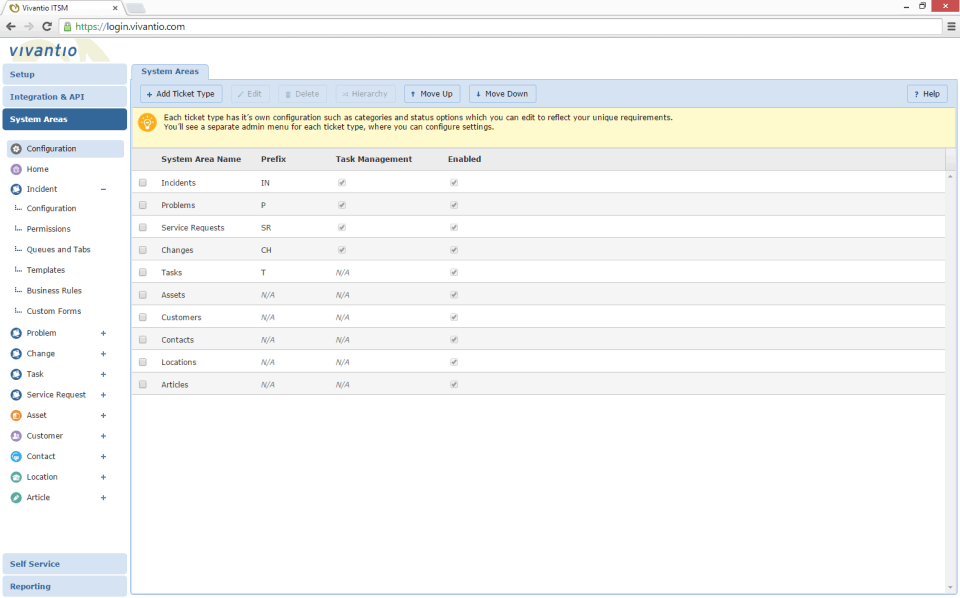
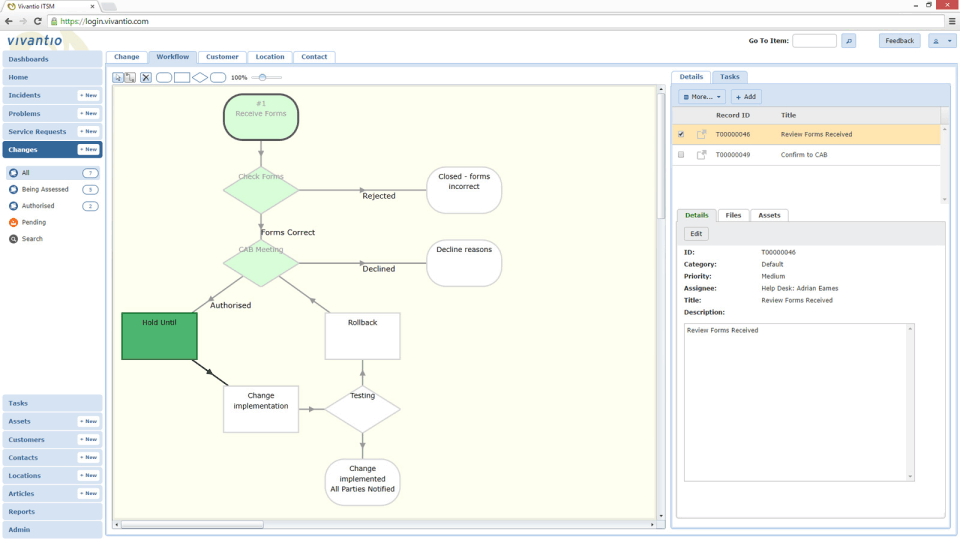
Description
What is Vivantio?
Vivantio is a service management platform built in Edinburgh, Scotland for mid-market and enterprise B2B service organizations. The product handles ITSM (IT Service Management) for internal IT teams, B2B customer service for external-facing service operations, and shared service center workflows across HR, facilities, finance, and legal.
The strongest positioning is flexibility in licensing and deployment. Named, Concurrent, and Pool licensing options let organizations match license cost to actual usage patterns (full-time agents need named licenses; shift teams or rotating staff use concurrent or pool). Multi-tenant deployment supports managed service providers running ITSM for multiple clients from one platform.
Who Vivantio is built for
Vivantio fits mid-market and enterprise organizations (200 to 50,000+ users) needing structured service management. Three buyer profiles stand out: corporate IT teams running ITIL-aligned ITSM, B2B service operations supporting external clients (managed service providers, B2B SaaS support), and shared service centers handling HR, facilities, finance, and legal requests internally.
The strongest fit is organizations with structured service workflows (SLAs, change management, asset tracking, approval routing) that have outgrown lighter helpdesk tools (Zendesk, Freshdesk) but find enterprise ITSM platforms (ServiceNow, BMC) too heavy or expensive. Educational institutions, charities, and nonprofits also get discounts.
It is less of a fit for very small teams (under 15 users where the platform starts), for B2C customer support at scale (Zendesk or Intercom fit better), or for organizations already deep into ServiceNow or BMC where switching cost is prohibitive.
Vivantio pricing plans
| Tier | Price (agent/month annual) | Best for |
|---|---|---|
| The Vivantio Platform | £35-£75 (~$49-$99 USD) | All-feature unified platform |
| Named License | Dedicated to individual agent | Full-time service desk agents |
| Concurrent License | Shared by shift workers | Rotating teams, 24x7 operations |
| Mixed/Pool | Combine types across teams | Flexible workforce mix |
| Volume discount | Up to 40% off | Scaling from 15 users |
Vivantio uses one all-feature platform price of £35-£75 per agent per month (approximately $49-$99 USD), billed annually. Every Vivantio feature is included on the platform price; there are no per-feature tier gates. The £35-£75 range reflects volume discounts that scale up to 40% off as user count grows from the 15-user starting minimum.
License type flexibility is one of Vivantio's strongest pricing differentiators. Named licenses are dedicated to individual agents (the standard model). Concurrent licenses allow shift workers to share licenses (10 concurrent licenses can serve 30 shift workers across 3 shifts). Mixed/Pool licensing combines both across teams. This matches license cost to actual usage rather than peak headcount.
End-users accessing self-service portals do not require licenses; only application users do. Educational institutions get a 5% additional discount. Non-profits and charities get 10% additional. Volume scaling can reach 40% off at higher user counts.
Vivantio core capabilities
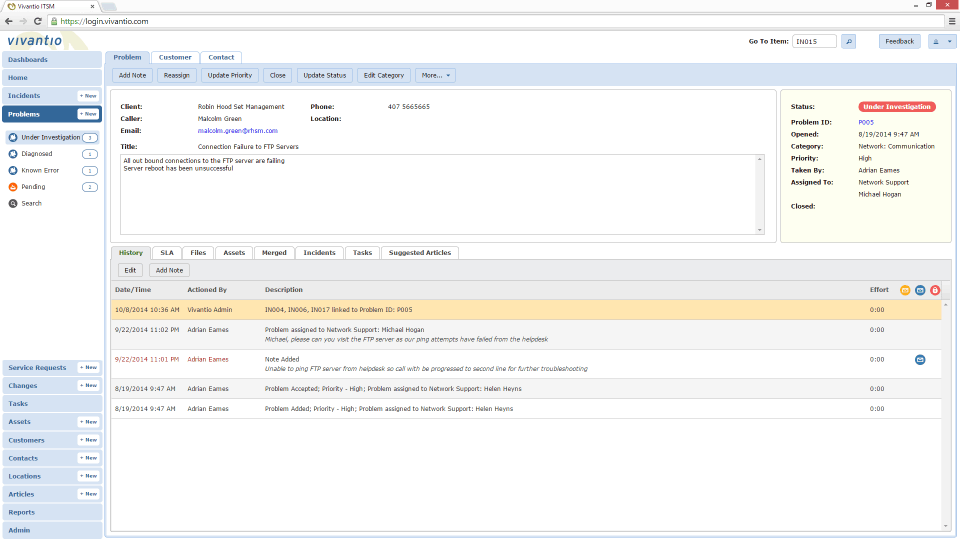
Ticketing is the spine with ITIL-aligned categories: incidents (unplanned interruptions), problems (root causes), changes (planned modifications), service requests (standard requests), and events (monitored conditions). Each category has its own workflow, fields, and SLA targets.
Multi-channel intake handles email, web portal, mobile app, phone integration (via CTI), chat, and API. All inbound requests route to the appropriate queue based on intake channel, requester, category, or other rules. Skills-based routing assigns tickets to the right agent or team.
SLA management
SLA monitoring tracks response time and resolution time against contractual or internal targets. Breach alerts notify managers and assigned agents before SLAs miss; missed SLAs generate audit trail records for reporting. Different SLA targets can apply by customer tier, ticket category, priority, or service contract.
For B2B service operations contractually obligated to SLAs (managed service providers, B2B SaaS), SLA management is one of the strongest reasons to pick Vivantio over lighter helpdesks. SLA reporting feeds customer-facing service reports.
Asset management and CMDB
Asset management and Configuration Management Database (CMDB) track infrastructure assets, software licenses, hardware inventory, and relationships between configuration items. Change management workflows can reference CMDB items so impact analysis happens automatically before approving a change.
For ITIL-aligned IT organizations, the integrated CMDB is one of the differentiators versus pure helpdesk tools. Vivantio's CMDB is functional but lighter than ServiceNow's; mid-market IT shops generally find it adequate.
Self-service portal
Branded self-service portal with custom domain (e.g., support.acmecompany.com) lets end-users submit requests, track ticket status, and search the knowledge base without contacting an agent. Knowledge base articles can be public (for end-users) or internal (for agents).
Self-service deflection (end-users solving their own issues from the knowledge base) reduces agent workload significantly when the KB is current. End-users do not consume licenses, so unlimited self-service portal users are free.
Workflow automation
Workflow automation fires on triggers (ticket created, SLA at risk, status changed, custom field updated) with actions (assign to user, notify by email, post to Slack, escalate to manager, update CMDB). Approval workflows route change requests through multiple approvers based on impact, risk, or financial threshold.
Integrations
600+ integrations through native connectors and Zapier handle major IT tools (Active Directory, Azure AD, Okta, OneLogin), monitoring (PagerDuty, Datadog, Splunk, SolarWinds, Nagios, Zabbix), communications (Microsoft Teams, Slack, Zoom), and CRM (Salesforce, HubSpot, Dynamics 365). REST API enables custom integrations.
Multi-tenant for MSPs
Multi-tenant deployment lets managed service providers run ITSM for multiple clients from one Vivantio instance, with isolated tenants per client, branded portals, and per-client reporting. MSPs save significant cost versus deploying a separate ITSM per client.
Mobile and remote
Mobile-responsive web interface works on phones and tablets without a dedicated mobile app. Agents handle tickets on the go; end-users access the self-service portal from any device. The desktop is the primary work surface for full ticket handling and workflow management.
Security and compliance
Vivantio holds HIPAA, SOC 2 Type II, ISO 27001, and Cyber Essentials Plus certifications. Multiple data center options support US, UK, EU, and AU residency requirements. SSO via SAML, role-based permissions, and audit trails are standard. Multi-factor authentication is enforced.
Vivantio vs ServiceNow
ServiceNow is the enterprise ITSM market leader with deep workflow automation, extensive partner ecosystem, and Now Platform breadth across ITSM, ITOM, ITBM, GRC, and HR. Vivantio is the mid-market alternative with comparable ITSM features at lower entry cost. Pick ServiceNow for large enterprise with multi-domain workflow needs. Pick Vivantio for mid-market ITSM without ServiceNow's price tag.
Vivantio vs Freshservice
Freshservice is the SMB-to-mid-market ITSM tool from Freshworks with strong UI and integration with Freshdesk. Vivantio has stronger flexibility in license types and multi-tenant for MSPs. Freshservice is more polished for SMB; Vivantio is more flexible for mid-market and MSP operations.
Vivantio vs Jira Service Management
Jira Service Management is Atlassian's ITSM product, strongest for engineering and DevOps teams with tight Jira integration. Vivantio is the structured ITIL-aligned alternative for non-engineering service operations. Pick Jira Service Management for engineering teams. Pick Vivantio for IT, HR, facilities, and B2B service operations.
Vivantio vs SolarWinds Service Desk and Ivanti Neurons
SolarWinds Service Desk and Ivanti Neurons are mid-market ITSM competitors. All three target similar buyers. SolarWinds has IT monitoring depth; Ivanti has endpoint management strength; Vivantio has license flexibility and multi-tenant for MSPs. Pick on specific ecosystem fit and feature gaps.
Buyer pitfalls to avoid
Three patterns hurt Vivantio rollouts. First, picking Named licenses for shift teams: Concurrent licensing saves significant cost for rotating staff. Audit actual usage patterns before defaulting to Named.
Second, ignoring the self-service portal: end-users on the portal do not consume licenses, and deflection (end-users solving their own issues from the knowledge base) reduces agent workload. Invest in KB content from day one.
Third, treating it as a helpdesk: Vivantio is structured ITSM with ITIL alignment. Teams looking for lighter ticket triage without ITIL structure may find Zendesk or Freshdesk simpler.
Implementation and time to value
Mid-market deployments (15-500 users): 6-12 weeks including workflow configuration, integration setup, knowledge base import, and team training. Enterprise deployments (1,000+ users): 4-9 months adding multi-tenant setup, custom integrations, SSO, and dedicated customer success engagement. Vivantio provides direct customer success and onboarding on all contracts.
Customer support
All customers get US and UK technical support during business hours with priority response on enterprise contracts. Dedicated customer success managers are included in the platform price. The Vivantio Community and annual user conference connect customers across mid-market service operations.
The Bottom Line on Vivantio
Vivantio is the right call for mid-market and enterprise B2B service operations, IT teams, and managed service providers that want structured ITIL-aligned service management with flexible licensing and multi-tenant deployment options.
Standout strengths: one platform price with every feature included (no per-feature tier gates), Named/Concurrent/Pool license flexibility matching cost to actual usage, multi-tenant deployment for MSPs, HIPAA SOC 2 ISO 27001 Cyber Essentials Plus compliance, 600+ integrations plus REST API, multiple data center options (US UK EU AU), dedicated onboarding and customer success.
Pricing is one-tier with volume scaling: £35-£75 per agent per month (~$49-$99 USD) billed annually. Volume discount up to 40% off as user count grows from the 15-user starting minimum. 5% educational discount; 10% non-profit and charity discount. End-users on self-service portals do not require licenses.
Trade-offs to weigh: 15-user minimum excludes very small teams. UI is functional but less polished than newer SaaS challengers. CMDB depth is adequate for mid-market but lighter than ServiceNow at enterprise scale. Brand presence outside UK is growing but smaller than ServiceNow or Freshservice in North America. Single-tier pricing may force higher tiers for teams needing only basic features.
Alternatives worth comparing: ServiceNow for enterprise ITSM at scale, Freshservice for SMB-to-mid-market ITSM with strong UI, Jira Service Management for engineering and DevOps teams, SolarWinds Service Desk and Ivanti Neurons for similar mid-market positioning, ManageEngine ServiceDesk Plus for budget-tight mid-market, TOPdesk for European service management focus. Pricing and capabilities verified on vivantio.com/pricing on 2026-06-27.
Frequently Asked Questions
Is there a free plan or free trial for Vivantio ITSM?
How much does Vivantio ITSM cost?
What does Vivantio ITSM integrate with?
Who is Vivantio ITSM best for?
What are the best alternatives to Vivantio ITSM?
Is Vivantio ITSM GDPR / SOC 2 compliant?
Does Vivantio ITSM have a mobile app?
What do real users say about Vivantio ITSM?
How does Vivantio ITSM compare to its top competitor?
Does Vivantio ITSM offer customer support?
Find Your Perfect Software
See how it can transform your workflow
- Personalized for your needs Tailored recommendations based on your unique requirements.
- Save time & resources Streamline your workflow and boost team productivity.
- Trusted by thousands Join 10,000+ businesses already growing with SaaSrat.
You're all set! 🎉
A specialist for will reach out within 1 business day with tailored recommendations for your needs.