

Tebra
by Tebra Technologies, Inc
What is Tebra?
Tebra is the combined Kareo + PatientPop brand serving 150,000+ US independent providers with cloud EHR, practice management, billing, telehealth, and patient marketing in one platform. Pricing starts at $49 per provider per month for Patient Experience + Marketing and runs to $799 per MD/DO per month for the Practice Automation bundle. Founded as the Kareo + PatientPop merger in 2021.
Get Best Quote for Tebra
Connect with SaaSrat experts to get the best quote for your business.
You're all set!
A specialist for Tebra will reach out within 1 business day.
Tebra Features
Cloud EHR
Practice management
Medical billing
Managed RCM service
Patient Experience module (scheduling
Intake
View All 37 Features
Tebra Pricing Plans
Patient Experience + Marketing
- Per non-physician provider per month (starting)
- Custom practice website with SEO
- Online scheduling and reputation management
- 80+ directory listings management
- AI-powered review replies
EHR Starter
- Per provider per month (under 100 claims per month)
- Certified EHR with AI Note Assist
- E-prescribing with interaction checks
- Electronic labs ordering and results
- HIPAA-compliant telehealth
Billing Starter
- Per provider per month (under 100 claims per month)
- Electronic claim submission
- Insurance eligibility verification (2,700+ payers)
- Automated patient statements
- Robotic process automation for ERA posting
Practice Essentials (Therapist)
- Per therapist per month
- Clinical EHR + billing + telehealth
- Patient portal and intake
- Reporting and collections tracking
Practice Essentials (NP/PA)
- Per non-physician provider per month (standard)
- EHR + billing + telehealth bundle
- AI documentation tools
- Eligibility verification and claims
Practice Essentials (Physician)
- Per MD/DO per month (standard)
- Full EHR with clinical documentation
- Practice management and billing
- HIPAA-compliant telehealth
- Patient portal and intake
Practice Automation (Physician)
- Per MD/DO per month (standard)
- Everything in Practice Essentials
- Patient experience and engagement add-ons
- Marketing and reputation management
- AI-powered automation across workflows
Tebra Resources
Tebra Screenshots

Description
| Vendor | Tebra (formerly Kareo + PatientPop) |
|---|---|
| Headquartered | Corona del Mar, California, USA |
| Founded | 2021 (merger of Kareo, founded 2004, and PatientPop) |
| Best fit for | Independent solo and small group ambulatory practices (1 to 10 providers), therapists, behavioral health, and small specialty groups |
| Pricing model | Tiered per-provider monthly: $49 marketing, $99 starter, $225 therapist, $399 NP/PA, $599 physician, $799 automation |
| Network scale | 150,000+ providers (vendor-published 2026) |
| Certifications | ONC 2015 Cures Update CEHRT, HITRUST CSF, AICPA SOC 2, HIPAA, PCI DSS |
| AI module | AI Note Assist (ambient clinical documentation, included with EHR tiers) |
Pros and Cons
Pros
- All-in-one platform unifies EHR, billing, scheduling, and marketing in one login, which is rare in independent-practice software.
- AI Note Assist reduces clinical documentation time significantly. Tebra reports one practice saving $750,000 annually after activation.
- Intuitive interface that reviewers consistently describe as easy to learn with minimal training.
- Responsive onboarding and customer support team during go-live and the first 90 days.
- Competitive entry-tier pricing for small independent practices and solo providers.
- Built-in patient portal, two-way text messaging, and online scheduling included in the bundle.
Cons
- Reporting capabilities are inadequate with data refresh issues and occasional duplication.
- Lab integration with LabCorp and Quest can be unreliable in practice, despite being marketed as bidirectional.
- Limited template and form customization compared with specialty-built EHRs.
- Customer service response times via ticket queue can be lengthy after the onboarding window closes.
- Pricing rises sharply at the physician/standard tier (up to $799 per MD/DO per month for Practice Automation).
- Occasional system downtime and calendar sync issues persist post Kareo + PatientPop merger.
Who Should Use Tebra
Tebra fits independent ambulatory practices that want EHR, billing, telehealth, and patient marketing in one platform. The right shortlist candidate is typically:
- A solo or 1 to 5 provider practice in primary care, behavioral health, therapy, or a single specialty that currently runs separate EHR, billing, website, and review tools.
- A therapist solo or group practice (mental health, speech therapy, occupational therapy) where the dedicated Practice Essentials Therapist tier at $225 per therapist per month maps to the billing profile.
- A small specialty group (cardiology, dermatology, chiropractic, MedSpa) that values the bundled Practice Growth tools more than deep specialty templates.
- An independent physician practice that wants AI Note Assist included without contracting a separate ambient scribe vendor.
- A practice opening a new location and wanting custom website, SEO, online reputation, and online scheduling in the same contract as the EHR.
Larger multi-specialty groups (10+ providers, multi-site) often find Tebra's customization depth insufficient and shortlist eClinicalWorks, NextGen, or athenahealth instead.
Product Suite
Tebra ships a unified set of modules under one platform:
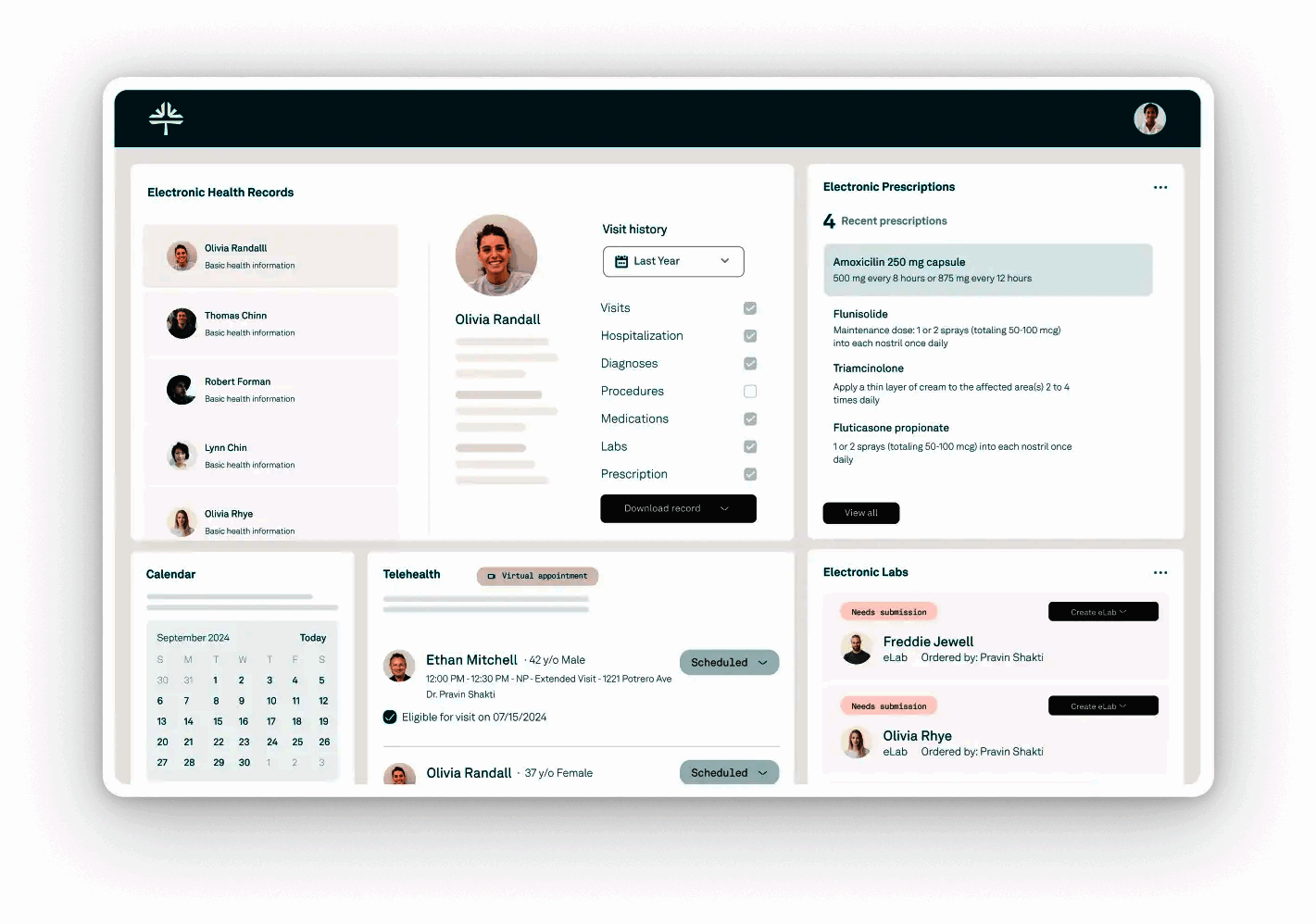
- Tebra EHR (formerly Kareo Clinical) handles clinical charting, ePrescribing via Surescripts, lab orders and results, telehealth integration, and 50+ specialty templates.
- Tebra Billing (formerly Kareo Billing) covers practice management, claim submission, eligibility verification (2,700+ payers), ERA posting via robotic process automation, patient statements, and collections.
- Tebra Managed Billing is the optional RCM service, where Tebra's team handles claims, denials, and follow-up.
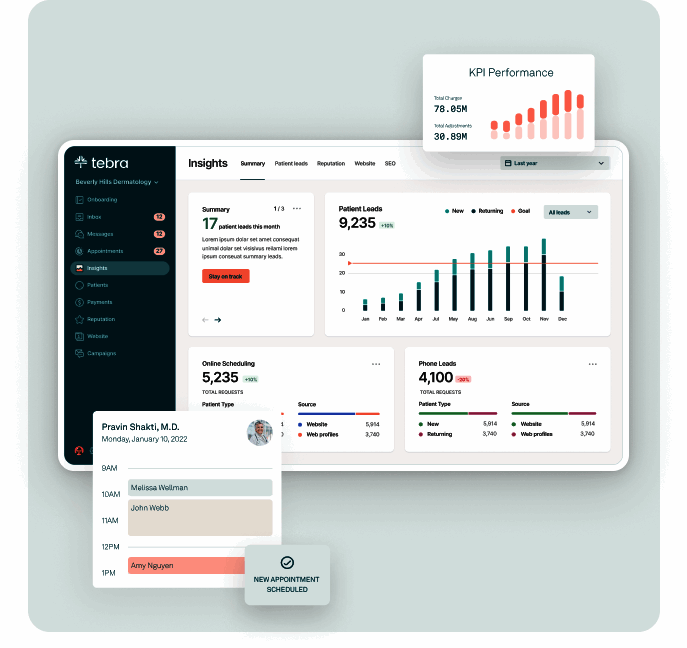
- Tebra Practice Growth (formerly PatientPop) delivers custom practice website with SEO, online reputation management, AI-powered review replies, online scheduling, and 80+ directory listings management.
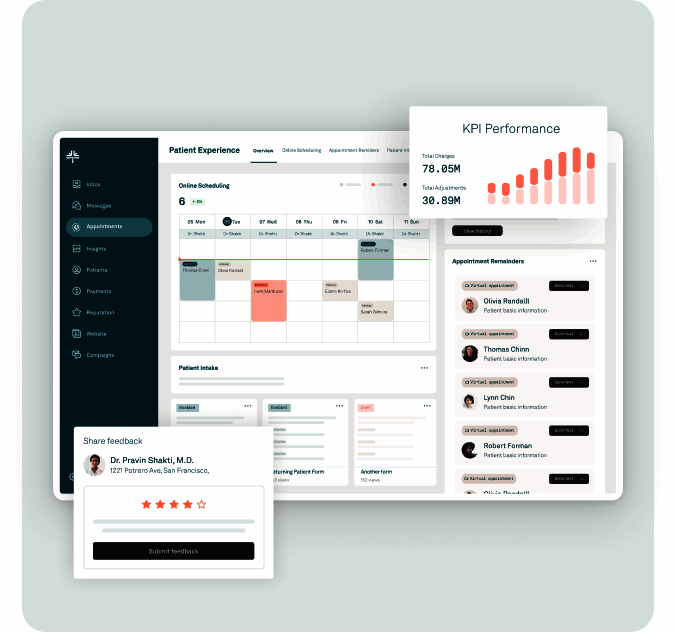
- Tebra Patient Experience covers scheduling, intake forms, two-way text messaging, patient portal, and patient communications.
- Tebra Telehealth is HIPAA-compliant embedded video visits.
- Tebra Payments handles Patient Collect and online payments.
- Tebra Mobile (iOS) is the clinician charting app.
- Tebra Kiosk (iOS and Android) is the patient self-check-in tablet app.
- AI Note Assist generates ambient clinical documentation during the patient encounter.
How Much Does Tebra Cost
Tebra publishes seven pricing tiers on its website:
- Patient Experience + Marketing: $49 per non-physician provider per month (starting). Website, SEO, reputation, 80+ directory listings.
- EHR Starter: $99 per non-physician provider per month (under 100 claims per month). Certified EHR with AI Note Assist, ePrescribing, electronic labs, telehealth.
- Billing Starter: $99 per non-physician provider per month (under 100 claims per month). Electronic claims, eligibility verification, automated statements, ERA posting automation.
- Practice Essentials (Therapist): $225 per therapist per month. Clinical EHR + billing + telehealth bundle.
- Practice Essentials (NP/PA): $399 per non-physician provider per month. EHR + billing + telehealth bundle.
- Practice Essentials (Physician): $599 per MD/DO per month. Full EHR + practice management + billing + telehealth.
- Practice Automation (Physician): $799 per MD/DO per month. Everything in Practice Essentials plus patient experience, marketing, reputation management, and AI workflow automation.
For a 3-provider therapist practice on Practice Essentials Therapist tier, that's roughly $675 per month or $8,100 per year. A 3-physician practice on Practice Automation runs $2,397 per month or $28,764 per year. Compare against published rates in the clinic management category and lighter EMR options.
Hidden Costs and Contract Gotchas
- Data migration. Migration from a legacy EHR is quoted separately and not included in the base subscription. Get a fixed quote tied to specific data classes (charts, billing history, schedules).
- Claims volume escalators. The $99 Billing Starter and EHR Starter tiers are capped at under 100 claims per month. Higher volume moves you to Practice Essentials tiers automatically.
- Physician vs non-physician pricing. Watch the tier mapping carefully. Practice Essentials runs $399 for NP/PA but $599 for MD/DO. A solo MD with one NP on Practice Essentials pays $599 + $399 = $998 per month.
- Practice Growth services. The custom website + SEO + reputation bundle is included only at $49 (marketing-only) and $799 (Physician Automation) tiers. Adding it to Practice Essentials is a separate quote.
- Annual escalators. Multi-year contracts commonly include annual price increases. Negotiate a cap into your master agreement.
- EPCS for controlled substances. Tebra supports EPCS but verify it is included in your tier vs an add-on quote.
Alternatives to Tebra
Practices most commonly shortlist Tebra against:
- athenahealth: percentage-of-collections pricing, deeper RCM rules engine, Best in KLAS recognition.
- DrChrono (EverHealth): iPad-native EHR for small practices.
- eClinicalWorks: $449 to $599 per provider per month with deeper 50+ specialty templates.
- AdvancedMD: tiered specialty bundles from $130 to $1,070 per provider per month.
- NextGen Healthcare: specialty-templated EHR with strong FQHC footprint.
- Elation Health: AI-native EHR for independent primary care and DPC.
- SimplePractice: behavioral health-focused PM + EHR for solo therapists.
- Practice Fusion: lighter browser EHR.
- CareCloud: modular cloud PM + EHR + RCM.
For RCM service alternatives, see the medical billing category.
What Real Buyers Report
Tebra carries a 3.9 out of 5 G2 rating across 251+ reviews and a 3.9 out of 5 Capterra rating across 1,365 reviews. Capterra sub-scores: Ease of Use 4.0, Customer Service 3.7, Features 3.8, Value 3.6. The vendor self-reports 150,000+ providers on the platform.
The praise themes from real customers are consistent: all-in-one platform value, AI Note Assist documentation savings, ease of use and short training time, responsive onboarding, and competitive entry-tier pricing for independent practices. The complaint themes are also consistent: reporting limitations, lab integration reliability, template customization depth, ticket-queue support response times, sharp pricing jump at physician tier, and lingering post-merger system issues.
Therapist groups, solo physicians in primary care, and small behavioral health practices tend to weigh the bundled marketing + EHR highly. Specialty practices that need deep custom templates more frequently flag the customization limits and lean toward AdvancedMD or eClinicalWorks.
Bottom Line
Tebra is the right shortlist candidate when an independent solo or small-group practice wants one cloud platform for EHR, billing, telehealth, AND practice marketing (website, SEO, reputation, directory listings) under one contract and one login. The $49 to $799 per-provider monthly range, ONC 2015 Cures Update CEHRT, HITRUST CSF, AICPA SOC 2, HIPAA, and PCI DSS credentials cover the compliance bar most ambulatory buyers care about.
It is the wrong choice when a multi-specialty group needs deep specialty template customization, when an enterprise hospital needs an inpatient-grade EHR, or when the buying team needs sophisticated reporting beyond what Tebra currently delivers. Build data migration, claims-volume escalator risk, Practice Growth add-on pricing, and annual escalator caps into your total cost of ownership before signing. Then compare side-by-side with athenahealth, DrChrono, eClinicalWorks, and AdvancedMD to confirm the bundle and the pricing tier match your practice profile.
Frequently Asked Questions
How much does Tebra cost?
Tebra publishes seven pricing tiers on its website. Patient Experience + Marketing starts at $49 per non-physician provider per month. EHR Starter and Billing Starter each run $99 per provider per month for practices doing fewer than 100 claims per month. Practice Essentials starts at $225 for therapists, $399 for non-physician providers, and $599 for physicians. Practice Automation for physicians runs $799 per MD/DO per month and bundles patient experience, marketing, and AI-powered workflow automation. Setup, data migration, and clearinghouse-only volume discounts are quoted separately.
What is the difference between Kareo and Tebra?
Tebra is the unified brand that emerged from the 2021 merger of Kareo (founded 2004, EHR + billing software) and PatientPop (practice marketing and patient experience). Kareo Clinical became Tebra EHR. Kareo Billing became Tebra Billing. PatientPop became Tebra Practice Growth. The combined platform now serves 150,000+ US providers under one login, one contract, and one support team. Legacy Kareo customers were migrated to the unified Tebra platform.
Is Tebra ONC-certified for the 2015 Cures Update?
Yes. Tebra EHR (CEHRT ID 2025CE1M5T854Z4, Tebra/Kareo EHR v5.1) holds ONC 2015 Edition Cures Update certification. The platform is also HITRUST CSF certified, AICPA SOC 2 audited, HIPAA compliant, and PCI DSS compliant for payment processing. Tebra participates in Surescripts for ePrescribing and supports EPCS for controlled substance prescribing.
Is Tebra a good fit for solo and small practices?
Yes. Tebra was built specifically for independent practices, with most customers running 1 to 10 providers. The $49 to $225 per provider per month entry tiers map well to solo and small group economics, and the bundled Practice Growth tools (custom website, SEO, online reputation, 80+ directory listings) cover marketing needs that solo practices otherwise stitch together from 3 to 5 vendors. Therapists, behavioral health, primary care, and small specialty groups form the core customer base.
How does Tebra compare to athenahealth and DrChrono?
The three serve overlapping independent-practice segments. Tebra wins on practice marketing depth (custom website, SEO, reputation, directory listings bundled into the platform). athenahealth uses percentage-of-collections pricing exclusively and has the deepest RCM rules engine. DrChrono is iPad-native and lighter on practice management depth. See the full ranked list in the clinic management category.
Does Tebra include AI documentation?
Yes. AI Note Assist is built into Tebra EHR and generates clinical notes during the patient encounter for clinician review. Tebra reports one practice saving $750,000 annually on documentation time after activating AI Note Assist. The feature is included with EHR Starter and higher tiers, no third-party scribe contract required. Reviewers note AI Note Assist works well for primary care and behavioral health follow-ups; complex specialty workflows may still need template-driven charting.
How long does Tebra implementation take?
Solo practices typically go live in 30 to 60 days. Small groups (2 to 5 providers) commonly run 60 to 90 days. Data migration from a legacy EHR is the most variable cost and is quoted separately. Tebra's onboarding team handles payer enrollment, fee schedule configuration, and clinical template setup. Reviewers consistently praise responsive onboarding and minimal training time once configured.
Which specialties does Tebra support?
Tebra ships templates for 50+ specialties including primary care, mental health, psychiatry, behavioral health, pediatrics, OB-GYN, cardiology, dermatology, chiropractic, physical therapy, speech therapy, occupational therapy, podiatry, orthopedics, internal medicine, family practice, dental (general, cosmetic, pediatric), MedSpa, acupuncture, and integrative medicine. Therapists and behavioral health groups form a major segment, with a dedicated Practice Essentials Therapist tier at $225 per month.
What are the biggest complaints about Tebra?
The recurring themes across G2 (3.9/5 over 251+ reviews) and Capterra (3.9/5 over 1,365 reviews) are: (1) reporting capabilities feel inadequate with data refresh issues and duplication; (2) lab integration with LabCorp/Quest can be unreliable in practice; (3) limited template and form customization compared with specialty-built EHRs; (4) customer service response times via ticket queue can be lengthy; (5) pricing rises sharply at the physician/standard tier (up to $799 per provider per month); (6) occasional system downtime and calendar sync issues since the Kareo+PatientPop merger. The unified platform and AI Note Assist remain the strongest praise points.
Does Tebra include practice marketing tools?
Yes. Tebra Practice Growth (the former PatientPop product) is bundled into the Patient Experience + Marketing tier and the Practice Automation Physician tier. It includes a custom practice website with SEO optimization, online reputation management, AI-powered review replies, online scheduling, intake forms, two-way patient messaging, and management of 80+ directory listings (Google Business Profile, Healthgrades, Vitals, Yelp Health, etc.). For independent practices that previously paid separately for website hosting, SEO agency, review tool, and directory submission service, this consolidation is a primary reason to switch.
Find Your Perfect Software
See how it can transform your workflow
- Personalized for your needs Tailored recommendations based on your unique requirements.
- Save time & resources Streamline your workflow and boost team productivity.
- Trusted by thousands Join 10,000+ businesses already growing with SaaSrat.
You're all set! 🎉
A specialist for will reach out within 1 business day with tailored recommendations for your needs.