

athenahealth
by The athenahealth, Inc
What is athenahealth?
athenahealth is a Boston-based cloud EHR, practice management, and revenue cycle network used by 170,000+ US clinicians across primary care, specialty, and hospital ambulatory groups. The athenaOne platform bundles charting, billing, scheduling, patient portal, and a 300+ partner marketplace, priced as a percentage of collections so vendor revenue scales only when the practice gets paid.
Get Best Quote for athenahealth
Connect with SaaSrat experts to get the best quote for your business.
You're all set!
A specialist for athenahealth will reach out within 1 business day.
athenahealth Features
Cloud EHR
Practice management
Revenue cycle management
AthenaCollector medical billing
Patient portal (athenaCommunicator)
Telehealth
View All 31 Features
athenahealth Pricing Plans
athenaOne
- Percentage-of-collections pricing (industry-reported 4-8% range)
- Integrated EHR + practice management + patient engagement + RCM
- No long-term contracts; practices retain their data on exit
- Minimal upfront costs and no per-provider monthly fee
athenaIDX
- Enterprise revenue cycle management for large medical groups and academic systems
- Quote-only pricing scoped to claim volume and configuration
- Sold separately from athenaOne SaaS bundle
athenaClinicals (Hospital Ambulatory)
- Standalone EHR module for hospitals layering ambulatory care
- Carequality and CommonWell connectivity included
- FHIR API access for custom integrations
athenahealth Resources
athenahealth Screenshots
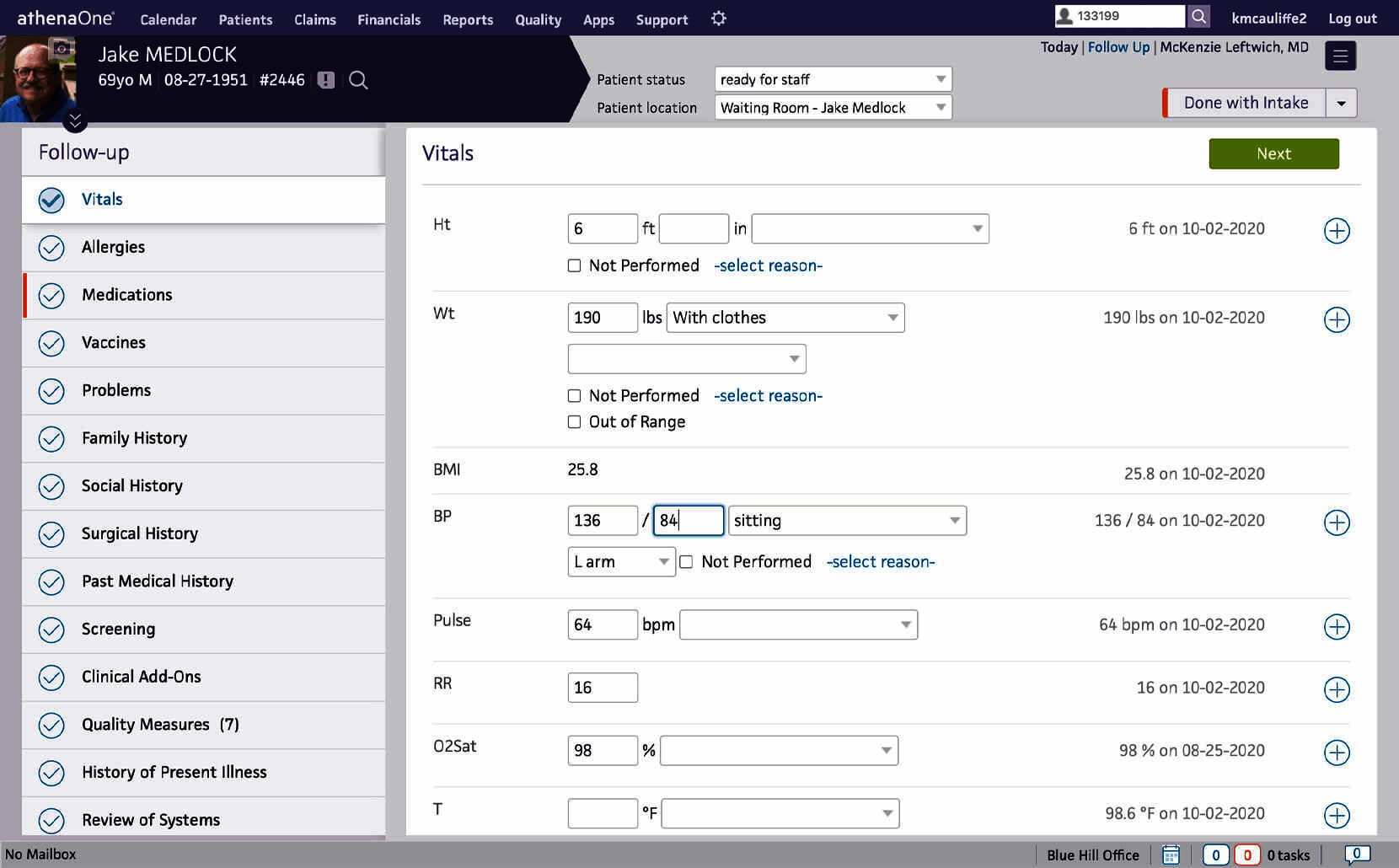
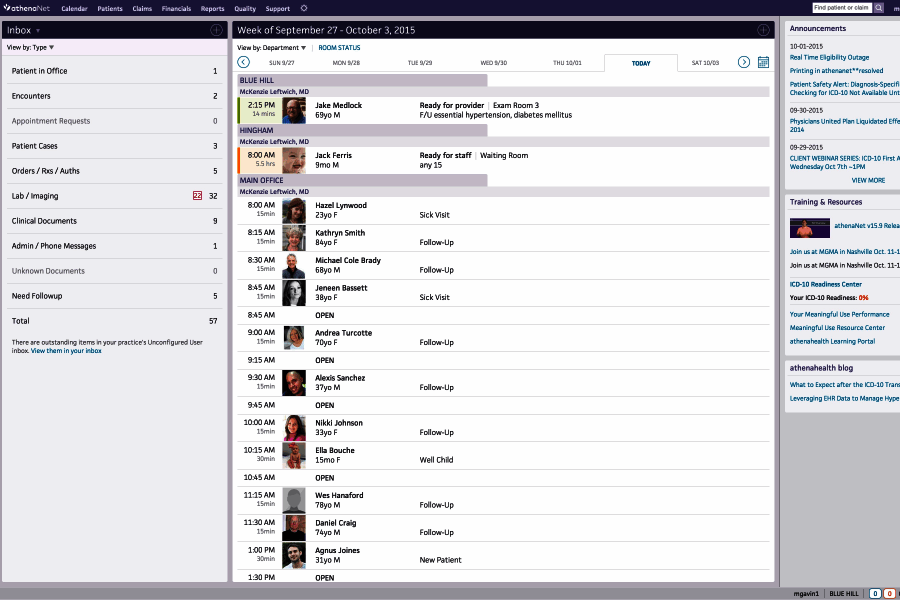
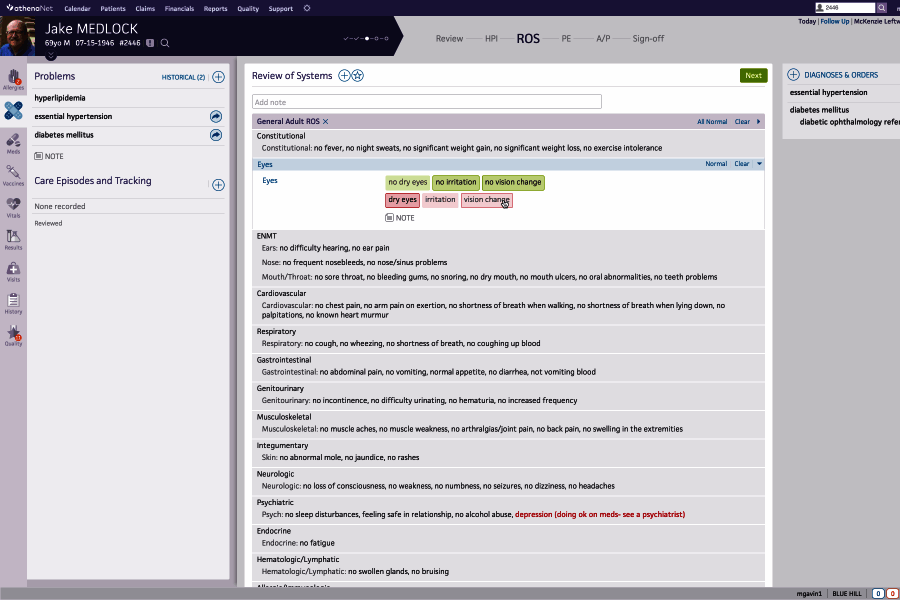
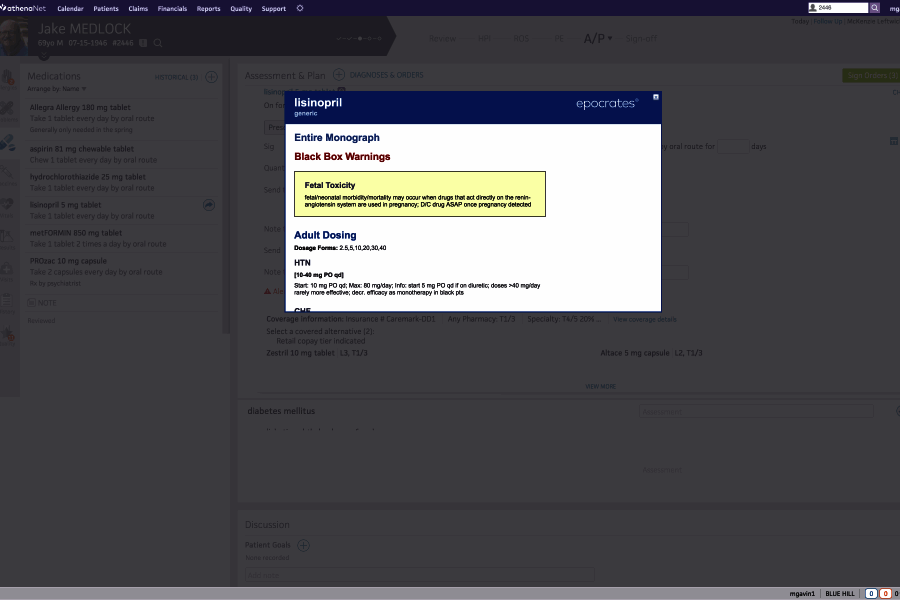
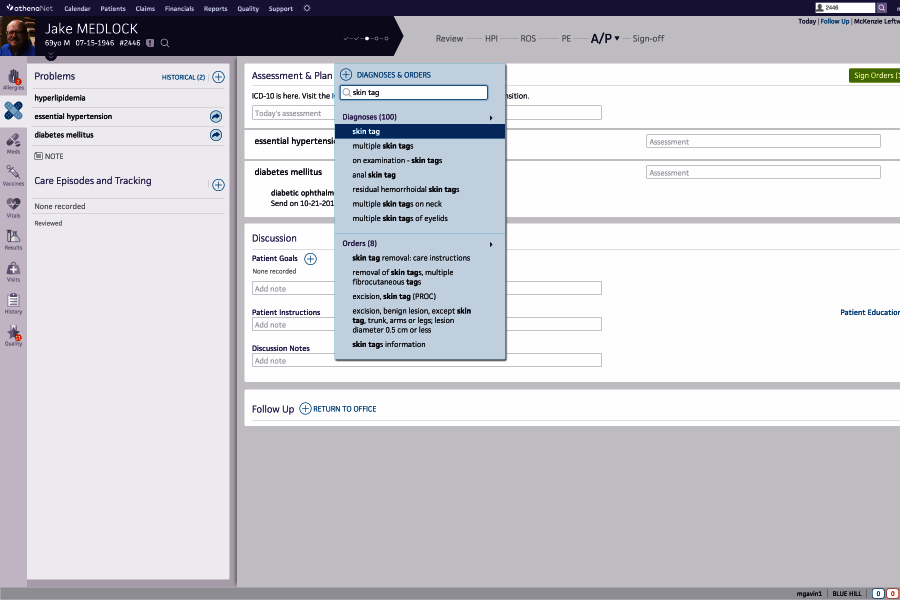
Description
| Vendor | athenahealth, Inc. |
|---|---|
| Headquartered | Boston, Massachusetts, USA |
| Founded | 1997 |
| Best fit for | Independent ambulatory practices, FQHCs, and mid-size multi-specialty groups (solo through 75+ providers) |
| Pricing model | Percentage of collections (industry-reported 4 to 8 percent); no per-provider monthly fee |
| Network scale | 170,000+ clinicians, 315M+ claims annually, serves over 20 percent of the US population |
| Certifications | ONC 2015 Cures Update, HITRUST CSF, SOC 1 SSAE 18, PCI-DSS, EHNAC, DirectTrust HISP, EPCS |
| KLAS recognition | 2025 Best in KLAS Overall Independent Physician Practice Suite (2nd consecutive year) |
Pros and Cons
Pros
- Cloud-native architecture means automatic updates, no on-prem servers, and uptime that reviewers consistently praise as reliable.
- The RCM rules engine catches denials before claims go out the door, which reduces AR days for most practices switching from older clearinghouse-only setups.
- One integrated workflow across EHR charting, billing, scheduling, and the patient portal removes the swivel-chair tax of stitching point tools together.
- Best in KLAS Overall Independent Physician Practice Suite winner in both 2024 and 2025 reflects sustained satisfaction across independent practices, not just a single product line.
- The marketplace of 300+ vetted partners (Phreesia for intake, Luma Health for engagement, Notable for ambient AI scribing) makes adding specialty workflows a configuration choice instead of a custom build.
Cons
- Clinical documentation in athenaClinicals has a high click count: reviewers describe charting workflows that feel busy and slow daily encounter throughput.
- Percentage-of-collections pricing scales with practice success. High-volume specialty groups eventually report fees that exceed what flat-fee competitors like NextGen Office would charge.
- Customer support and customer-success-manager quality drew repeated complaints across G2 and Capterra in 2025 and 2026 (slow case resolution, manual claim follow-up, mixed-up support cases).
- Implementation timelines for ambulatory groups commonly run 6 to 9 months, with a 3 to 6 week clinical productivity dip after go-live regardless of starting point.
- Independent practice reviewers report price increases mid-contract and a lack of default multifactor authentication.
Who Should Use athenahealth
athenahealth fits practices and health systems that prioritise cloud delivery and a single platform across charting, billing, and patient engagement over the cheapest per-provider sticker price. The right shortlist candidate is typically:
- An ambulatory group from 5 to 75 providers that wants the EHR vendor to own the entire revenue cycle, not just the charts.
- A FQHC or community health center that needs UDS reporting, sliding-fee schedules, 340B drug pricing workflows, and Carequality or CommonWell exchange in one platform.
- A specialty group (cardiology, orthopedics, OB-GYN, behavioral health) where the marketplace's specialty templates and partner apps save months of custom work.
- A hospital adding ambulatory clinics onto an existing Epic or Oracle Cerner inpatient EHR, where athenaOne handles clinic visits while inpatient stays on the legacy system.
- A growing practice that is tired of paying its current EHR a flat fee while losing 12 percent of claims to denials, and would rather pay a percentage that rewards the vendor when collections come in.
Solo practices collecting under $400,000 a year often find that smaller EMR options like Elation Health, DrChrono, or RXNT map better to their billing volume. Mental and behavioural health solo practices typically shortlist SimplePractice or TheraNest instead.
Product Suite
athenahealth's flagship offering is athenaOne, an integrated SaaS bundle that wraps the entire ambulatory practice workflow into one cloud platform:
- athenaClinicals handles the EHR side: clinical charting, e-prescribing via Surescripts, lab orders and results from Quest and LabCorp, ordering, clinical decision support, and quality reporting (MIPS, HEDIS, Promoting Interoperability).
- athenaCollector is the practice management and billing engine. Its rules engine sits between the chart and the clearinghouse, scrubbing claims and surfacing denials before they ship. Eligibility verification, patient billing, payment posting, and AR follow-up all live here.
- athenaCommunicator covers the patient side: portal, secure messaging, online scheduling, self-service intake forms, and automated reminders.
- athenaTelehealth adds embedded video visits with no separate vendor or platform fee.
- athenaIDX is the separately-sold enterprise revenue cycle platform for large multi-specialty groups, academic medical centres, and complex billing environments. It is not part of the athenaOne bundle.
The Marketplace publishes 800+ FHIR API endpoints and connects 300+ vetted partner apps, so specialty workflows (Phreesia for orthopedic intake, Notable for ambient AI scribing, Press Ganey for patient experience surveys) attach as configuration rather than custom code.
How Much Does athenahealth Cost
athenahealth does not publish a fixed per-provider monthly price. Instead, the vendor charges a percentage of practice collections. The published cost-value page describes the model as "scales with your success" but does not name a percentage. Industry reports place the range at roughly 4 to 8 percent of collections, with the specific number negotiated based on practice size, specialty mix, and which athenaOne modules the practice activates.
For a primary-care practice collecting $1.5 million per provider per year, that translates to approximately $60,000 to $120,000 per provider per year, all-in for EHR, practice management, billing, patient engagement, and telehealth. There is no separate per-user subscription fee and no long-term contract requirement. The athenaIDX enterprise RCM offering is quote-only and is priced separately based on claim volume.
Compare that against per-provider flat-fee competitors in the medical billing software and clinic management categories to decide which model maps better to your billing profile.
Hidden Costs and Contract Gotchas
- Implementation services. The vendor's services team runs data migration, payer enrollment, and clinical template configuration. Quotes scale with practice size and specialty count; mid-market groups commonly see implementation fees in the $30,000 to $100,000 range layered on top of the collections percentage.
- Mid-contract price increases. Reviewers on G2 and Capterra repeatedly mention rate adjustments after the first contract anniversary. Negotiate a cap into your master agreement.
- Marketplace partner fees. Apps in the 300+ marketplace are sold by their own vendors. Phreesia, Luma, Notable, Press Ganey, and others each have their own per-encounter or per-seat pricing on top of athenahealth's percentage.
- Exit data migration. Practices retain ownership of their data on exit, but packaging it for migration to another EHR commonly requires an exit-services engagement that stretches several months.
- Multi-factor authentication. MFA is not on by default for clinical users. Plan for an internal security configuration sprint at go-live.
Alternatives to athenahealth
Practices most commonly shortlist athenahealth against the same set of cloud and legacy ambulatory EHRs:
- eClinicalWorks: similar EHR + PM + RCM bundle, flat per-provider pricing, broader 50+ specialty coverage, lower price point but more dated UI.
- NextGen Healthcare: specialty-templated EHR with very strong FQHC footprint and Best in KLAS Behavioral Health Suite recognition.
- Epic: enterprise EHR for large hospitals and academic systems, not realistic for solo or small ambulatory practices.
- Greenway Health Intergy: ambulatory EHR with strong FQHC and family-medicine adoption.
- Practice Fusion (Veradigm): lightweight browser EHR for sub-10-provider practices.
- DrChrono and Tebra: iPad-native and Kareo-derived options popular with small practices.
- Elation Health: AI-native EHR built for independent primary care and Direct Primary Care.
For hospital ambulatory ops, browse the hospital management software list. For RCM service alternatives (Waystar, Availity, R1 RCM), see the medical billing category.
What Real Buyers Report
The G2 athenaOne profile carries a 3.4 out of 5 rating across 111 reviews, with a 3.6 out of 5 average across 129 athenahealth reviews overall. Capterra and Software Advice combined show 3.8 out of 5 across 835 athenaOne reviews. KLAS Research awarded athenahealth Best in KLAS Overall Independent Physician Practice Suite in both 2024 and 2025, plus 2025 Best in KLAS for Ambulatory EHR 11-75 Physicians Independent and Practice Management 11-75 Physicians Independent.
The praise themes are consistent: cloud reliability, RCM rules engine catching denials, single integrated workflow, and the marketplace ecosystem. The complaint themes are equally consistent: click count in charting, percentage-of-collections fees growing with practice success, declining support and CSM quality in 2025-26, and long implementation timelines for groups coming from server-based EHRs.
Mid-market and FQHC reviewers tend to weigh the integrated workflow and rules engine higher than solo reviewers do. Solo reviewers more frequently flag the support and click-count issues as deal-breakers and lean toward lighter alternatives.
Bottom Line
athenahealth is the right shortlist candidate when an ambulatory practice or FQHC wants a single cloud vendor to own EHR, practice management, billing, patient engagement, and a vetted partner ecosystem in one contract. The percentage-of-collections pricing aligns vendor incentives with practice revenue, which is genuinely different from the flat per-provider model everyone else runs. Best in KLAS recognition three years running and a 170,000-clinician network confirm the platform works at scale.
It is the wrong choice when a solo or 2-3 provider practice wants the cheapest sticker price, when a specialty group has very high collections and would pay more under percentage pricing than under flat fees, or when the buying team cannot stomach a 6 to 9 month implementation. Build implementation cost, mid-contract rate caps, marketplace partner fees, and exit data services into your total cost of ownership before signing. Then compare side-by-side with eClinicalWorks, NextGen Healthcare, Greenway, and Elation Health to confirm the percentage-of-collections model is the right financial fit for your billing profile.
Frequently Asked Questions
How much does athenahealth cost?
athenahealth uses percentage-of-collections pricing for the athenaOne bundle (EHR + practice management + RCM + patient engagement). The vendor does not publish a fixed rate; industry reports place the range at roughly 4 to 8 percent of collections depending on practice size, specialty mix, and modules included. There is no per-provider monthly subscription, no long-term contract requirement, and minimal upfront cost per the vendor's cost-value page. athenaIDX, the enterprise RCM offering for large medical groups and academic systems, is quote-only and sold separately.
Is athenahealth ONC-certified for the 2015 Cures Update?
Yes. athenaClinicals (the EHR module inside athenaOne) holds ONC 2015 Edition Cures Update certification, which means it supports the FHIR APIs, EHI export, USCDI data classes, and information-blocking provisions required by 21st Century Cures Act regulations. athenahealth also carries HITRUST CSF certification, SOC 1 (SSAE 18), PCI-DSS for payments, EHNAC accreditation, and operates a DEA-approved EPCS service for controlled substance prescribing.
Is athenahealth a good fit for solo or very small practices?
It can be. athenaOne serves practices from solo through 75+ providers and won 2025 Best in KLAS for both Ambulatory EHR 11-75 Physicians Independent and PM 11-75 Physicians Independent. For solo and 2-5 provider practices, the percentage-of-collections model is attractive (no fixed monthly cost), but reviewers sometimes feel implementation services are tuned more for mid-market groups. If you collect under $400K per year and want flat per-provider pricing, lighter alternatives like EMR options such as Elation Health or DrChrono may map better to your billing profile.
What is the difference between athenaOne and athenaIDX?
athenaOne is the integrated SaaS bundle: EHR (athenaClinicals), practice management and billing (athenaCollector), patient engagement (athenaCommunicator), and add-on telehealth and population health modules. It is priced as a percentage of collections and targets ambulatory groups from solo through mid-size health systems. athenaIDX is a separate enterprise RCM platform, originally GE Centricity Business, aimed at large multi-specialty groups, academic medical centers, and complex billing environments. It is quote-only and is not bundled with the athenaOne EHR.
Which EHRs do practices compare against athenahealth?
The most common shortlists pit athenahealth against eClinicalWorks, NextGen Healthcare, Epic, Greenway Health, Practice Fusion, DrChrono, Tebra (formerly Kareo), Elation Health, and RXNT. Hospitals layering ambulatory care onto an inpatient EHR often weigh athenahealth against Epic or Oracle Cerner. See the full set in the EHR category buyer's guide and the broader clinic management software list.
How long does athenahealth implementation take?
Most practices report a 90 to 180 day implementation timeline for athenaOne, with larger and multi-specialty groups stretching to 6 to 9 months. The vendor's services team handles data migration, fee schedule configuration, payer enrollment, and clinical template setup. Reviewers consistently note that practices coming from legacy server-based EHRs face the steepest learning curve, while practices coming from another cloud EHR ramp faster. Plan for a 3 to 6 week clinical productivity dip after go-live regardless of starting point.
Does athenahealth integrate with Surescripts, Quest, LabCorp, and major lab networks?
Yes. athenaOne is connected to Surescripts for ePrescribing, eligibility, and formulary checks; integrates with Quest Diagnostics and LabCorp for lab orders and results; and supports Direct Trust, Carequality, and CommonWell for nationwide HIE exchange. The marketplace lists 300+ vetted partner apps including Phreesia (patient intake and payments), Press Ganey (patient experience), Luma Health (communications), Notable Health (AI documentation), Updox (secure fax), and DocuSign (consent). The FHIR API exposes 800+ endpoints for custom builds.
What are the biggest complaints about athenahealth?
The recurring themes across G2, Capterra, and Reddit reviews are: (1) high click count in clinical charting, which slows daily encounter throughput; (2) customer support and CSM quality have declined in 2025-26 with slow case resolution; (3) percentage-of-collections pricing scales with practice success, so high-volume specialty groups eventually pay more than flat-fee competitors; (4) reports of price increases mid-contract; and (5) a steep learning curve for staff coming from server-based EHRs. The cloud architecture, RCM rules engine, and integrated workflow are the most consistently praised strengths.
Does athenahealth work for FQHCs and community health centers?
Yes. athenahealth serves a large FQHC and community health center footprint with UDS reporting, sliding-fee schedule support, grant tracking, and 340B drug pricing program workflows. The platform handles the Medicare and Medicaid eligibility verification rhythms FQHCs run on, plus the population health and quality reporting required for HRSA grant compliance. NextGen Healthcare and eClinicalWorks are the other two systems FQHCs most commonly evaluate alongside athenahealth.
Can I switch off athenahealth later if it does not work out?
Yes. athenahealth's contracts do not require long-term commitments, and the vendor's policy is that practices retain ownership of their clinical and financial data on exit. Migration to another EHR will still require an exit-services engagement to package the data in usable formats, and reviewers warn the unwind can stretch several months for established practices. Build the exit cost into your total cost of ownership before signing.
Find Your Perfect Software
See how it can transform your workflow
- Personalized for your needs Tailored recommendations based on your unique requirements.
- Save time & resources Streamline your workflow and boost team productivity.
- Trusted by thousands Join 10,000+ businesses already growing with SaaSrat.
You're all set! 🎉
A specialist for will reach out within 1 business day with tailored recommendations for your needs.