
KaiNexus
by KaiNexus
What is KaiNexus?
Get Best Quote for KaiNexus
Connect with SaaSrat experts to get the best quote for your business.
You're all set!
A specialist for KaiNexus will reach out within 1 business day.
KaiNexus Features
Continuous improvement workflow
Employee idea submission
Idea evaluation workflow
Lean and Kaizen methodology support
Six Sigma project tracking
Project huddle boards
View All 40 Features
KaiNexus Pricing Plans
Mid-Market
- 500 to 2,000 employees
- Buyer ranges $30,000 to $150,000 per year
- Continuous improvement workflow
- Project tracking
Enterprise
- 2,000-plus employees
- Multi-facility deployment
- Strategy deployment (X-matrix)
- Dedicated coach
Healthcare BAA
- HIPAA-ready
- Business Associate Agreement
- Epic and Cerner integration
- Healthcare-specific dashboards
KaiNexus Resources
KaiNexus Screenshots
Description
KaiNexus at a Glance
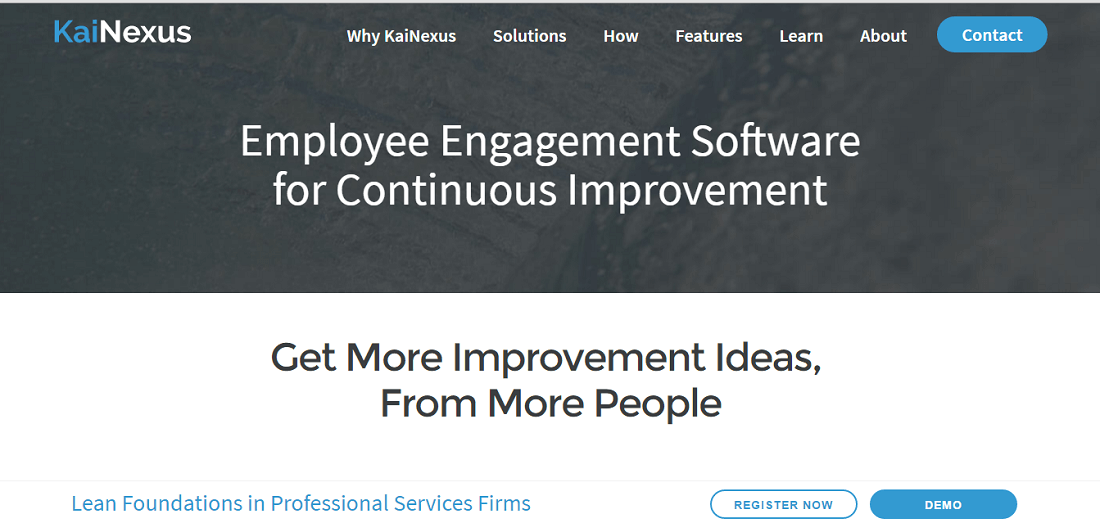
KaiNexus is continuous improvement software built around Lean, Kaizen, and Six Sigma methodologies. Instead of treating engagement as surveys and pulse polls, KaiNexus turns improvement ideas, A3 problem solving, and PDSA cycles into a structured workflow that every employee can see, contribute to, and act on. The platform combines an idea-capture system, project management for improvement work, knowledge repositories, capacity planning, habit tracking, and visual CI boards in one place.
The platform is most often used by manufacturers, hospitals, mining and oil and gas operators, food and beverage companies, and financial services firms that already run formal Lean or Six Sigma programs. Engagement is a downstream effect: when frontline staff see their suggestions move through a transparent workflow and produce measurable savings, they stay involved. KaiNexus puts numbers on that work through built-in impact tracking and an optional Advanced ROI module.
Company Background and Founding Story
KaiNexus was founded in 2009 in the Austin, Texas area. The company was started by Dr. Gregory Jacobson, an emergency room physician who wanted a better way to capture and act on improvement ideas in the hospital where he worked, and Matt Paliulis, who brought the software engineering side. The combination of clinical frustration with paper suggestion boxes and engineering discipline shaped a product that still leans heavily on workflow rigor rather than gamification.
The original use case was healthcare, but the platform expanded outward into manufacturing, mining, food and beverage, finance, and oil and gas as Lean practitioners in those sectors asked for the same idea-to-impact tracking. KaiNexus has remained an independent, privately held company headquartered in Austin and has not been acquired or rolled into a larger HCM suite. That independence shows up in the product, which integrates with HR systems by export and API rather than living inside an employee experience platform.
KaiNexus Product Suite
KaiNexus organizes its product around four use-case bundles, and customers usually buy one to start and expand from there.
- Employee-Driven: Idea capture, suggestion workflows, and recognition for frontline contributors. This is the bundle most often associated with engagement outcomes.
- Leader-Driven: Daily huddles, leader standard work, gemba walks, and CI board management for supervisors and middle managers.
- Strategy-Driven: Hoshin Kanri / Strategy Deployment, goal cascading, and X-matrix tracking that ties shop-floor improvements to executive objectives.
- Process-Driven: A3 problem solving, PDSA cycles, Kaizen events, Six Sigma DMAIC projects, and value stream mapping.
Underneath those bundles, the shared platform handles knowledge repositories so improvements get documented, capacity planning so teams do not overload themselves with concurrent projects, habit tracking to embed CI behaviors, and visual boards that mirror physical Kanban or huddle walls. The Advanced ROI add-on layers financial impact calculations on top of completed projects.
How KaiNexus Compares to Engagement-First Platforms
Buyers often evaluate KaiNexus against tools that approach engagement from the opposite direction. Survey-led platforms like Culture Amp, Lattice, and 15Five start with feedback and performance check-ins, then try to drive action items. Recognition-led platforms like Bonusly, Motivosity, and Achievers build engagement on peer-to-peer kudos and reward catalogs. KaiNexus inverts that order: engagement is the byproduct of giving people real work to improve and visible credit when their ideas land.
That makes the head-to-head decision less about feature parity and more about culture fit. A knowledge-worker company with a strong hybrid workforce often gets more out of Officevibe or Workhuman. A manufacturer with a Lean program, daily huddles, and a director of continuous improvement gets more out of KaiNexus.
How Much Does KaiNexus Cost
KaiNexus does not publish pricing. Every deployment is quoted by the vendor based on a combination of factors, and there is no free trial.
| Quote Driver | What It Means |
|---|---|
| Use-case bundle | Employee-Driven, Leader-Driven, Strategy-Driven, or Process-Driven; bundling multiple raises price. |
| Template tier | Standard vs. advanced workflow templates for A3, PDSA, and Kaizen events. |
| User roles and counts | Frontline contributor seats are priced differently from leader and admin seats. |
| Add-on modules | Advanced ROI, API access, compliance configuration, and custom branding are quoted separately. |
| Services and onboarding | Implementation, training, and ongoing CSM hours are scoped per engagement. |
Because there is no published price list and no self-serve trial, buyers should expect a discovery call, a scoped demo, and a written proposal before any commercial conversation. Procurement teams used to per-seat SaaS pricing should plan for a longer cycle than they would with a tool like TinyPulse or Assembly.
Hidden Costs and Contract Gotchas
KaiNexus pricing is quote-based, so the variance drivers matter more than headline numbers:
- User-tier mix. Pricing scales by the count of active improvement contributors versus passive viewers; ratio shifts quote materially.
- Strategy Deployment add-on. Hoshin Kanri / X-matrix workflows sit on a higher tier than core idea-tracking.
- Coaching and content services. Lean-coaching engagements with the KaiNexus team are quoted separately.
- Annual prepay. Standard contracts are annual commit; multi-year carries discount but locks renewals.
Pros and Cons of KaiNexus
Pros
- Deep continuous-improvement workflows that engagement-first tools cannot match.
- Healthcare and manufacturing customer base anchors the platform.
- Strong ROI reporting tied to improvement-project savings.
Cons
- Not a fit for buyers who want recognition or pulse-survey-led engagement.
- Quote-only pricing makes shortlist comparison harder.
- Niche category means smaller partner ecosystem than mainstream HR tools.
Implementation Plan: Rolling Out KaiNexus
KaiNexus implementations are workflow projects, not configuration tasks. The vendor's services team works with the customer's CI lead to map the existing idea-capture process, decide which boards mirror physical huddle walls, and configure templates for A3 or PDSA. A typical first-bundle rollout takes several weeks before the platform goes live to a pilot group, and full-site rollouts in healthcare and manufacturing can extend over a quarter or more.
Once boards are live, idea volume tends to climb quickly. Customer feedback on review sites highlights how flexible the CI boards are and how easy it is for frontline staff to submit an improvement without training. Compared to forcing engagement through a recognition feed like Reward Gateway or Vantage Circle, the KaiNexus path feels more like operational software that happens to produce engagement data.
What Real Buyers Report
KaiNexus does not publish a public customer roster on its site. The most prominent customer the vendor references in marketing is BHP, the global mining company, which uses KaiNexus to run continuous improvement across operations. Beyond that, the customer base skews toward mid-market and enterprise organizations in healthcare systems, manufacturing plants, food and beverage producers, financial services firms, and energy operators.
Buyers should ask the vendor for two or three reference calls in their specific industry rather than relying on logo walls. Because the platform is configured tightly to each customer's CI methodology, a manufacturing reference will not necessarily reflect what a healthcare deployment looks like.
Strengths Reviewers Consistently Highlight
Across G2 and Capterra, the same themes come up in positive KaiNexus reviews. Customer support is described as top tier, with responsive CSMs who understand Lean methodology rather than only the software. Ease of use is praised for frontline contributors, who can submit ideas without formal training. The CI boards are called flexible enough to mirror almost any physical huddle wall, and the workflow engine handles A3 and PDSA without forcing teams to abandon existing templates.
For engagement buyers specifically, the strongest signal is that improvement work stays visible. Submitters see their ideas move through stages, get assigned, complete, and produce measurable impact. That visibility is what survey-first tools like Engagedly and WorkTango try to manufacture through action plans; KaiNexus produces it as a side effect of doing the work.
Limitations and Honest Caveats
KaiNexus is not a general-purpose engagement platform, and buyers expecting one will be disappointed. There is no pulse survey engine in the style of Perkbox or Exceed Space, no peer-recognition feed with a reward catalog like AdvantageClub.ai or Efectio, and no onboarding journey builder in the style of Enboarder. If those features are central to the buyer's wish list, KaiNexus will feel incomplete.
Pricing opacity is a real friction point. With no public tiers and no trial, smaller teams cannot easily evaluate the platform on their own. Mobile experience is not heavily marketed by the vendor, so buyers with deskless workforces should validate the mobile workflow during the demo rather than assume parity with the desktop UI. Compliance certifications are not detailed on the public site, so HIPAA, SOC 2, or other attestations must be confirmed directly with the vendor's sales and security teams during procurement.
Who Should Use KaiNexus
KaiNexus fits best when the buying organization already has, or is building, a formal continuous improvement function. That usually means a director of operational excellence, a Lean or Six Sigma program, daily huddles, and a backlog of improvement ideas that currently lives in spreadsheets or paper boxes. Industries where this pattern shows up most often include healthcare systems, manufacturing, mining, oil and gas, food and beverage, and finance.
It is not the right fit for a knowledge-worker company looking for a single platform to run engagement surveys, recognition, performance reviews, and onboarding. Those buyers are better served by a dedicated employee engagement platform, and they can revisit KaiNexus later if a CI program emerges.
KaiNexus Alternatives
Within the continuous improvement category, the most common direct alternatives are Planview LeanKit, KPI Fire, Kanbanize, LeanSuite, Hives, and The Lean Way. Each takes a slightly different angle: LeanKit emphasizes Kanban-style flow, KPI Fire emphasizes financial impact tracking, Kanbanize emphasizes portfolio-level Lean management, and The Lean Way leans toward standardized work and daily management. Shortlists in regulated industries often pair KaiNexus with one of these and pick based on services fit and reference depth rather than feature count.
Buyers also evaluate Lattice, 15Five, Culture Amp, Bonusly, Motivosity, Workhuman, Achievers, Perkbox, Vantage Circle, Reward Gateway, and others in SaaSRat's employee engagement category.
The Bottom Line
KaiNexus is the right purchase when continuous improvement is already a discipline inside the organization and the buying team wants software that respects Lean and Six Sigma methodology rather than papering over it with surveys. The platform produces engagement as a measurable outcome of visible improvement work, and customers in healthcare, manufacturing, mining, and finance have run it for years to do exactly that. Pricing is custom and quote-driven, implementation is a real services engagement, and the vendor publishes very few public customer logos, so reference calls and a scoped pilot matter more than usual during evaluation. For buyers whose engagement problem is really an operational excellence problem, that tradeoff is worth making.
Frequently Asked Questions
How much does KaiNexus cost in 2026?
Who is KaiNexus for?
How does KaiNexus compare to traditional engagement platforms?
Does KaiNexus have a free trial?
Is KaiNexus HIPAA compliant?
What integrations does KaiNexus support?
Is KaiNexus SOC 2 compliant?
Does KaiNexus have a mobile app?
What languages does KaiNexus support?
Is KaiNexus part of a larger HR suite?
Find Your Perfect Software
See how it can transform your workflow
- Personalized for your needs Tailored recommendations based on your unique requirements.
- Save time & resources Streamline your workflow and boost team productivity.
- Trusted by thousands Join 10,000+ businesses already growing with SaaSrat.
You're all set! 🎉
A specialist for will reach out within 1 business day with tailored recommendations for your needs.