
CareCloud
by CareCloud • Founded 2009
What is CareCloud?
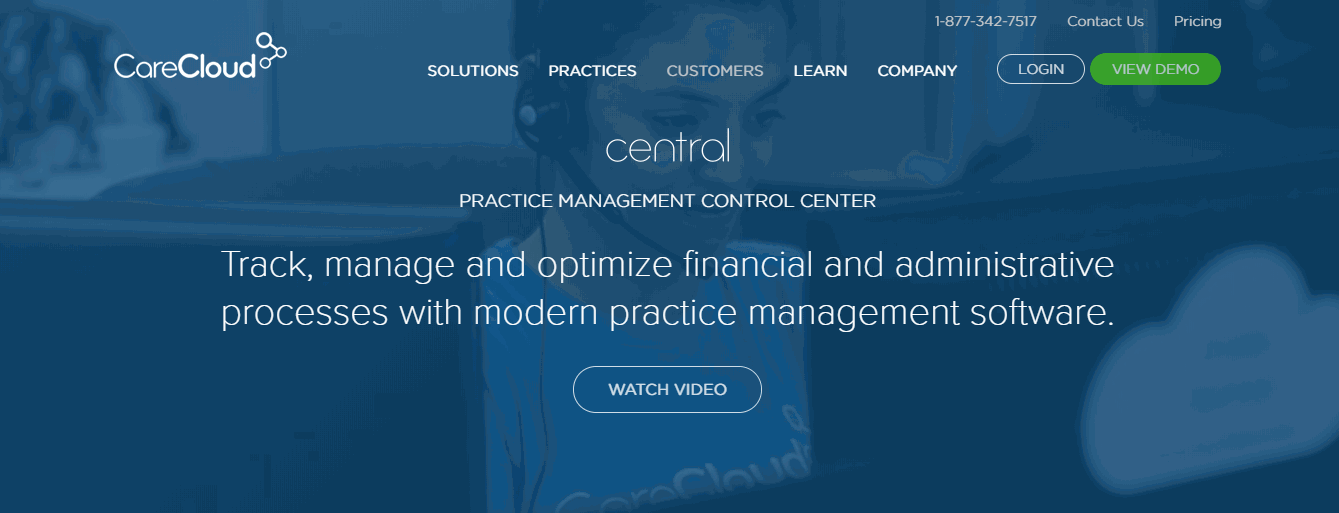
CareCloud is a Somerset, New Jersey-based publicly traded cloud PM + EHR + RCM platform used by 40,000+ US providers. The modular suite includes CareCloud Central (PM), CareCloud Charts (EHR), CareCloud Concierge (RCM service), and CareCloud Breeze (patient experience). The vendor trades on Nasdaq as CCLD. ONC 2015 Cures Update certified.
Get Best Quote for CareCloud
Connect with SaaSrat experts to get the best quote for your business.
You're all set!
A specialist for CareCloud will reach out within 1 business day.
CareCloud Features
Cloud Practice Management (CareCloud Central)
Cloud EHR (CareCloud Charts)
RCM Concierge service
Patient Experience (CareCloud Breeze)
Telehealth
CirrusAI clinical documentation automation
View All 27 Features
CareCloud Pricing Plans
CareCloud Central (PM)
- Per provider per month
- Cloud-based practice management and scheduling
- Billing rules engine and clean-claims automation
- Patient appointment reminders and document management
- Clearinghouse connectivity and denial management
- Reporting and productivity dashboards
CareCloud Charts (EHR)
- Per provider per month
- ONC 2015 Edition Cures Update certified EHR
- Specialty-driven, customizable templates
- e-Prescribing via Surescripts and EPCS
- Lab integrations (Quest Diagnostics, LabCorp)
- Patient portal and telehealth built in
CareCloud Concierge (RCM)
- End-to-end revenue cycle management service (typically 3 to 7 percent of collections)
- Dedicated client success manager
- Coding, claims scrubbing, denial follow-up
- Patient statements and collections
- Real-time financial analytics
CareCloud Breeze (Patient Experience)
- Per provider per month
- Patient check-in and digital intake forms
- Online appointment booking
- Patient payments and balance collection
- Two-way messaging and reminders
- Telehealth visit launch
CareCloud Resources
CareCloud Screenshots
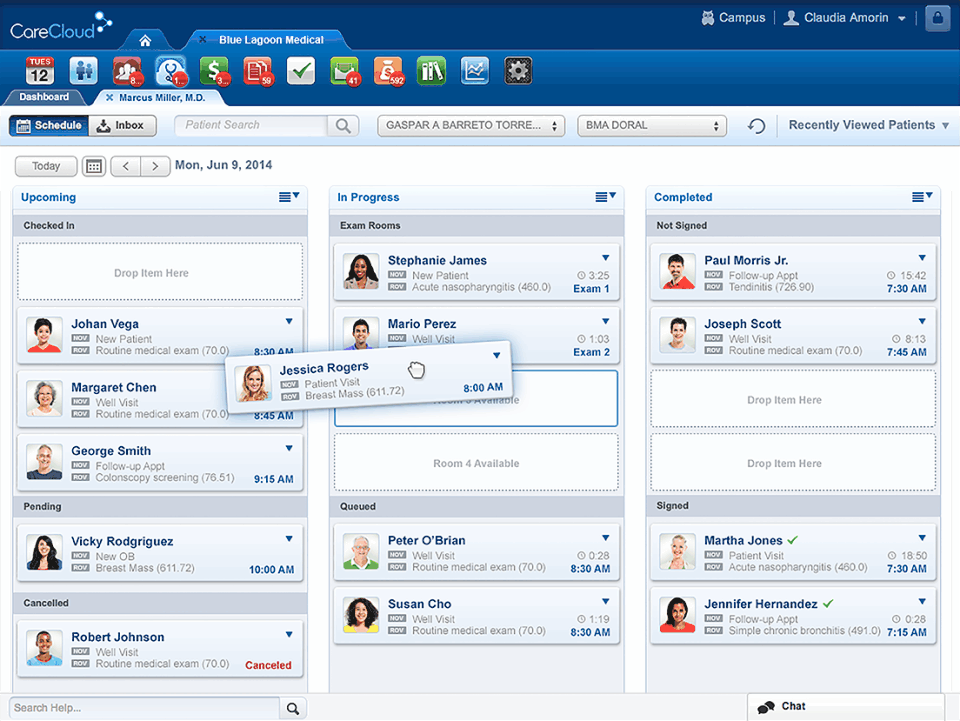
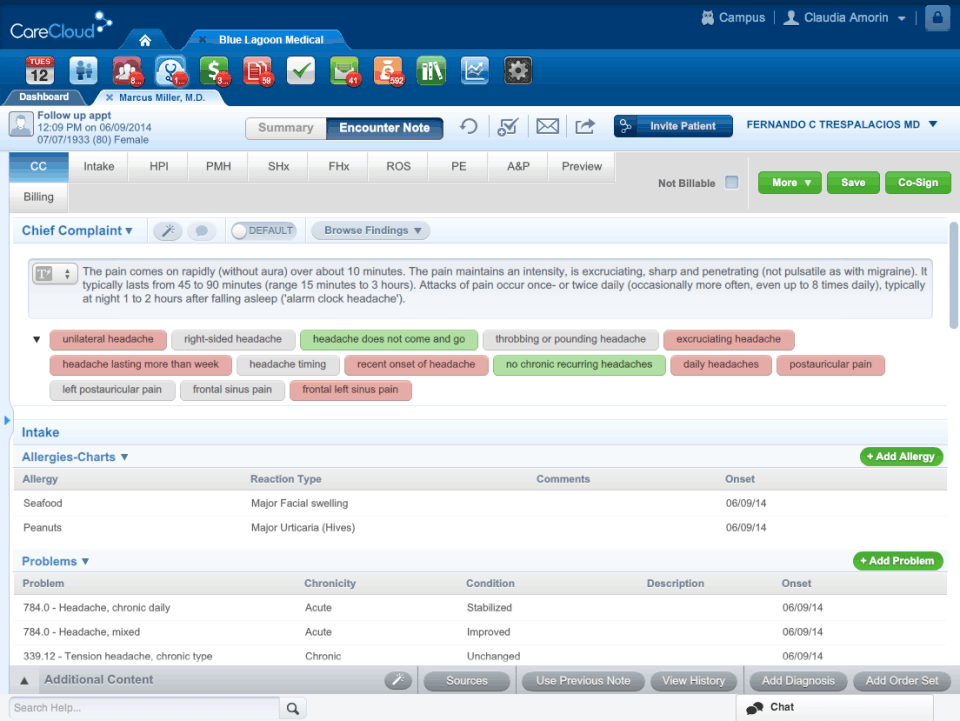
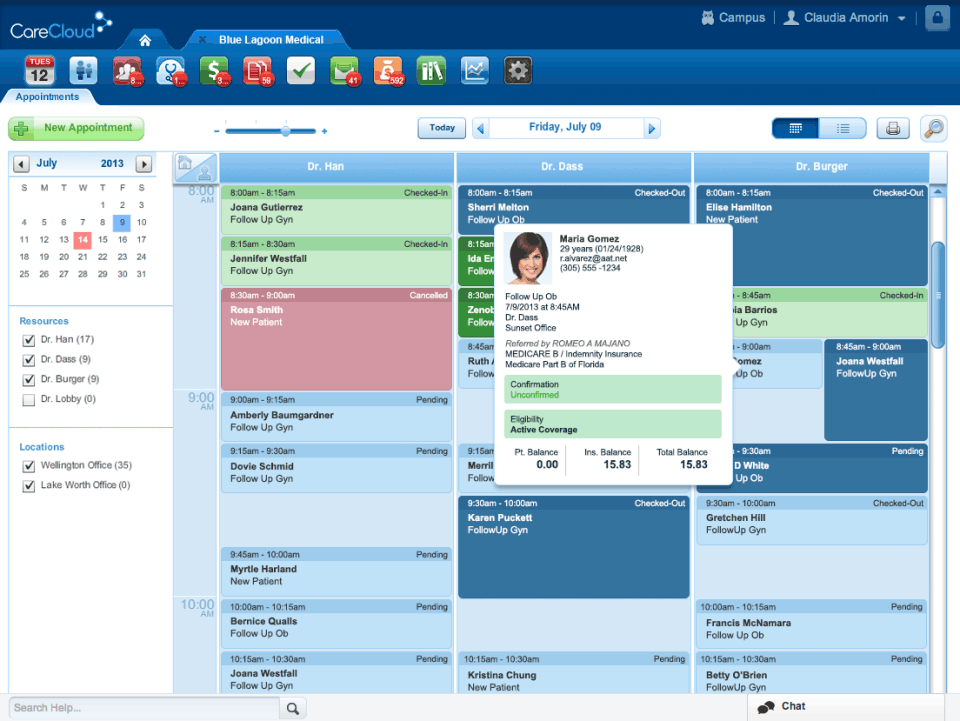
Description
| Vendor | CareCloud, Inc. (Nasdaq: CCLD) |
|---|---|
| Headquartered | Somerset, New Jersey, USA |
| Founded | 1999 |
| Best fit for | US specialty and multi-specialty ambulatory groups (5 to 50 providers) wanting modular cloud PM + EHR + RCM + patient experience |
| Pricing model | Quote-only per-provider monthly for Central, Charts, Breeze; Concierge RCM at 3 to 7 percent of collections (aggregator estimate) |
| Network scale | 40,000+ providers (vendor-published 2026) |
| Certifications | ONC 2015 Cures Update (ONC-ACB), SOC 2 Type II, HIPAA, HITRUST-aligned AWS hosting |
| Public status | Nasdaq: CCLD (rebranded from MTBC in 2021) |
Pros and Cons
Pros
- Intuitive, modern cloud interface that staff learn quickly.
- Strong practice analytics and customizable productivity dashboards.
- Concierge RCM service includes a dedicated case manager available by phone and email.
- Frequent free product updates and a continuous-improvement product cadence.
- Specialty-customizable Charts templates and widgets.
Cons
- Reports of occasional slowness, crashing, and unscheduled downtime.
- Customer support communication gaps. Reviewers describe issues going into a black hole and reps reading from scripts.
- Higher pricing with multi-year contracts and unexpected add-on charges after signing.
- Limited customization of analytic reports and global-only calendar settings.
- Lab integration and data migration to other systems requires manual workarounds.
Who Should Use CareCloud
CareCloud fits practices and ambulatory groups that want a modular cloud platform across PM, EHR, RCM, and patient experience, with the option to subscribe to any combination of the four. The right shortlist candidate is typically:
- A 5 to 50 provider US ambulatory group that values modular subscriptions over forced unified bundles.
- A specialty or multi-specialty practice that wants Charts EHR templates plus Concierge RCM under one vendor contract.
- A practice that prefers a publicly traded vendor (Nasdaq: CCLD) for financial transparency.
- A 10 to 30 provider group looking for AI documentation (cirrusAI) integrated into the EHR.
- A growing practice that wants Patient Experience tools (Breeze) bundled with PM and EHR.
Solo practices and very small groups typically find lighter alternatives like DrChrono, Tebra, or options in the EMR category more economical.
Product Suite
CareCloud's platform is modular across four flagship products plus AI and analytics add-ons:
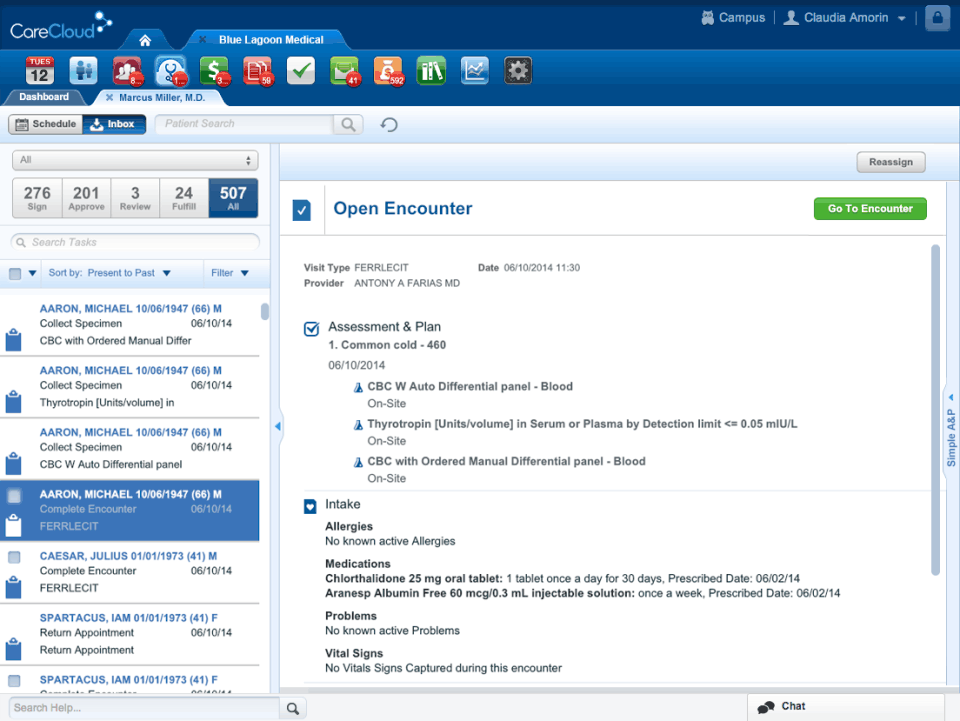
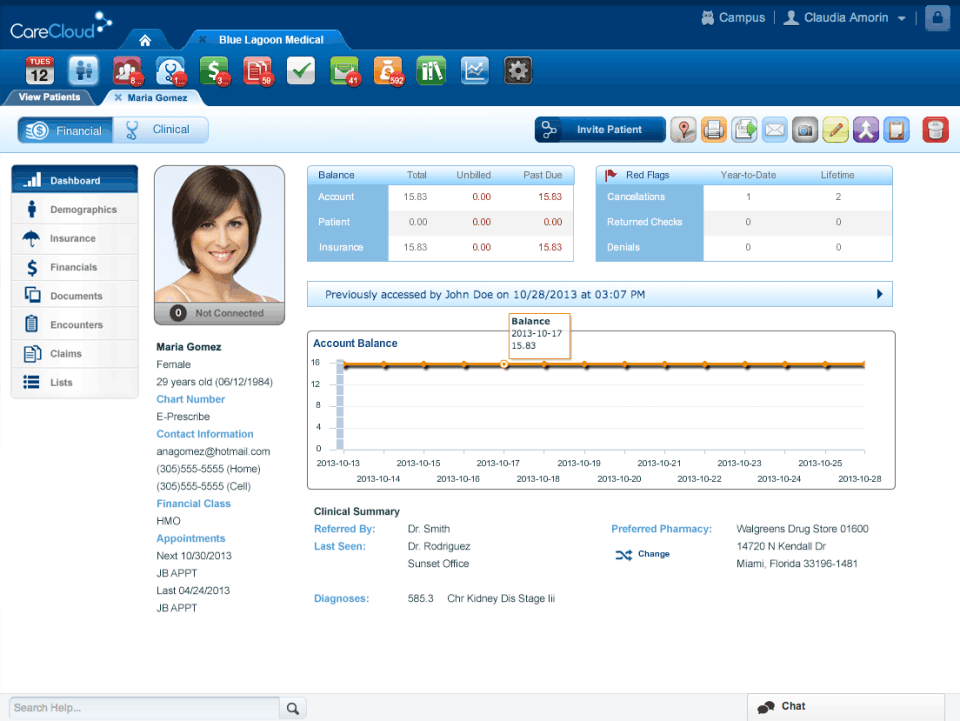
- CareCloud Central: cloud practice management with scheduling, billing rules engine, clean-claims automation, document management, clearinghouse connectivity, and denial management.
- CareCloud Charts: ONC 2015 Cures certified EHR with specialty-driven customizable templates, ePrescribing via Surescripts (with EPCS), lab integrations to Quest and LabCorp, patient portal, and built-in telehealth.
- CareCloud Concierge: end-to-end revenue cycle management service with dedicated client success manager, coding, claims scrubbing, denial follow-up, patient statements, and real-time financial analytics.
- CareCloud Breeze: patient experience module with check-in, digital intake forms, online appointment booking, patient payments, two-way messaging and reminders, and telehealth launch.
- cirrusAI: clinical documentation automation generating ambient SOAP notes during patient encounters.
- stratusAI Desk Agent: front-desk automation for appointment confirmation, intake routing, and patient communication.
- Chronic Care Management and Remote Patient Monitoring modules for value-based care.
- Robotic Process Automation for repetitive billing and admin workflows.
- Business Intelligence / Analytics and Interoperability Connector.
How Much Does CareCloud Cost
CareCloud does not publish per-provider numeric pricing on its website. Each of the four modules is quote-only and scoped to provider count, specialty, and module mix:
- CareCloud Central: aggregator references cite approximately $349 per provider per month (third-party estimate, not vendor-confirmed).
- CareCloud Charts: aggregator references cite approximately $349 per provider per month (third-party estimate).
- CareCloud Concierge: aggregator references cite 3 to 7 percent of collections for the full-service RCM offering.
- CareCloud Breeze: quote-only patient experience module.
For a 10-provider specialty group on Central + Charts + Breeze plus Concierge RCM at 5 percent of collections on $5M in annual collections, that translates to roughly $7,000 per month in software ($840 per year per provider per module) plus $250,000 per year in RCM fees. AI modules (cirrusAI, stratusAI) layer on top. Compare against published rates from eClinicalWorks and Tebra.
Hidden Costs and Contract Gotchas
- Multi-year contracts. Reviewers report multi-year terms with unexpected add-on charges. Itemize every module and add-on before signing.
- cirrusAI and stratusAI add-ons. AI modules are quoted separately on top of Charts and Central. Confirm whether your contract includes them.
- Concierge RCM percentage. Aggregator estimate of 3 to 7 percent of collections has wide variability. Negotiate based on specialty mix and claim volume.
- Implementation fees. Multi-module rollouts run 4 to 6 months. Get fixed implementation pricing with milestone payments.
- Annual escalators. Confirm and cap annual price increases in your master agreement.
- Support tier. Standard support has communication gaps per G2/Capterra reviews. Confirm whether premium support is needed.
- Data migration to other systems. Migrating off CareCloud requires manual workarounds; budget exit services if relevant to your procurement risk model.
Alternatives to CareCloud
Practices most commonly shortlist CareCloud against:
- athenahealth: percentage-of-collections unified bundle, Best in KLAS Independent Physician Practice Suite.
- eClinicalWorks: $449 to $599 per provider per month with 50+ specialty templates.
- NextGen Healthcare: specialty-templated EHR with strong FQHC footprint.
- Tebra: $49 to $799 per provider per month with bundled marketing tools.
- DrChrono: iPad-native EHR for small practices.
- AdvancedMD: tiered specialty bundles from $130 to $1,070 per provider per month.
- Praxis EMR: AI Concept-Processor EHR (template-free).
- Greenway Health Intergy: ambulatory EHR with FQHC presence.
- Practice Fusion (Veradigm): lighter browser EHR.
- Epic: enterprise option for large ambulatory networks.
What Real Buyers Report
CareCloud carries a 3.6 out of 5 G2 rating across 34 reviews and a 3.6 out of 5 Capterra rating across 112 reviews. The vendor self-reports 40,000+ providers on the platform. CareCloud was recognized in 2023 Best in KLAS Small Practice Ambulatory EMR/PM (2-10 Physicians); 2025 data is insufficient for a current ranking.
The praise themes from real customers are consistent: modern cloud UI, ease of learning, strong practice analytics and dashboards, Concierge RCM with named case manager, frequent product updates, and specialty-customizable templates. The complaint themes are equally consistent: slowness and downtime episodes, support black-hole behavior, multi-year contract surprises, limited analytics report customization, and rough data migration workflows.
Mid-size specialty groups tend to weigh the modular suite and Concierge RCM favourably. Solo and small group practices more frequently flag the pricing opacity and lean toward simpler per-provider competitors with published pricing.
Bottom Line
CareCloud is the right shortlist candidate when a 5 to 50 provider US ambulatory group wants a modular cloud platform across PM, EHR, RCM, and patient experience under one vendor contract, with the flexibility to subscribe to any combination. The publicly-traded status (Nasdaq: CCLD), ONC 2015 Cures Update certification, SOC 2 Type II, HIPAA, and HITRUST-aligned hosting cover the compliance bar that matters for ambulatory buyers.
It is the wrong choice when a practice wants transparent published pricing before quotes, when multi-year contracts with potential add-on surprises are a deal-breaker, or when support response time is mission-critical. Build implementation services, multi-year contract terms, AI module add-ons, and annual escalator caps into your total cost of ownership before signing. Then compare side-by-side with athenahealth, eClinicalWorks, Tebra, and AdvancedMD to confirm the modular subscription model fits your practice profile.
Frequently Asked Questions
How much does CareCloud cost?
CareCloud does not publish per-provider numeric pricing on its website. Each of the four modules (Central PM, Charts EHR, Concierge RCM, Breeze Patient Experience) is quote-only and scoped to provider count, specialty, and module mix. Industry aggregator references commonly cite CareCloud Central at $349 per provider per month and Concierge RCM at 3 to 7 percent of collections, but these are third-party estimates. Multi-year contracts and add-on charges (telehealth, AI modules) layer on top.
Is CareCloud ONC-certified for the 2015 Cures Update?
Yes. CareCloud Charts holds ONC 2015 Edition Cures Update certification from ONC-ACB. The platform is also SOC 2 Type II audited and HIPAA compliant, with HITRUST-aligned hosting on AWS. The company is publicly traded on Nasdaq under the ticker CCLD, providing additional financial transparency.
What are the four CareCloud products?
CareCloud's platform is modular: (1) CareCloud Central is the practice management module covering scheduling, claims, denial management, and reporting; (2) CareCloud Charts is the ONC-certified EHR with specialty templates, ePrescribing, and lab integration; (3) CareCloud Concierge is the full-service RCM offering with dedicated case manager; (4) CareCloud Breeze handles patient check-in, intake forms, online scheduling, payments, and two-way messaging. Practices can subscribe to any combination.
How does CareCloud compare to athenahealth and Tebra?
The three target overlapping segments. CareCloud Concierge RCM is comparable in scope to athenahealth's percentage-of-collections model. CareCloud's modular pricing lets practices subscribe to PM-only, EHR-only, or both, while athenahealth is a unified athenaOne bundle. Tebra publishes per-provider monthly pricing transparently while CareCloud quotes everything. See the full ranked list in the clinic management category.
Is CareCloud a good fit for specialty practices?
Yes. CareCloud Charts ships specialty-customizable templates and widgets, and 40,000+ providers in the customer base span multi-specialty groups. The platform's strength is in 5 to 50 provider practices that value a modular suite over a forced unified bundle. Solo practices typically find lighter alternatives like DrChrono or Practice Fusion more economical.
Does CareCloud have AI documentation?
Yes. cirrusAI is CareCloud's clinical documentation automation module, generating ambient SOAP notes during the patient encounter. stratusAI Desk Agent automates front-desk tasks (appointment confirmation, intake routing). Both AI modules are quote-only add-ons on top of Charts and Central. Competing ambient scribes (Nuance DAX, Abridge, Sunoh.ai) work across EHRs while cirrusAI is tightly integrated with CareCloud Charts.
How long does CareCloud implementation take?
Single-module implementations (Central or Charts alone) typically go live in 60 to 90 days for small groups. Full PM + EHR + RCM rollouts for multi-specialty groups commonly run 4 to 6 months. The vendor's services team handles data migration, payer enrollment, and template configuration. Reviewers note multi-year contracts and unexpected add-on charges as the biggest contract concern, so itemize implementation deliverables in writing before signing.
What integrations does CareCloud support?
CareCloud integrates with Surescripts for ePrescribing (including EPCS), Quest Diagnostics and LabCorp for labs, TriZetto for clearinghouse, ChartLogic, Relatient for patient engagement, NextPatient for online scheduling, PrecisionBI for analytics, Stripe and integrated payments, and Zoom for telehealth. The Interoperability Connector handles HL7 and FHIR exchange with hospital EHRs and HIEs.
What are the biggest complaints about CareCloud?
The recurring themes across G2 (3.6/5 across 34 reviews) and Capterra (3.6/5 across 112 reviews) are: (1) occasional slowness, crashing, and unscheduled downtime; (2) customer support communication gaps where issues go into a black hole and reps read from scripts; (3) higher pricing with multi-year contracts and unexpected add-on charges; (4) limited customization of analytic reports and global-only calendar settings; (5) lab integration and data migration to other systems requires manual workarounds.
Is CareCloud publicly traded?
Yes. CareCloud trades on Nasdaq under the ticker CCLD (rebranded from MTBC in 2021). Public trading provides additional financial transparency for buyers concerned about vendor longevity, with quarterly earnings reports, audited financials, and SEC filings available. For practices that prefer privately-held vendors with less quarterly pressure, alternatives like Tebra (private), DrChrono (EverCommerce subsidiary), or AdvancedMD (Marlin Equity Partners) may map differently.
Find Your Perfect Software
See how it can transform your workflow
- Personalized for your needs Tailored recommendations based on your unique requirements.
- Save time & resources Streamline your workflow and boost team productivity.
- Trusted by thousands Join 10,000+ businesses already growing with SaaSrat.
You're all set! 🎉
A specialist for will reach out within 1 business day with tailored recommendations for your needs.