
What is Acumatica?
Acumatica is a cloud ERP platform built for mid-market distribution, manufacturing, and construction businesses. It uses consumption-based pricing with unlimited users included, making it cost-effective for large teams. Available exclusively through certified implementation partners.
Get Best Quote for Acumatica
Connect with SaaSrat experts to get the best quote for your business.
You're all set!
A specialist for Acumatica will reach out within 1 business day.
Acumatica Features
Financial Management
Multi-Entity Accounting
Multi-Currency
Order Management
Inventory Management
Warehouse Management
View All 18 Features
Acumatica Pricing Plans
Consumption-Based Subscription
- No per-user fees
- Priced on: applications used, transaction volume, and data storage
- Typical range: $12,000 to $60,000+/year
- Industry-specific editions: Manufacturing, Distribution, Commerce, Construction, Field Service
- Annual contract required
- Implementation services quoted separately
- Contact Acumatica or an authorized partner for a formal quote
Acumatica Resources
Acumatica Screenshots
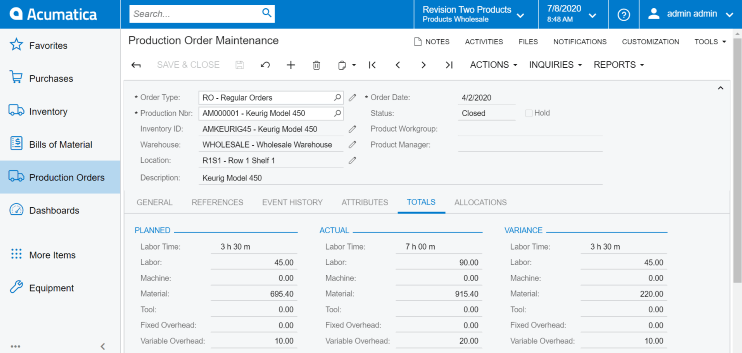
Description
Acumatica at a Glance
| Best fit for | Mid-market companies in distribution, manufacturing, construction, or retail that want no per-user pricing and a strong open API |
|---|---|
| Company size | 20 to 1,000 employees; strongest fit at 50 to 500 |
| Deployment | Cloud, SaaS; also available as private cloud or on-premises |
| Pricing model | Consumption-based (by transaction volume and resource usage), not per-user; quote required |
| Free trial | No public trial; demo available through a certified partner |
| Per-user fees | No; unlimited users included at all tiers |
| Industry verticals | Distribution, manufacturing, construction, field service, commerce, non-profit |
| Open API | Yes, well-documented REST API with open source components |
| Mobile app | Yes, iOS and Android |
Acumatica Pros and Cons in 2026
Where Acumatica Stands Out
No per-user pricing. Acumatica charges based on transaction volume and computing resources consumed, not the number of users who log in. You can add your entire team, all your accountants, and every warehouse employee without paying per seat. For mid-market companies with 50 or more users that need ERP access, this pricing model can produce significantly lower total costs than per-user systems like NetSuite or Microsoft Dynamics.
Strong distribution and manufacturing modules. Acumatica's Distribution Edition covers inventory, purchase orders, sales orders, and warehouse management with depth that rivals tools costing far more. The Manufacturing Edition adds bill of materials, production orders, material requirements planning, and advanced scheduling. For distribution and manufacturing companies evaluating ERP for the first time, Acumatica is often the most cost-effective fit.
Cloud-native platform with open API. Acumatica was built as a cloud-native platform from the beginning, not a legacy on-premises system moved to the cloud. The REST API is well-documented and open, which means development work is straightforward for internal teams and integration partners. The open source components give the platform unusual flexibility compared to proprietary ERP systems.
Flexible deployment options. While most customers use Acumatica on the public cloud, private cloud and on-premises deployments are also available. For businesses in regulated industries or with specific data residency requirements, this flexibility is a meaningful advantage over cloud-only competitors.
Modern user interface. Acumatica has invested consistently in its interface design. The platform is generally considered easier to navigate than SAP Business One or older Microsoft Dynamics versions, which reduces training time and end-user resistance during go-live.
Where Acumatica Falls Short
Less name recognition than NetSuite or SAP. Acumatica has around 9,000 customers globally compared to NetSuite's 37,000+. The smaller install base means a smaller ecosystem of certified partners, third-party apps, and online community resources. Finding experienced Acumatica implementation partners in some geographies can be harder than finding NetSuite or SAP partners.
Consumption pricing is hard to estimate without a partner. Because pricing is based on resource consumption rather than users, it is difficult to estimate costs independently. You need a certified partner to scope the implementation and model pricing based on your transaction volumes. This makes comparison shopping harder than with per-user pricing tools.
Implementation requires a certified partner. Acumatica sells exclusively through certified reseller and implementation partners. You cannot buy directly from Acumatica or implement it without partner involvement. Implementation timelines are typically three to nine months depending on complexity.
Financial reporting depth is less than Sage Intacct. Acumatica's financial management is solid for a general ERP platform, but it lacks the dimensional GL depth, AICPA endorsement, and pure accounting specialization of Sage Intacct. Companies whose primary driver is financial reporting sophistication rather than operations are often better served by Sage Intacct.
Who Should Use Acumatica?
Acumatica is the right fit for mid-market companies in distribution, manufacturing, construction, and field service that need ERP-level operations management without per-user seat fees. It works best when your organization has 50 or more employees who need system access, when you run multi-location operations, or when you need deep inventory, production, or construction project tracking in one platform. Companies where the total cost of per-user ERP would exceed Acumatica's consumption-based pricing get the most direct financial benefit.
It is the wrong fit for small businesses under 20 employees, businesses that primarily need accounting depth rather than operations management, or organizations that want a fixed monthly price without a partner-led implementation. For pure financial management needs at smaller scale, see our accounting software guide. For businesses comparing mid-market ERP options, see our ERP software guide for a full side-by-side breakdown.
Acumatica Product Features
Financial Management
General ledger, accounts payable, accounts receivable, multi-currency, cash management, fixed assets, and intercompany accounting. Tax management covers US sales tax and international VAT. The financial module supports multi-entity consolidation and dimensional reporting by project, department, or cost center.
Distribution and Inventory
Inventory management with multi-location warehousing, lot and serial tracking, purchase orders, sales orders, shipping management, and landed cost calculation. The Distribution Edition handles high-volume order processing with automated replenishment and vendor-managed inventory options.
Manufacturing
Bill of materials, production orders, material requirements planning (MRP), capacity planning, and shop floor control. Supports make-to-stock, make-to-order, and engineer-to-order production models. The manufacturing module is one of Acumatica's strongest differentiators against Sage Intacct and QuickBooks.
Construction Project Management
Project cost tracking, change order management, subcontractor management, certified payroll, and AIA billing for construction companies. One of the stronger construction ERP modules in the mid-market. The construction edition integrates job costing directly with the general ledger for real-time project profitability.
Field Service
Work order management, scheduling and dispatch, technician mobile app, service contracts, and equipment maintenance tracking. Field technicians can access and update work orders from mobile devices in the field, with offline capability for areas with poor connectivity.
Project Accounting
Project budgeting, cost tracking, billing milestones, time and expense management, and project profitability reporting. The project accounting module links directly to the general ledger, so project costs and revenue flow into financial statements without manual journal entries.
Reporting and Dashboards
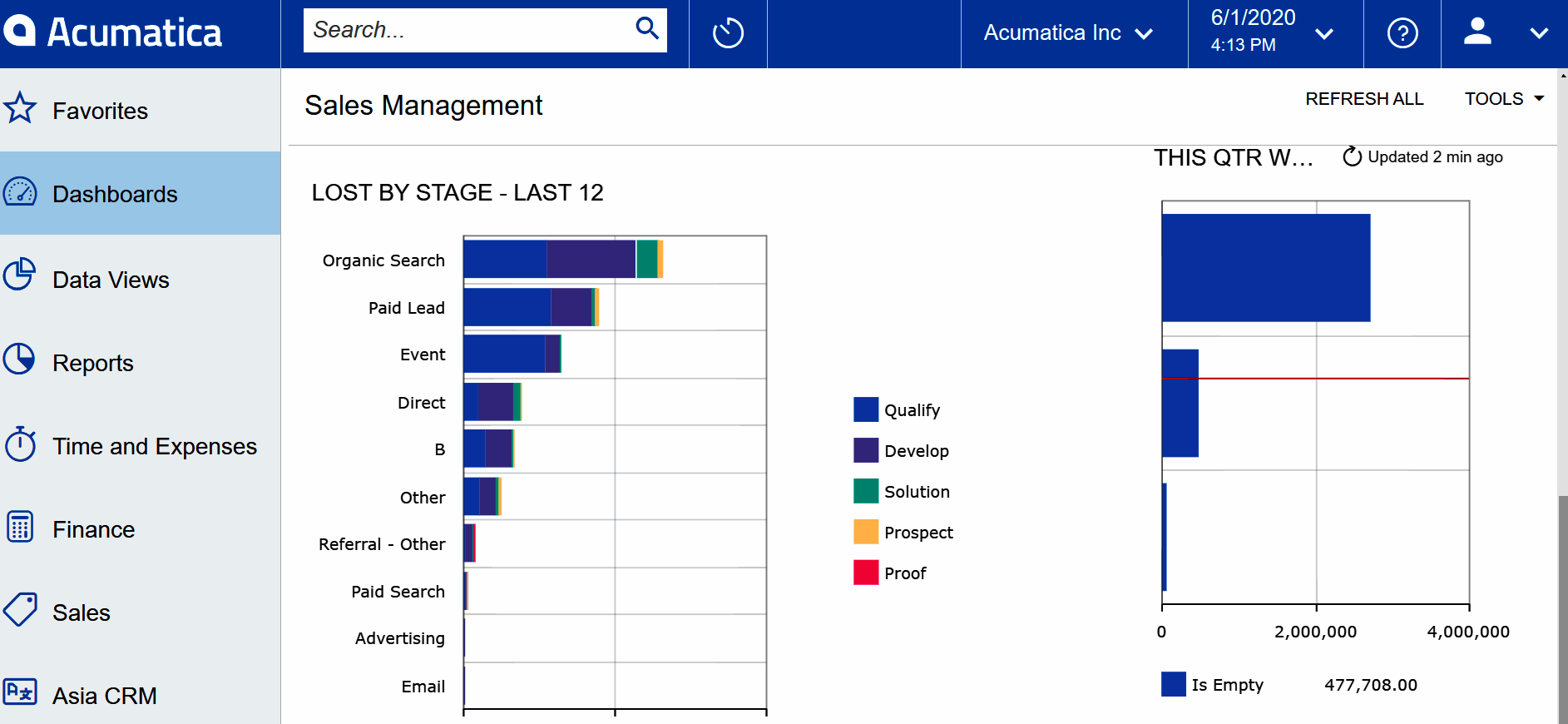
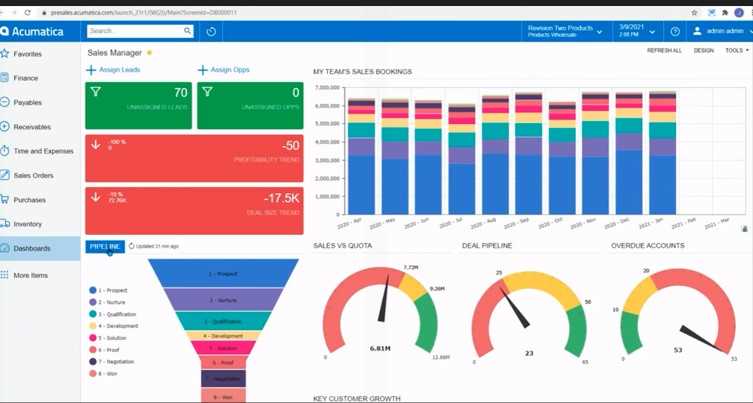
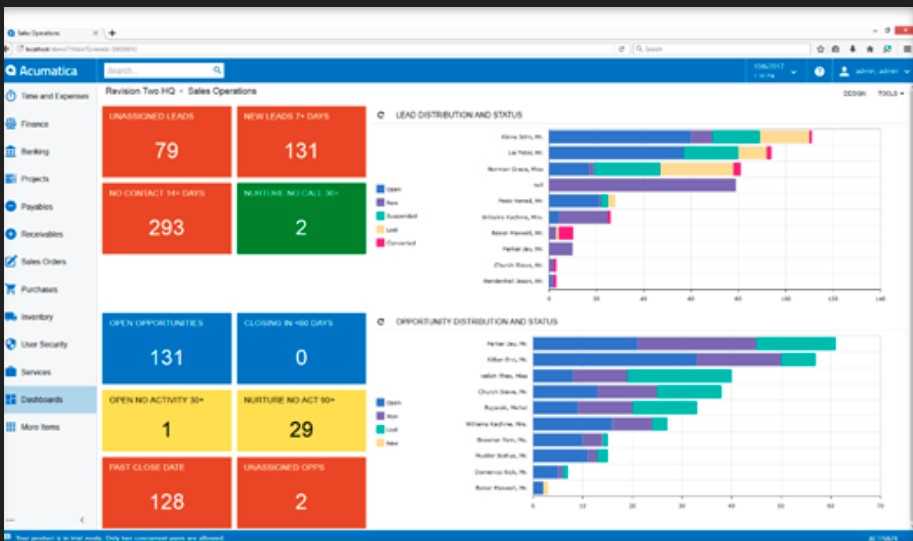
Real-time dashboards with configurable KPI widgets. The Generic Inquiry tool builds custom reports without custom code. Report Viewer covers standard financial and operational reports. Advanced plans add business analytics with direct Excel sync for custom dashboards. All reports update in real time as transactions post.
How Much Does Acumatica Cost in 2026?
Acumatica does not publish pricing. All contracts are quoted through certified partners based on resource consumption (transaction volumes, data storage, API calls) and modules selected. The figures below are based on independent research from ERP analysis firms and are not official Acumatica rates.
| Tier | Indicative Annual Cost | Typical Profile |
|---|---|---|
| Small business | $20,000 to $40,000/year | Single location, basic financials and distribution, low transaction volume |
| Mid-market | $40,000 to $180,000/year | Multiple locations, manufacturing or distribution modules, higher transaction volume |
| Complex deployments | $180,000+/year | Multi-entity, advanced manufacturing, high-volume transactions, multiple modules |
Implementation costs are separate and typically range from $30,000 to $200,000+ depending on scope. Because pricing is consumption-based, actual costs depend on your specific transaction volumes, which your implementation partner will model during the sales process.
Hidden Costs to Watch For
- Implementation services. Acumatica is sold exclusively through partners. Implementation fees are mandatory and scale with the complexity of modules, data migration, and integrations. Budget 1x to 2x the first-year license cost for implementation.
- Module licensing. Core financials are included in the base license. Distribution, manufacturing, construction, field service, and commerce are separate modules with separate license costs. Adding modules after the initial contract increases the annual cost.
- Consumption overage. If your transaction volume grows beyond the contracted tier, costs increase. Understand the consumption tiers and growth assumptions before signing the initial contract to avoid mid-year surprises.
- Customization development. Acumatica's open API allows extensive customization, but development work is billed at partner consulting rates. Custom workflows, reports, and integrations beyond the standard platform add ongoing development costs.
- Training. End-user and administrator training is typically a separate line item in the implementation project. Acumatica University provides online training courses, some included and some at extra cost.
Acumatica vs the Alternatives
NetSuite ERP is the primary alternative for companies needing the largest mid-market ERP ecosystem and global multi-subsidiary support. NetSuite has 37,000+ customers and charges per user, where Acumatica does not. For companies with large teams needing ERP access, Acumatica's consumption pricing often wins on total cost. For companies prioritizing ecosystem size and partner availability, NetSuite wins.
Sage Intacct is the alternative for mid-market companies with multi-entity structures and deep financial management needs. Sage Intacct is deeper on pure financial management, AICPA-endorsed, and preferred by CFOs whose primary requirement is financial reporting rather than operational ERP. Acumatica covers more operational modules.
QuickBooks Online Advanced is the alternative for growing companies not yet ready for ERP complexity or cost. QuickBooks is simpler and far less expensive. Acumatica is appropriate when operational complexity requires ERP-level workflow, multi-location management, or manufacturing integration.
Microsoft Dynamics 365 Business Central is the alternative for companies already in the Microsoft 365 ecosystem. Dynamics has deeper Microsoft integration and a large partner network. Acumatica is more flexible and does not require per-user licensing at scale.
For a full comparison of mid-market ERP options, see our ERP software guide.
What Real Buyers Report About Acumatica
Companies that choose Acumatica over NetSuite most commonly cite the no-per-user pricing model as the deciding factor. For distribution and manufacturing businesses with 50 or more warehouse staff, receiving clerks, and production employees who need system access, the difference between per-user and consumption pricing can be $100,000+ over a three-year contract. This financial calculation drives a large share of Acumatica's competitive wins.
The most consistent criticism from buyers is implementation timeline overruns and the difficulty of finding experienced implementation partners in some regions. Businesses outside major metro areas report longer timelines to find a qualified partner and higher travel costs when working with partners who need to be on-site for go-live. Selecting a partner with industry-specific Acumatica experience in your vertical (distribution vs. construction vs. manufacturing) significantly affects implementation quality. Post-implementation, the most consistent positive feedback is on the API flexibility and the manufacturing module depth.
Acumatica Integrations and App Ecosystem
Acumatica's open API and integration framework support connections with most enterprise software platforms. CRM integrations include Salesforce (pre-built bidirectional connector for contacts, opportunities, and orders) and HubSpot via middleware. For ecommerce, native connectors cover Shopify, BigCommerce, WooCommerce, and Magento for order and inventory sync. See our ecommerce software guide for platforms with Acumatica connectors.
Payroll integrations include ADP, Paychex, and other payroll providers via API or pre-built connectors. For expense management, Concur and Expensify support expense report import and reimbursement. EDI platforms including SPS Commerce handle B2B trading partner integration in retail and distribution. Shipping integrations include ShipStation and ShipBob for fulfillment. Middleware platforms including Celigo, Workato, Boomi, and MuleSoft have pre-built Acumatica connectors for complex integration scenarios. Bank feeds from major US and international banks are available via direct connection for automatic transaction import.
Security and Compliance
Acumatica holds SOC 1 Type II and SOC 2 Type II certifications from annual independent audits covering security, availability, and processing integrity controls. Cloud hosting infrastructure meets ISO 27001 information security management standards. The platform is GDPR compliant with data residency and processing controls for EU data subjects. Role-based access controls cover granular user permissions at the module, screen, and field level, supporting segregation of duties for audit requirements. Transaction history is maintained as a complete, immutable audit trail with user, timestamp, and change detail for every record modification. Data is encrypted with TLS 1.2+ in transit and AES-256 at rest. Public cloud (multi-tenant), private cloud (single-tenant), and on-premises deployment options are available for organizations with data isolation requirements.
Bottom Line: Is Acumatica Right for You?
Acumatica is the strongest ERP choice for mid-market distribution, manufacturing, and construction companies that need to give system access to a large number of employees without paying per-user fees. The no-per-user pricing model is a genuine structural advantage over NetSuite and Dynamics for businesses with 50+ system users. If your primary need is financial management sophistication rather than operational ERP, Sage Intacct is a more focused fit. If you need the largest ecosystem and global support infrastructure, NetSuite is more established.
The implementation investment is real and not optional. Acumatica sells exclusively through partners, and a skilled partner makes a significant difference in implementation quality and timeline. Budget the implementation as part of the total investment, not as an afterthought. Get quotes from at least two certified partners before committing, and prioritize partners with proven experience in your specific industry vertical. See our ERP software guide for a full side-by-side comparison with NetSuite, Sage Intacct, and Microsoft Dynamics.
Frequently Asked Questions
How does Acumatica pricing work?
What industries does Acumatica serve?
How does Acumatica compare to NetSuite?
How long does Acumatica implementation take?
Does Acumatica work for manufacturing businesses?
Does Acumatica have a mobile app?
Can Acumatica handle multi-currency and multi-entity?
Does Acumatica work with Shopify or other ecommerce platforms?
What is the difference between Acumatica cloud and on-premises deployment?
Does Acumatica include payroll?
Find Your Perfect Software
See how it can transform your workflow
- Personalized for your needs Tailored recommendations based on your unique requirements.
- Save time & resources Streamline your workflow and boost team productivity.
- Trusted by thousands Join 10,000+ businesses already growing with SaaSrat.
You're all set! 🎉
A specialist for will reach out within 1 business day with tailored recommendations for your needs.