TeamSense
by TeamSense
What is TeamSense?
Get Best Quote for TeamSense
Connect with SaaSrat experts to get the best quote for your business.
You're all set!
A specialist for TeamSense will reach out within 1 business day.
TeamSense Features
Pulse surveys
Feedback collection
Recognition and rewards
Performance tracking
Goal setting
Employee well being
View All 108 Features
TeamSense Resources
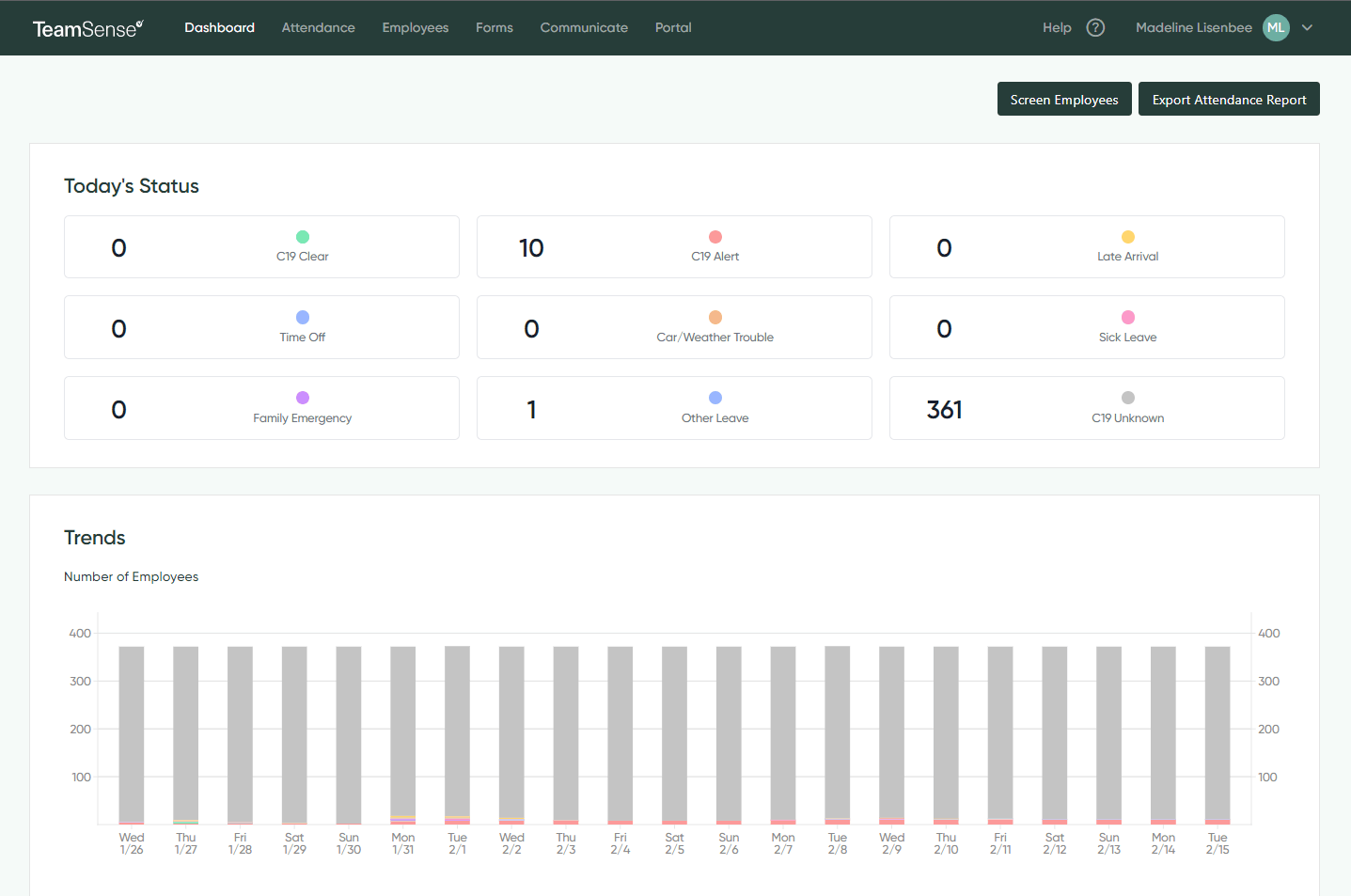
TeamSense Screenshots
Description
TeamSense at a Glance
| Company | TeamSense |
|---|---|
| Headquarters | Kirkland, Washington, United States |
| Category | Absence management, frontline communication, hourly workforce HR |
| Best for | Manufacturing and logistics operations with multi-shift hourly workforce |
| Model | Text-first with any-language translation, syncs to HRIS automatically |
| Named outcomes | 39% absenteeism reduction, $2.6M labor cost stabilized, 17% eNPS lift, Toyo Tires 53% to 34% turnover |
TeamSense Overview
TeamSense is a text-first absence reporting and frontline workforce communication platform aimed at manufacturing, logistics, and multi-shift hourly workforce operations. The pitch is meeting employees where they are: a hourly worker on a factory floor does not have a corporate email or an HRIS login, but they do have a personal phone that can text.
The platform replaces voicemail-based call-off systems and paper attendance forms. Vendor-reported outcomes across the customer base include 39 percent absenteeism reduction, USD 2.6M labor cost stabilization, 17 percent eNPS lift, and a named case at Toyo Tires cutting turnover from 53 percent to 34 percent.
TeamSense Capabilities and Named Features
Text-based absence reporting is the anchor product. Employees text their absence in a few taps, pick a reason from a menu, and the system logs the absence in the HRIS instantly. No voicemail transcription, no missed details, no paper forms.
Any-language support removes a real barrier for multilingual hourly workforces. Employees text in their native language and the platform translates automatically. Two-way communication for safety notices, updates, and reminders flows the same way.
HRIS integration is a real differentiator: TeamSense syncs to the HR system so absences flow into timecards and attendance points without manual updates. That is the point at which shift planners stop reconciling paper forms with HR data.
AI Assistance for the Frontline is layered on top of the base attendance product. Employees can text questions about policies, benefits, or schedules and get instant AI-generated answers, and leaders get real-time visibility into trends, engagement, and performance across every site.
Named feature list
- Text-based absence reporting with reason menu
- Interactive Voice Response (IVR) for phone-based call-off
- Timestamped audit trail of all absences
- Any-language translation for two-way communication
- HRIS integration syncing absences to timecards
- Attendance point tracking
- Employee visibility into own points and history before call-off
- Real-time absence alerts for shift planners
- Broadcast messaging to reach every worker fast
- Analytics with trend lines and heat maps
- Automate frontline workflows (overtime, safety incident, PPE sizing, pulse survey, shift preference, transportation, carpool)
- AI-powered instant answers to HR and policy questions
- 24/7 multilingual answers covering every shift and every site
- Employee portal for policies and documents via text
- Insights into common queries surface policy gaps
- Integrations with HRIS and HR systems
- Enterprise-ready pricing that scales predictably
TeamSense Pricing
TeamSense publishes three named plans on the vendor pricing page but headline pricing is enterprise-scaled and Contact Vendor. The plans are outcome-based: Visibility, Action, and Autonomy, each covering deeper capability.
Pricing is built to workforce size, number of sites, and the productivity results the buyer is driving. The vendor does not publish flat prices because frontline environments vary, but pricing is described as consistent, predictable, and designed to scale from single sites to global operations.
| Tier | Price | What is included |
|---|---|---|
| Visibility | Contact Vendor | Shared attendance truth. Employees see points and attendance history in real time before call-off. Clear, timestamped call-offs reduce disputes. Leaders get early visibility to plan every shift. Establishes single source of truth across HR and Ops. Best for teams starting with attendance clarity. |
| Action | Contact Vendor | Most Popular. Everything in Visibility plus Analytics (trends and heat maps) revealing what is driving absences. Broadcast messages to reach every worker fast. Employee portal to access policies and documents via text. Automate frontline workflows (overtime requests, safety incident reports, PPE sizing, pulse surveys, shift preferences, transportation and carpool). |
| Autonomy | Contact Vendor | Everything in Action plus AI-powered automation: instant answers to HR and policy questions via text, 24/7 multilingual answers covering every shift and every site, insights into queries surface policy gaps enabling HR to stay proactive not reactive. Best for organizations ready to scale with AI-powered capabilities. |
TeamSense Pros
- Text-first design meets hourly workers where they are: no email, no login, just a phone number.
- Vendor-reported outcomes are concrete: Toyo Tires cut turnover from 53% to 34%, 39% absenteeism reduction, 50% fewer no-call/no-shows in 45 days.
- Any-language translation removes a real barrier for multilingual manufacturing and logistics workforces.
- HRIS integration syncs absences to timecards without manual entry: point-tracking becomes automatic.
- AI-powered instant answers to HR policy questions reduces HR call volume on the Autonomy tier.
- Enterprise-ready pricing scales predictably from single-site pilots to global operations.
TeamSense Cons and Trade-offs
- All commercial pricing is Contact Vendor: smaller single-site operators cannot self-serve budget.
- Focus is manufacturing and logistics hourly workforces: white-collar or knowledge-worker HR teams get less benefit.
- AI-powered features are Autonomy-tier only, which raises the price for teams that want instant HR question answering.
- HRIS integration depth varies by system: buyers should validate specific HRIS support during a demo.
- The single-source-of-truth benefit requires clean baseline HR data: teams with legacy paper trails may need cleanup before rollout.
TeamSense vs Alternatives
| Capability | TeamSense | Workday HCM | Beekeeper |
|---|---|---|---|
| Core focus | Text-first absence reporting plus frontline comms for hourly workforce | Full HCM suite for large enterprises | Frontline mobile app for team communication |
| Employee entry point | Text (SMS) plus IVR, no login required | Workday login required | Beekeeper mobile app with login |
| Absence reporting depth | Real-time text call-off plus reason menu plus HRIS sync | Full HR case management inside Workday | Team messaging and updates focus |
| Multi-language | Any-language translation baked in | Localized Workday tenant | Multi-language messaging in the app |
| Best for | Manufacturing and logistics hourly workforces | Enterprise HR org-of-record | Frontline mobile-first team engagement |
| Public pricing | Contact Vendor across tiers | Contact Sales enterprise licensing | Contact Sales |
Who Should Choose TeamSense
TeamSense is a fit for a manufacturing, logistics, or multi-shift hourly workforce operation where the daily pain is voicemail-based call-off, paper attendance forms, and shift-planner reconciliation. Multi-site operators plus multilingual workforces get the biggest lift.
It is less of a fit for white-collar knowledge-worker HR teams (where employees have corporate email and HRIS logins), and for very-small single-site operations where a spreadsheet still works. Buyers focused on team engagement mobile app first may lean Beekeeper.
Named Alternatives to TeamSense
- Workday HCM. Full enterprise HCM with attendance modules. Chosen when the buyer needs a single system-of-record HR platform across all worker types.
- Beekeeper. Frontline mobile app for team communication and engagement. A better fit when the primary purchase is frontline mobile engagement, not attendance.
- YOOBIC. Frontline enablement platform with training and communication. Preferred when task management and training are the priority.
- Blink. Frontline app for hourly worker communication. Chosen when the buyer wants a mobile-first engagement app.
- When I Work. Employee scheduling and time tracking for SMB hourly workforces. Preferred when scheduling and timesheets are the primary need.
TeamSense Implementation and Deployment
Rollouts start with the Visibility tier at a pilot site: employees text their absences, points and history flow into the HRIS, and shift planners see call-offs in real time. Vendor-reported outcome is 50 percent fewer no-call/no-shows in the first 45 days.
Action tier adds analytics (trends and heat maps), broadcast messaging, and automated workflows (overtime requests, safety incident reports, PPE sizing). Rollouts typically expand from pilot site to full multi-site during phase two.
Autonomy tier adds AI-powered instant answers to HR policy questions. Teams enable it once employees have a baseline volume of policy questions and HR needs proactive insights into query gaps. The Toyo Tires case study progresses through all three tiers.
What Real Buyers Say About TeamSense
The vendor publishes a Toyo Tires case study describing turnover reduction from 53 percent to 34 percent using TeamSense to address rigid attendance policies in automotive manufacturing. See the vendor TeamSense home page for the current customer case study feed.
Public commentary on manufacturing HR forums positions TeamSense as one of the first text-first absence platforms built specifically for hourly manufacturing and logistics workforces, with the multi-language plus HRIS-sync combination as a real moat.
The trade-off most reviewers name is the Contact Vendor pricing model. Single-site operators looking for self-serve pricing should scope their workforce size before the demo, since pricing scales meaningfully with worker count.
Sources
- vendor website, TeamSense Pricing page listing Visibility, Action, and Autonomy tiers
- vendor website, TeamSense home page describing text-first absence reporting and named customer outcomes
Frequently Asked Questions about TeamSense
What is TeamSense?
A text-first absence reporting and frontline workforce communication platform for manufacturing, logistics, and multi-shift hourly workforce operations. Employees call off via text, and the system syncs absences to the HRIS.
How do employees report absences?
By text (SMS) or Interactive Voice Response (IVR). No corporate email, no HRIS login, no app install required. Employees pick a reason from a menu and the absence is logged with a timestamped audit trail.
Does TeamSense support multiple languages?
Yes. Any-language translation is baked in for both call-off and two-way broadcast communication. Employees text in their native language and the platform translates automatically.
What outcomes have customers reported?
Toyo Tires cut turnover from 53 percent to 34 percent. Vendor-reported across the customer base: 39 percent absenteeism reduction, USD 2.6M labor cost stabilized, 17 percent eNPS lift, 50 percent fewer no-call/no-shows in 45 days, 60 percent reduction in unplanned absences within the first few months.
Does TeamSense integrate with my HRIS?
Yes. TeamSense syncs absences automatically to the HR system so timecards and attendance points stay up to date. Specific HRIS support depends on the buyer platform; validate during a demo.
What is the difference between Visibility, Action, and Autonomy?
Visibility is shared attendance truth. Action adds analytics, broadcast messaging, employee portal, and workflow automation. Autonomy adds AI-powered instant answers to HR and policy questions with 24/7 multilingual coverage.
Is there public pricing?
No. Pricing is Contact Vendor and is scaled by workforce size, number of sites, and productivity results the buyer is driving.
Where is TeamSense headquartered?
TeamSense is headquartered in Kirkland, Washington, United States.
The Bottom Line on TeamSense
TeamSense is a fit for a manufacturing or logistics operation with a multi-shift hourly workforce where voicemail-based call-off, paper attendance forms, and shift-planner reconciliation are the daily pain. Multi-site plus multilingual workforces get the biggest lift.
The tradeoffs are Contact Vendor pricing and Autonomy-tier-gated AI features. White-collar HR teams or very-small single-site operators may not see the value, and buyers focused on frontline mobile engagement may lean Beekeeper.
A useful evaluation is to pilot the Visibility tier at a single site for 45 days and measure absenteeism reduction, no-call/no-show drop, and shift planner time saved. The Toyo Tires case study trajectory (53% to 34% turnover) provides a real reference for what full rollout produces.
Verified on 2026-08-01 against vendor website.
Frequently Asked Questions
What is TeamSense?
How do employees report absences?
Does TeamSense support multiple languages?
What outcomes have customers reported?
Does TeamSense integrate with my HRIS?
What is the difference between Visibility, Action, and Autonomy?
Is there public pricing?
Where is TeamSense headquartered?
Find Your Perfect Software
See how it can transform your workflow
- Personalized for your needs Tailored recommendations based on your unique requirements.
- Save time & resources Streamline your workflow and boost team productivity.
- Trusted by thousands Join 10,000+ businesses already growing with SaaSrat.
You're all set! 🎉
A specialist for will reach out within 1 business day with tailored recommendations for your needs.