

Change Healthcare (Optum)
by Change Healthcare
What is Change Healthcare (Optum)?
Change Healthcare is the largest US clearinghouse (~2,400 payers, ~15 billion annual transactions, touching roughly 1 in 3 US patient records) and the dominant choice when hospitals and large groups need the broadest payer reach. The Optum/UnitedHealth Group ownership since October 2022 provides capital and integration with the broader Optum stack. The procurement risk you cannot ignore: the February 2024 ALPHV/BlackCat ransomware attack exposed ~190 million Americans' PHI (largest US healthcare breach ever), took the clearinghouse offline for weeks, cost hospitals $2.87 billion in delayed cash flow per the AHA, and remains under active HHS OCR and Senate Finance Committee investigation. Most hospitals now run Waystar or Availity as a backup clearinghouse alongside Change Healthcare to mitigate single-vendor risk.
Get Best Quote for Change Healthcare (Optum)
Connect with SaaSrat experts to get the best quote for your business.
You're all set!
A specialist for Change Healthcare (Optum) will reach out within 1 business day.
Change Healthcare (Optum) Features
ConnectCenter (web clearinghouse portal)
Claims management and submission (837P/I/D)
Real-time eligibility and benefits verification (270/271)
Electronic remittance advice (835)
Claim status inquiry (276/277)
Denials and appeals management
View All 19 Features
Change Healthcare (Optum) Pricing Plans
ConnectCenter (provider portal)
- Free web-based clearinghouse portal for participating providers
- Real-time claim submission, eligibility, ERA viewing
- Available to providers contracted through Change Healthcare payer connectivity
- Source: changehealthcare.com/medical-network/connectcenter
Assurance Reimbursement Management
- Enterprise revenue cycle and claims management platform
- Pricing scoped per hospital, health system, or large group volume
- Claims editing, denials, remits, analytics modules
- Quote via Optum sales after needs assessment
Clearinghouse + EDI Network (enterprise)
- Connectivity to 2,400+ payers under enterprise contracts
- Per-transaction or bundled pricing model
- Layered with eligibility, payments, denials add-ons
- Quote-only via Optum Insight commercial team
Change Healthcare (Optum) Screenshots
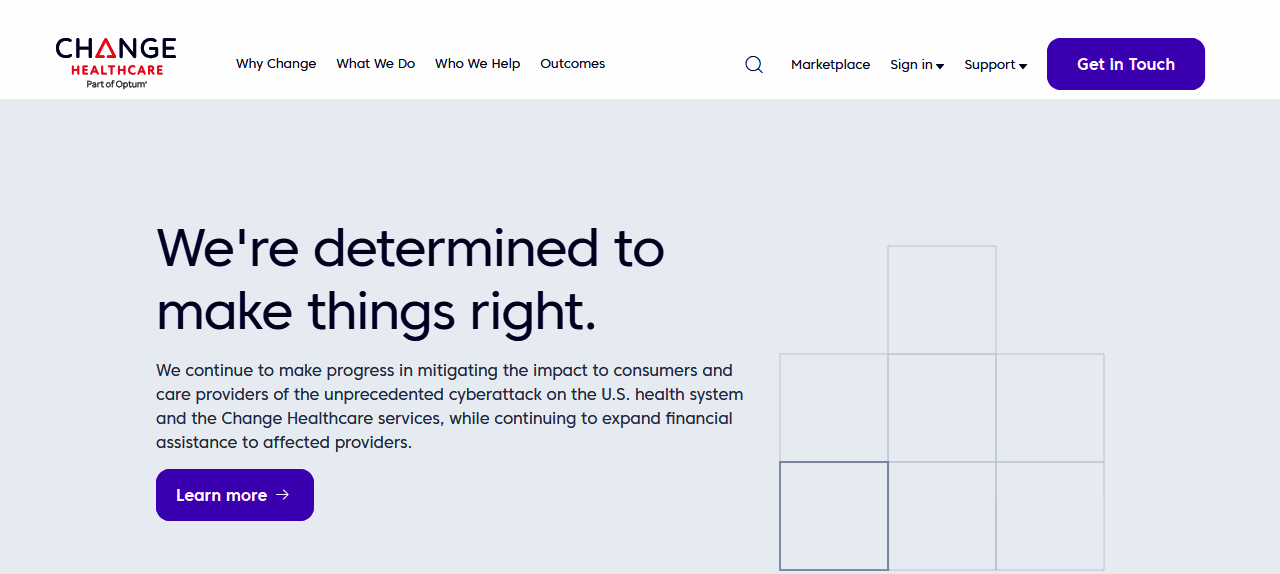
Description
Change Healthcare at a Glance
Change Healthcare is the largest medical claims clearinghouse in the United States, now operating as part of Optum Insight after UnitedHealth Group closed its acquisition on October 3, 2022. The company sits between roughly 800,000 providers, 5,500 hospitals, and about 2,400 payers, and processes around 15 billion healthcare transactions a year. Senate Finance Committee testimony in May 2024 described it as touching one in every three US patient records.
The clearinghouse is widely used because it is everywhere. Most major EHR systems and practice management tools ship out-of-the-box connectivity to it. Buyers should weigh that scale against the February 2024 ransomware incident, which is the single biggest procurement risk signal in this category today.
Who Should Buy Change Healthcare and Who Should Skip It
Right for: mid-size to enterprise hospitals and health systems that already use Optum on the payer or pharmacy side, large physician groups already connected to Change Healthcare payer IDs, and clinical groups that need broad multi-payer reach with deep claim editing built in. Hospital management teams running Epic, Oracle Health, or MEDITECH typically inherit Change Healthcare connectivity by default.
Wrong for: small clinics or solo practices that want a single clearinghouse with no fallback, security-sensitive specialties (behavioral health, reproductive health) where the 2024 PHI exposure is a hard procurement gate, and buyers who want a vendor with current Best in KLAS standing. Many clinic management buyers are now standardizing on a primary plus backup clearinghouse, which changes the comparison versus alternatives like Waystar or Availity.
Core Modules and Product Coverage
Change Healthcare runs a stack rather than a single tool. The pieces buyers actually evaluate are:
- ConnectCenter is the free browser-based provider portal. It handles 837P, 837I, and 837D claim submission, 270/271 real-time eligibility, 276/277 claim status, and 835 remittance viewing. Validation is real-time so errors surface before submission.
- Assurance Reimbursement Management is the enterprise claims editing and workflow platform that hospitals license for denial prevention, claim scrubbing libraries, and revenue cycle analytics.
- Eligibility and benefits verification across roughly 2,400 commercial and government payers.
- Payments, including EFT and ERA reconciliation and patient billing.
- Denials and appeals management with auto-generated appeal workflows.
- Revenue Performance Advisor for analytics-driven AR follow-up.
- Pharmacy and prescription transaction routing under the Optum Rx network.
For procurement teams running side-by-side comparisons against medical billing software alternatives, the module breadth is the strongest argument for staying with Change Healthcare. Few competitors carry the same payer roster plus pharmacy plus analytics under one contract.
Pricing
Change Healthcare does not publish enterprise pricing. The current shape, verified on May 26, 2026:
- ConnectCenter portal: free for participating providers contracted through Change Healthcare payer connectivity.
- Assurance Reimbursement Management: quote-only, scoped per hospital, health system, or large physician group. Pricing reflects claim volume, modules selected, and integration scope.
- Enterprise clearinghouse and EDI Network bundles: per-transaction or bundled annual contracts negotiated through Optum Insight commercial.
Practical note: buyers comparing total cost of ownership should ask for the per-transaction rate, EHR integration fees, and any minimum monthly commitments in writing. Optum sales typically returns a custom quote within two to four weeks.
The February 2024 Ransomware Attack and What Buyers Must Know
This is the section every procurement team needs to read in full. On February 21, 2024, UnitedHealth Group disclosed that the ALPHV/BlackCat ransomware group had compromised Change Healthcare's systems. The attackers used leaked credentials to access a Citrix portal account that did not have multi-factor authentication enabled, dwelled in the network for nine days, exfiltrated data, and then encrypted systems.
The downstream effects were severe:
- The clearinghouse was offline for weeks, with some services degraded for months.
- The American Hospital Association estimated USD 2.87 billion in delayed cash flow across hospitals during the outage.
- UnitedHealth Group eventually disclosed that approximately 190 million individuals had personal or protected health information compromised, making this the largest healthcare data breach in US history.
- UnitedHealth Group paid a roughly USD 22 million ransom, confirmed in IBM and SecurityWeek reporting.
- UHG reported USD 872 million in first-quarter 2024 cyberattack costs, eventually rising past USD 2 billion across the year.
Federal and Congressional follow-up has been heavy and ongoing:
- The HHS Office for Civil Rights opened a HIPAA compliance investigation on March 13, 2024 into Change Healthcare and UnitedHealth Group.
- Senate Finance Committee Chair Ron Wyden held a May 1, 2024 hearing at which CEO Andrew Witty confirmed multi-factor authentication was not in place on the breached account.
- Wyden sent a follow-up letter on October 18, 2024 demanding independent audit reports and calling earlier UHG responses vague.
- OIG and FTC inquiries were also requested.
What this means for buyers in 2026: the breach is fully disclosed, remediation is underway, and Optum has invested heavily in security. But the regulatory file is open, the HIPAA investigation is not closed, and many hospital systems now mandate a backup clearinghouse policy. Build that into your selection criteria.
Integrations and Payer Network
The integration breadth is the second-strongest reason buyers stay. Out-of-the-box EDI 837 and 835 flows work with Epic, Oracle Health (Cerner), MEDITECH Expanse, athenahealth, eClinicalWorks, NextGen, Allscripts/Veradigm, Practice Fusion, Greenway Health, and Tebra. On the payer side, the network covers roughly 2,400 commercial and government payers including Medicare, Medicaid, Blue Cross Blue Shield plans, Aetna, Cigna, and Humana.
Specific provider documentation confirms the connection on the payer side: AmeriHealth Caritas Florida, L.A. Care Health Plan, and Kaiser Permanente Washington all publish public claims submission guides routing through Change Healthcare.
Security, Compliance, and Certifications
Change Healthcare has historically held HITRUST CSF certification, SOC 2 Type II attestation, PCI DSS compliance for payment products, and operates as a HIPAA covered entity and business associate. After the 2024 breach, Optum publicly committed to broader MFA rollout, expanded endpoint detection and response, and additional independent security testing. Buyers should request current SOC 2 Type II and HITRUST certification reports, the post-incident remediation summary, and the most recent penetration testing summary before signing.
Reviews and Real-World Reputation
On G2, Change Healthcare carries 3.8 of 5 stars across 55 verified reviews. On Capterra, the Change Healthcare Platform listing shows 3.9 of 5 across roughly 1,280 reviews. Reviewers consistently praise the payer reach and the depth of claim editing logic. Recurring complaints focus on support responsiveness during outages, with some Capterra reviewers calling the platform "brutal" during periods of degraded service.
On the analyst side, KLAS Research awarded the 2024 Best in KLAS Claims Management and Clearinghouse title to Experian Health, and the 2025 title went to Waystar. Change Healthcare's Assurance Reimbursement Management remains a covered product but is no longer the category leader.
Alternatives to Compare
If Change Healthcare's risk profile is a hard no, or you simply want a primary plus backup pair, these are the alternatives most often shortlisted:
- Waystar: 2025 Best in KLAS Claims Management and Clearinghouse, often the top primary replacement.
- Availity: large multi-payer network, free essentials tier, deep payer relationships.
- Experian Health: 2024 Best in KLAS Claims Management with ClaimSource.
- Inovalon: strength in payer analytics and risk adjustment.
- Tebra: bundled clearinghouse plus practice management for small and mid-size groups.
- R1 RCM: end-to-end revenue cycle outsourcing for hospitals.
- TriZetto Provider Solutions (Cognizant): clearinghouse with strong specialty practice coverage.
- Phreesia: stronger on patient access and intake than pure clearinghouse.
- Cedar: patient financial experience layer, often run alongside Change Healthcare.
- Olive: AI-driven RCM automation, useful where staffing is the bottleneck.
For a side-by-side shortlist, start with the SaaSRat medical billing software category page, then layer in clinic management and EHR picks that already carry the clearinghouse integration you need.
Bottom Line
Change Healthcare is the default clearinghouse in US healthcare because of scale, payer reach, and integration depth. The Optum acquisition adds capital and engineering muscle, and post-breach security investment is real. But the February 2024 ransomware incident reset the procurement conversation. In 2026, the right framing is not "Change Healthcare yes or no" but "Change Healthcare plus what backup, on what contract terms, with what current SOC 2 and HITRUST evidence, and how does the HHS OCR investigation outcome change our renewal." Verified on May 26, 2026.
Frequently Asked Questions
How much does Change Healthcare cost?
Change Healthcare is quote-only enterprise pricing with three primary access models (verified 2026-05-26): ConnectCenter is a free web-based clearinghouse portal for participating providers (real-time claim submission, eligibility, ERA viewing). Assurance Reimbursement Management is an enterprise revenue cycle and claims management platform priced per hospital/health system/large group volume. Clearinghouse + EDI Network connectivity to 2,400+ payers is per-transaction or bundled enterprise pricing. All non-ConnectCenter pricing is via Optum Insight sales after needs assessment.
What happened in the February 2024 Change Healthcare ransomware attack?
On February 21, 2024, ALPHV/BlackCat ransomware operators breached a Citrix portal account that did not have multi-factor authentication enabled (per UnitedHealth Group CEO Andrew Witty's Senate testimony May 1, 2024). The clearinghouse went offline for weeks; pharmacies and hospitals could not submit claims. UnitedHealth Group disclosed the protected health information of approximately 190 million individuals was compromised, making it the largest healthcare data breach in US history. The American Hospital Association estimated $2.87 billion in delayed cash flow across hospitals during the outage. HHS OCR opened a HIPAA compliance investigation March 13, 2024; Senate Finance Committee Chair Ron Wyden held a May 1, 2024 hearing and sent follow-up letters demanding independent audit reports.
Is Change Healthcare HIPAA compliant?
Change Healthcare is HIPAA compliant (covered entity and business associate), HITRUST CSF certified historically across multiple product lines, SOC 2 Type II attested, and PCI DSS compliant for payment products. However, the February 2024 ransomware incident is the subject of an ongoing HHS Office for Civil Rights HIPAA compliance investigation opened March 13, 2024, with potential enforcement and corrective action plans pending. Procurement teams should request the latest independent audit reports during contracting.
Who owns Change Healthcare?
Change Healthcare is owned by Optum, the health services arm of UnitedHealth Group (NYSE: UNH), headquartered in Eden Prairie, Minnesota. The acquisition closed October 3, 2022 after a contested antitrust trial (DOJ lost its challenge in September 2022). Change Healthcare's legacy Nashville, Tennessee headquarters remains operational. The platform is now part of Optum Insight's broader revenue cycle, pharmacy benefit, analytics, and data products stack.
How does Change Healthcare compare to Waystar and Availity?
All three are major US clearinghouses. Change Healthcare (Optum) has the broadest payer reach (~2,400 payers, ~15B annual transactions) but carries 2024 breach risk. Waystar won KLAS 2025 Best in KLAS Claims Management and Clearinghouse and is preferred by hospitals adding a backup clearinghouse post-incident. Availity is the industry-owned (Anthem, Florida Blue, Health Care Service Corp, Humana, BCBSM) clearinghouse with strong payer-side integration. See the medical billing category.
What integrations does Change Healthcare support?
Change Healthcare integrates with Epic, Oracle Health (Cerner), MEDITECH Expanse, athenahealth, eClinicalWorks, NextGen Healthcare, Allscripts/Veradigm, Practice Fusion, Greenway Health, Tebra (Kareo + PatientPop), and connects to 2,400+ commercial and government payers including Medicare, Medicaid, Blue Cross Blue Shield plans, Aetna, Cigna, and Humana via standard EDI (837P/I/D, 270/271, 276/277, 835).
How long does Change Healthcare implementation take?
ConnectCenter portal access is provisioned in days for participating providers. Enterprise Assurance Reimbursement Management deployments commonly run 3 to 9 months for hospitals, including EDI mapping, payer enrollment, denials workflow configuration, and clearinghouse cutover. Post-2024 breach, many hospitals also implement a backup clearinghouse (Waystar or Availity) in parallel to mitigate single-vendor risk.
What are the biggest complaints about Change Healthcare?
Recurring themes per G2 3.8/5 (55 reviews), Capterra 3.9/5 (1,280 reviews), and federal investigation reporting (verified 2026-05-26): (1) February 2024 ransomware attack disrupting clearinghouse operations for weeks and exposing 190M Americans' PHI; (2) HHS OCR HIPAA investigation pending; (3) Senate Finance Committee follow-up letters on independent audit findings; (4) customer support responsiveness flagged during outages; (5) KLAS 2024 + 2025 Best in KLAS Claims Management and Clearinghouse went to Experian Health (2024) and Waystar (2025), not Change Healthcare, signaling hospital reviewers shifted scoring after the outage.
Should hospitals still use Change Healthcare after the breach?
Many hospitals continue to use Change Healthcare given the unmatched ~2,400 payer reach and ~15B transaction throughput, but now also implement a backup clearinghouse (Waystar, Availity, or Experian Health) to mitigate single-vendor risk. Procurement teams should: (1) require current independent audit reports; (2) negotiate SLAs with breach-notification and downtime credits; (3) maintain a parallel clearinghouse; (4) confirm MFA is enforced on all administrative access; (5) review HHS OCR investigation status before signing multi-year terms.
Which payers does Change Healthcare connect to?
Change Healthcare connects to approximately 2,400 US commercial and government payers including Medicare, Medicaid (state-by-state), Blue Cross Blue Shield plans nationwide, Aetna, Cigna, Humana, UnitedHealthcare (sister company via UHG parent), and AmeriHealth Caritas Florida among many others. The payer breadth is the platform's primary differentiator versus competitor clearinghouses. Pharmacy network and prescription transaction routing are also included for retail and specialty pharmacy claims.
Find Your Perfect Software
See how it can transform your workflow
- Personalized for your needs Tailored recommendations based on your unique requirements.
- Save time & resources Streamline your workflow and boost team productivity.
- Trusted by thousands Join 10,000+ businesses already growing with SaaSrat.
You're all set! 🎉
A specialist for will reach out within 1 business day with tailored recommendations for your needs.