KEY TAKEAWAYS
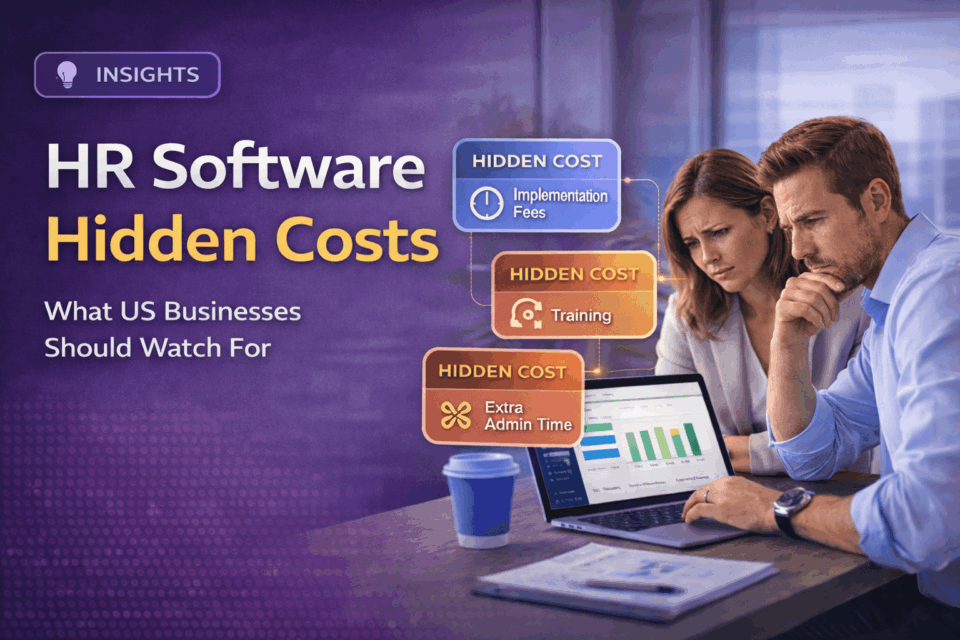
– A 50-person company signing a $12/employee/month HR software contract will pay $18,000-$31,200 in year one once payroll add-ons, SSO fees, implementation, and time-and-attendance modules are included.
– Payroll processing is the single largest hidden cost. It is almost never included in the base HRIS subscription and adds $3,600-$6,000/year at 50 employees.
– Annual price escalation clauses of 5-10% (often uncapped) turn an $18,000 year-one contract into $21,780 by year three. The clause is negotiable before signing and non-negotiable after.
– Data export fees at contract termination run $500-$2,500 for a 50-person company. This fee is what keeps companies on platforms they’ve outgrown.
– Five contract questions in this article, asked before signing, save a 50-person company $3,000-$6,000 over a 3-year term.
A 50-person company that signs a $12-per-employee-per-month HR software contract, the standard entry-level price point from vendors like Rippling, BambooHR, and Gusto in 2026, will pay up to $31,200 in year one once implementation, SSO configuration, payroll add-ons, and offboarding data export fees are included. That $12 base rate covers core employee records, basic onboarding flows, and document storage. It does not cover payroll processing, time-and-attendance tracking, benefits administration, SSO/SAML configuration, or API access above tier limits.
If you’ve already received a vendor quote and the number felt low, this breakdown is for you. I break down seven cost categories that vendors do not put on their pricing pages, with dollar ranges tied to a 50-person U.S. company.
This article does not recommend a single vendor and does not argue that HR software isn’t worth the cost. It helps you know what to budget before you sign, so the first invoice isn’t a surprise.
Hidden costs compound as companies scale into enterprise-lite HR (500-1000 employees). Our best HR software for 500-1000 employees guide breaks down the 60-month TCO across 10 platforms from $845,000 (Rippling) to $2,605,000 (Workday HCM).
What a 50-Person Company Actually Pays: The Full Breakdown
Vendors quote “per employee per month” for the base module only. Everything below is what gets added in the first 90 days after contract signing.
| Cost Category | What Vendors Quote | What You Actually Pay (50 Employees) | Notes |
|---|---|---|---|
| Base HR module | $6-$12/PEPM | $3,600-$7,200/year | Core records, basic onboarding |
| Payroll processing | Often separate | $3,600-$6,000/year add-on | Not included in BambooHR or Rippling base |
| Time and attendance | Optional module | $1,200-$2,400/year | Separate module on all 5 major platforms |
| Benefits administration | Optional module | $600-$1,800/year | Sometimes bundled, often not |
| SSO/SAML configuration | “Included” or one-time | $500-$1,500 one-time | Rippling charges per IdP; ADP bills hourly |
| Implementation/onboarding | Waived or flat fee | $1,500-$8,000 one-time | Varies dramatically by vendor |
| Data export on offboarding | Not quoted | $500-$2,500 one-time | You pay this when you leave |
| Year-one total | $7,200 quoted | $18,000-$31,200 | Depending on vendor and add-ons |
Payroll is the largest hidden line item. Every company needs payroll processing. It is frequently not in the base plan. At 50 employees, the payroll add-on alone doubles or triples the quoted cost depending on the vendor.
The year-two cost is typically higher, because price escalation clauses activate after the first contract year. That compounding cost is covered in section 4 of this article.
Pricing based on author’s 2026 practice advising 50-person companies through HRIS purchases. Rippling, BambooHR, and Gusto figures based on published pricing pages as of Q1 2026. ADP Workforce Now and Paychex Flex are quote-only; ranges reflect direct sales engagement experience.
The Three Columns Vendors Don’t Show You
Every HR software purchase has three price columns. The “listed price” is what appears on the vendor’s website. The “contract price” is what your sales rep offers after negotiation. The “invoice price” is what appears after 90 days once every module, fee, and configuration charge is billed.
In the implementations I manage, the invoice price and the listed price rarely match by less than 40%. The table above shows the invoice column, the one that matters for budget planning.
How This Changes at 25 vs. 200 Employees
Per-employee fees scale linearly, but implementation fees and SSO configuration are largely flat. A 25-person company pays roughly the same $1,500 SSO fee as a 200-person company.
That means hidden costs are proportionally more painful at smaller headcounts. A 25-person company on a $12/PEPM contract sees hidden costs represent 60-70% of total year-one spend. At 200 employees, that proportion drops to 30-40%.
The Fees You Pay Before a Single Employee Logs In
Implementation, data migration, and initial configuration happen before anyone at the company has used the system. These are sunk costs that hit the budget in the first 60-90 days.
Gusto and Rippling typically include basic setup for SMBs. BambooHR charges $1,500-$3,500 for guided implementation. ADP Workforce Now and Paychex Flex charge $2,000-$8,000 for a 50-person company. The scope difference matters: “basic implementation” usually means data import only, while custom workflows, integrations, and approval chains are always extra.
For context, Panorama Consulting’s 2025 ERP Report puts the average enterprise ERP implementation at $2.1 million over 16 months. SMB HR implementations are a fraction of that dollar figure, but the proportional cost structure is identical: one-time setup, recurring fees, then escalation.
The implementation fee is the one I catch most often missing from a vendor’s initial proposal. It’s not that the salesperson forgot to include it. It’s that including it raises the total-cost-of-first-year number enough to complicate the close.
What “Free Implementation” Actually Means
“Free implementation” from Gusto or Rippling means self-serve data import with a support queue for questions. It does not mean someone configures your approval chains, sets up your PTO policy categories, or trains your HR admin.
For a company with existing processes to migrate, “free implementation” still costs 15-25 hours of internal staff time. At $50/hour blended HR cost, that’s $750-$1,250 in labor that never appears on a vendor invoice but hits your operating budget just the same.
The Data Migration Trap
If the company has 3+ years of payroll history, compliance records, or I-9 documentation in a prior system, migration is not copy-paste. Most vendors treat historical data migration as a professional services engagement.
At $150-$300/hour for ADP’s professional services team, a 50-person historical data migration runs $1,500-$4,500. Vendors classify this as “optional,” but for a company with federal record-retention obligations, it’s mandatory.
Why Payroll Is Never Included in the Base Price
Payroll processing is the highest-margin module in every HR platform’s product lineup. It is almost never included in the base HRIS subscription. This is intentional product architecture, not an oversight.
Rippling charges $8/PEPM for core HR plus a $35/month platform base fee. Payroll is a separate module at approximately $6/PEPM. A 50-person company on base HR plus payroll lands at approximately $14/PEPM, or $8,820/year including the base fee.
BambooHR offers payroll as an add-on at approximately $6-$8/employee/month (verified April 2026). At 50 employees on the Core plan ($10/PEPM), adding payroll brings the real cost to $16-$18/PEPM, or $9,600-$10,800/year.
Gusto is the exception. Payroll is included in every plan. The Simple plan costs $49/month plus $6/employee (increased from $40 in March 2026). The Plus plan costs $80/month plus $15/employee.
But time-tracking, onboarding checklists, and compliance alerts are module add-ons even on Gusto. Transparent base pricing does not mean transparent total cost.
ADP Workforce Now is entirely quote-only, but in practice I consistently see $23-$30/PEPM all-in for 50-person companies. Payroll is typically included in the base quote, but the quoted package always includes 2-3 modules the company didn’t request and can’t easily remove.
Paychex Flex starts at approximately $39-$45/month base plus $4-$5/employee for Essentials. Payroll is bundled, but time-and-attendance, HR advisor access, and compliance filing are separate tiers that push costs up quickly.
The payroll module question is the first thing I ask a vendor in the first sales call, before they show me a single screenshot. The answer tells me immediately whether they’re going to be transparent about the rest. I call this “module creep”: when a base plan requires add-ons to do things you assumed were standard.
The Contract Clause That Makes Year Two Cost 10% More
Most HR software contracts include an annual price escalation clause. It is typically written as “pricing subject to annual adjustment of up to X%,” where X is 5-10% and the clause is uncapped. Across 50+ client contracts I’ve reviewed, this clause appears in over 80% of multi-year agreements.
I read the price escalation clause before I read anything else in a vendor contract. It tells me more about how a vendor views the customer relationship than any of the marketing language in the rest of the document.
The 3-Year True Cost Calculation
A 50-person company paying $18,000/year in year one (all-in, post-module) pays $19,800 in year two at a 10% increase, and $21,780 in year three. Over three years, the total outlay is $59,580, which is $17,580 more than the year-one contract implied.
At a 5% annual increase, the same $18,000 year-one cost becomes $18,900 in year two and $19,845 in year three. Three-year total: $56,745. The difference between a 5% and 10% escalator over three years is $2,835. That’s the dollar value of reading one contract clause.
How to Negotiate a Price Cap Before You Sign
Ask for the “price escalation cap” in writing before the contract is finalized. Accept no more than 5% annually or CPI, whichever is lower.
I have never had a BambooHR or Rippling rep refuse a 5% escalation cap in year-one negotiations. The negotiation window is pre-signature only. After signing, the clause is not negotiable. If a vendor refuses to cap escalation before you sign, treat that refusal as a material risk factor in your evaluation.
What It Costs to Leave: The Exit Fees Vendors Don’t Advertise
Data export fees are the single most underestimated hidden cost in HR software. They are rarely mentioned in sales conversations, almost never appear on pricing pages, and are buried in the contract’s “Termination” or “Data Portability” section.
The fee triggers when you request a full export of historical payroll records, employee files, I-9 documentation, benefits history, performance review data, and time-and-attendance logs at contract termination. Vendors charge because this export requires server-side processing that they classify as “professional services.”
In practice, data export fees at contract termination run $500-$2,500 for a 50-person company. The range depends on data volume, format requested (CSV vs. structured XML), and whether the vendor treats it as a flat fee or an hourly engagement.
This fee is what makes companies stay on platforms they’ve outgrown. A company that knows it will pay $2,000 to exit BambooHR will absorb two more years of suboptimal tooling rather than pay the exit cost plus implementation at a new vendor. I call this “data hostage”: not technically a penalty, but functionally one.
What to ask before signing: “What is the fee to export all employee and payroll data at contract termination, in CSV format?” If the vendor cannot give a number, add a data portability clause to the contract specifying format, timeline, and zero incremental fee.
I now include the data export conversation in every vendor evaluation I run. It’s the best signal of how a vendor thinks about the end of the relationship, which tells you a lot about how they’ll behave in the middle of it. If you’re evaluating a switch, compare onboarding capabilities across platforms before committing, since re-onboarding your team is part of the switching cost.
The Compliance Costs That Show Up When the System Doesn’t Cover Them
Most base-tier HR software plans do not include automated compliance updates. State-by-state minimum wage changes, ACA reporting, FMLA tracking, and I-9 re-verification reminders are either module add-ons or absent entirely from SMB-tier plans.
The G2 2026 Accounting Software Report (via Jumpstart Partners CPA, January 2026) found that wrong-fit software costs SMBs $8,000-$35,000 annually in workarounds and missed automation. HR software is subject to the same dynamic. A system that doesn’t automate ACA reporting forces an HR admin to spend 10-20 hours per quarter in manual reconciliation. At $35/hour loaded cost, that’s $1,400-$2,800/year in labor before accounting for error risk.
ADP Workforce Now gates its ACA reporting module as a separate add-on at the SMB tier. In practice, adding ACA compliance to an existing ADP contract runs $2-$4/PEPM, or $1,200-$2,400/year for a 50-person company. That’s a cost most buyers discover in their first January filing cycle, not during the demo.
Paychex Flex tiers compliance alerts and state-specific filing support by plan. Upgrading from Essentials to Select for compliance features adds approximately $10-$15/PEPM to the base cost. BambooHR does not include payroll compliance (ACA, W-2) in the Core plan and requires the payroll add-on, which adds $6-$8/PEPM.
Rippling separates compliance management into its own risk management module, priced separately from core HR. Gusto includes new hire reporting and W-2 generation in all plans, but state-specific compliance features are limited in the Simple tier.
The compliance gap is the hidden cost I discover in year two, never in the demo. It shows up in the auditor’s finding or the state penalty notice. An I-9 audit penalty ranges from $281 to $2,789 per violation under 2026 DOL civil monetary penalties. A 50-person company with 5 violations faces $1,400-$14,000 in fines that a $2/PEPM compliance module would have prevented.
What Is the True Total Cost of HR Software for a 50-Person Company?
For a 50-person U.S. company in 2026, the true total cost of HR software in year one, including base subscription, payroll module, time-and-attendance, SSO configuration, and implementation, runs $18,000-$31,200 against a quoted base price of $7,200.
The gap comes from five line items. The base module at $12/PEPM for 50 employees is $7,200/year. Payroll adds $3,600-$6,000. Implementation adds $1,500-$8,000.
SSO configuration adds $500-$1,500 as a one-time charge. Time-and-attendance adds $1,200-$2,400/year. Benefits administration, if separate, adds another $600-$1,800.
Use this formula to calculate your own number before signing:
Year-1 TCO = (Base PEPM x Headcount x 12) + Implementation + Integration + Training + SSO
For a worked example with Rippling at 50 employees: ($16/PEPM x 50 x 12) + $2,500 implementation + $1,200 SSO = $13,300 in year one. Add time-and-attendance at $1,800/year and the number reaches $15,100 before any training costs.
3-Year TCO = Year-1 Cost x (1 + Annual Escalator)^2 + Switching Cost
At a 7% annual escalator, that $15,100 year-one cost compounds to $17,270 by year three. Add a $14,000 switching cost if you leave, and the three-year committed spend reaches $46,940.
Year-two costs are typically 5-10% higher due to price escalation clauses. The three-year true cost for a 50-person company runs $55,000-$96,000 against a year-one quoted projection of $21,600. That three-year figure is the number most CFOs have never seen before signing.
Five Questions to Ask Every Vendor Before Signing
1. “What is the all-in per-employee cost including payroll, time-and-attendance, and compliance modules?” Not the base rate. The total.
2. “What is the annual price escalation clause, and will you cap it at 5% or CPI?” Get this in writing before the contract is executed.
3. “What is the fee to export all employee and payroll data in CSV format at contract termination?” If they can’t give a number, add a zero-fee data portability clause.
4. “What hours of implementation support are included, and what is the hourly rate beyond that?” ADP charges $195/hour beyond included hours. Know your number.
5. “Does the contract auto-renew, and what is the cancellation notice window?” Paychex Flex requires 90 days written notice. Missing that window costs a full additional contract year.
What hidden fees do HR software vendors charge that aren’t on the pricing page?
The seven cost categories in the breakdown table cover payroll module add-ons, SSO/SAML configuration, implementation fees, time-and-attendance modules, benefits administration, and data export fees at termination. These fees are disclosed in the contract but are rarely mentioned during the sales process. Reading the “Professional Services” and “Termination” sections before signing reveals most of them.
How much does HR software actually cost per employee per month when all fees are included?
The marketed base rate covers only core HR records and onboarding. Once payroll, time-tracking, and compliance modules are added, the all-in cost runs $14-$30/PEPM for a 50-person company in 2026. ADP Workforce Now lands at $23-$30/PEPM all-in (quote-only); Rippling with payroll runs approximately $14/PEPM; BambooHR Core plus payroll runs $16-$18/PEPM.
Which HR software platforms are most transparent about their pricing?
Gusto publishes the most transparent pricing: Simple plan at $49/month plus $6/employee, Plus at $80/month plus $15/employee (as of March 2026). BambooHR publishes tier pricing (Core $10, Pro $17, Elite $25 per employee) but requires a quote for payroll. ADP Workforce Now and Paychex Flex are entirely quote-only.
What is an HR software price escalation clause and how do I find it?
A price escalation clause is contract language that authorizes the vendor to raise prices annually by 5-10%, often without a cap. It appears in the “General Terms,” “Billing and Payment,” or “Service Fees” addendum, phrased as “pricing is subject to annual adjustment.” At a 10% annual increase, an $18,000 year-one contract reaches $21,780 by year three. Ask for a cap of 3-5% before signing.
What does it cost to export employee data when switching HR software vendors?
Data export fees at contract termination run $500-$2,500 for a 50-person company, depending on data volume and file format. This covers historical payroll records, I-9 documentation, performance review data, and benefits history. Ask every vendor “What is the fee to export all employee data in CSV format at contract termination?” before signing.
Before you sign an HR software contract, run the line-item table in Section 1 against your vendor’s actual quote. If the numbers don’t reconcile, ask for a written itemization of all modules, professional services, and termination fees before the contract is executed. That single step is what separates a $7,200 year-one expectation from a $31,200 invoice.
For a full comparison of HR software platforms with real user reviews, pricing transparency scores, and feature breakdowns, visit SaaSrat.