

Check
by Check Technologies, Inc
What is Check?
Get Best Quote for Check
Connect with SaaSrat experts to get the best quote for your business.
You're all set!
A specialist for Check will reach out within 1 business day.
Check Features
Embedded payroll API
REST API for SaaS platform integration
Money movement infrastructure
Tax calculation engine
Federal tax filing
State tax filing (50 US states)
View All 19 Features
Check Pricing Plans
Embedded Payroll API
- Embedded payroll API for SaaS platforms
- Money-movement and tax filing infrastructure
- SOC 2 Type II plus Money Transmitter License in 50 US states + DC
- 65+ platform partners
- Revenue-share or per-employee pricing models negotiated per platform
- Pricing depends on platform volume, embedded vs branded experience, and benefits scope
Check Screenshots
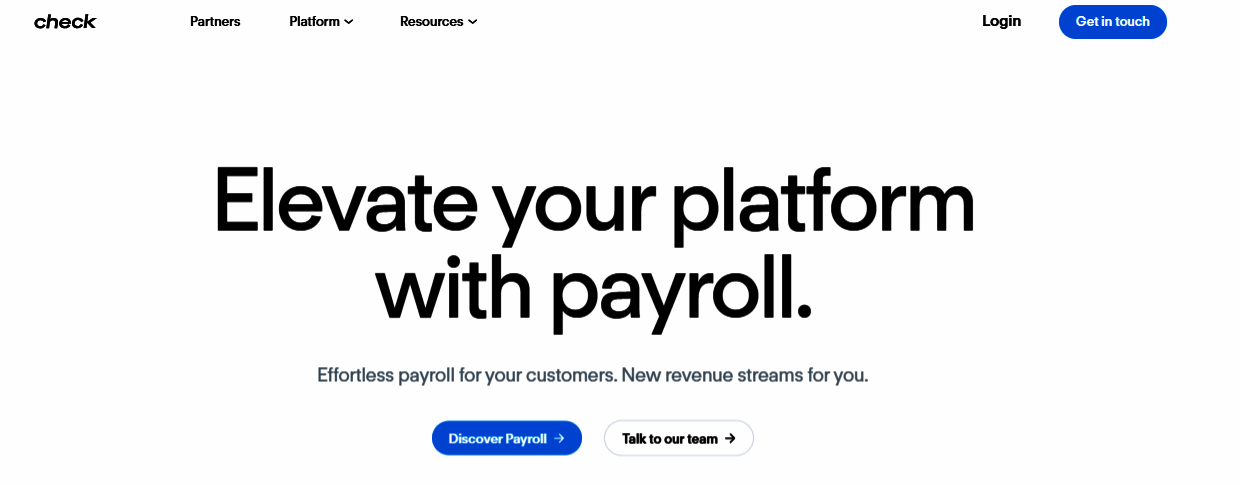
Description
Check at a Glance
| Question | Quick answer |
|---|---|
| What it is | Embedded payroll infrastructure (API) that lets SaaS platforms add native payroll, tax filing, and money movement inside their own product. Check is NOT an end-user payroll tool for SMBs. |
| Who it serves | Vertical SaaS, workforce-management, accounting, and POS platforms (B2B2B). The actual employer running payroll uses Check indirectly through partners such as Zoho, 7shifts, Homebase, or Housecall Pro. |
| Customer footprint | 1 million+ employees paid; 35,000+ businesses served through partners; 15 billion USD+ processed annually; 65+ platform partners (vendor verbatim). |
| Pricing posture | Contact Sales. No public tiers, no self-serve sign-up. Pricing is custom per platform partner and not designed for direct-buyer comparison. |
| Headline differentiator | The category-defining embedded payroll API. Handles wage calculation, multi-state tax filing in all 50 states plus DC, direct deposit, and W-2/1099 generation so platforms ship payroll in months instead of years. |
Important audience note. If you are an employer comparing payroll for your own business, Check is not what you are shopping for. Check sells to product teams at SaaS companies offering native payroll to their customers. End-employer buyers should evaluate Gusto, OnPay, QuickBooks Payroll, or Rippling. The rest is written for platform builders evaluating embedded payroll infrastructure.
Pros and Cons of Check
| Pros | Cons |
|---|---|
| Category-leading embedded payroll API with 65+ live platform partners and 15 billion USD+ processed annually | Not an end-user payroll product; SMB employers comparing Gusto or OnPay get no value here |
| SOC 2 Type II plus Money Transmitter License in 50 US states and DC (a moat that takes 3 to 5 years to replicate) | No public pricing. Pricing depends on volume, processing tier, and partnership terms |
| Backed by Stripe, Index Ventures, and Bedrock with depth across vertical SaaS, workforce, and accounting partners | US-only. Check does not handle cross-border payroll; multinational platforms need a second vendor |
| Named partners include Eddy, 7shifts, Miter, Trayd, Wave, Playground, Housecall Pro, Homebase, Warp, Dripos, Zoho, and Tekion | Implementation is engineering-heavy; partners commit a product and engineering team for the first 90 to 180 days |
| Handles federal, state, and local tax filing, W-2 and 1099 generation, and money movement end-to-end | Partners give up some control of the payroll UX and downstream support escalation paths to Check's compliance and risk team |
Who Should Use Check
Check is a platform-infrastructure decision, not an end-user payroll decision. The buyer is a product, engineering, or partnerships leader at a SaaS company who has decided native payroll is strategic enough to own.
Vertical SaaS platforms whose customers run payroll. Restaurant-tech (7shifts, Dripos), home services (Housecall Pro), construction (Trayd, Miter), childcare (Playground), and auto-retail (Tekion) all run on Check. The platform already owns scheduling or operations, and payroll is the natural next product. Without Check, the platform either refers customers out and loses the workflow, or spends three-plus years building tax-filing infrastructure in-house.
Workforce-management and HRIS platforms going downmarket on payroll. Platforms such as Eddy and Homebase added native payroll on Check because SMB customers would not pay for both a workforce app and a separate Gusto subscription. Check lets the platform fold payroll into one bill and one login.
Accounting and bookkeeping platforms. Wave Payroll is the canonical example. Accounting platforms with SMB distribution use Check to ship payroll as a paid module. Payroll attach rates typically run 30 to 50 percent of the active accounting base.
POS and operations platforms with payroll-adjacent data. Tekion (auto dealerships), Dripos (coffee shops), and similar platforms already capture hours, tips, and roles. Layering native payroll on Check turns a sticky operational tool into a revenue-multiplier product.
Not the right fit: Employers running their own payroll (use Gusto, OnPay, Paychex Flex, or ADP Run), platforms with fewer than 1,000 prospective payroll-paying customers (engineering cost outweighs revenue), platforms whose customers are predominantly outside the US, and platforms that want a white-label resale relationship rather than an API build.
Check Product Suite
Check sells one product, the embedded payroll API. The surface covers five functional areas; partners pick the depth they expose and Check handles the regulated portions.
Wage and Net-Pay Calculation Engine
The core API takes hours, rates, bonuses, tips, and deductions and returns gross wages, withholdings, FICA, FUTA, SUTA, and net pay. Multi-state and tipped-employee scenarios are handled out of the box.
Tax Filing in 50 States plus DC
Check files federal Form 941, Form 940, state withholding, state unemployment, and applicable local taxes on the partner's behalf. The Money Transmitter License and SOC 2 Type II posture enable this. For platforms, this is the highest-value piece of the API because replicating it in-house requires both a license footprint and a dedicated compliance team.
Money Movement and Direct Deposit
ACH and same-day ACH disbursement to employees, contractors, and tax authorities. Check handles bank-account verification, NACHA compliance, returns, and reversals. Partners route money into Check's licensed entity and Check moves it onward.
Tax Forms and Year-End
W-2 and W-3 for employees, 1099-NEC and 1096 for contractors, plus state-specific year-end forms. The API returns PDF and structured data so platforms can deliver forms inside their own product.
Compliance and Risk Operations
Check operates the compliance, fraud, and risk back office. KYB on new employer accounts, fraud monitoring on funding events, and remediation when filings are rejected. Partners get an in-house compliance team without staffing one.
How Much Does Check Cost
| Plan | Price | Notes |
|---|---|---|
| Embedded Payroll API | Contact Sales | Custom pricing per partner. Typical structure mixes a platform fee with per-employee or per-pay-run rates. |
| Implementation and onboarding | Contact Sales | Some partnerships include implementation services; others charge separately. Confirm scope in the master services agreement. |
| Volume and tier negotiation | Contact Sales | Pricing typically improves with scale. Partners with 5,000+ active employers see materially better unit economics than early-stage builders. |
| Free trial | Not offered | Check does not run a self-serve trial. Evaluation is a sales-led conversation with product, security, and compliance reviews. |
Model total cost as three variables: per-active-employee monthly fee, per-pay-run transaction fee, and any minimum commitment. Public case studies suggest Check's economics work when the partner can charge 30 to 60 USD per month plus 5 to 10 USD per employee at retail (consistent with Gusto and OnPay). Below that band, partner margin is thin.
Implementation Plan: Rolling Out Check
Check implementations are engineering-heavy, multi-month efforts. Plan a 90-to-180-day build from contract signature to GA launch.
Weeks 1 to 4: Contract and sandbox access. Sign the master services agreement and data processing agreement. Complete Check's KYC and platform-due-diligence questionnaire. Get sandbox API credentials, review the OpenAPI spec, and run first integration tests against synthetic records. Most platforms staff this with two engineers, a product manager, and a compliance reviewer.
Weeks 5 to 12: Core integration build. Wire up employer onboarding (company info, tax IDs, bank verification), employee onboarding (W-4, I-9, direct deposit), pay-run creation, and reporting endpoints. Build the partner-side UX in your own product and pipe data to Check. Plan two to three iteration cycles with Check's solutions engineering before UAT.
Weeks 13 to 18: UAT and pilot customers. Onboard 5 to 25 friendly pilot employers across multiple states. Run parallel payroll cycles for two pay periods to verify wage calculations and tax filings match expectations. Resolve state-specific edge cases (tipped wages, remote workers, garnishments).
Weeks 19 to 24: General availability. Open the product to the broader customer base in waves. Track payroll-attach rates against existing accounts, monitor first-pay-run completion rates, and review filing-rejection rates weekly. Most partners hit a stable run-state by month six.
Hidden Costs and Contract Gotchas
Engineering opportunity cost dwarfs Check's fees. The 90-to-180-day build typically consumes two to four full-time engineers plus product and design support. Budget the loaded labor cost (often 150,000 to 400,000 USD in fully-burdened time) on top of Check's platform fees when modeling year-one TCO.
Minimum-volume commitments. Partnership contracts frequently include processing-volume or active-employee minimums. If your customer base does not adopt payroll as quickly as forecast, the minimums still apply. Negotiate ramp curves explicitly.
Support boundary is shared, not handed off. Tier-one questions (paycheck math, deductions, deposit timing) land in your queue. Staff a payroll-trained support pod before launch; do not assume Check handles end-customer email.
US-only coverage is a hard ceiling. Check does not file or move money outside the US. International expansion requires a second vendor (Deel, Remote, or similar) which doubles the number of integrations to maintain.
Brand and trust transfer. When Check has a filing or money-movement issue, your customers experience it as your problem. Review the SLA and incident-communication clauses carefully before signing.
What Real Buyers Report
Positive themes from public partner case studies include the depth of the API surface (most platforms ship a credible payroll product on Check in under six months versus three-plus years in-house), the Money Transmitter License footprint as a regulatory moat, the responsiveness of Check's solutions-engineering team during integration, and the named-partner roster (Eddy, 7shifts, Homebase, Housecall Pro) that signals production-proven scale.
Critical themes include the engineering-heavy integration, the lack of public pricing, support-boundary ambiguity during the first 60 days post-launch, and the US-only scope which forces a second-vendor decision for international ambitions. Partners on developer forums noted that the build is justifiable only with clear payroll-attach data showing material revenue lift.
Check Alternatives
| If you are evaluating | Closest alternatives | Why |
|---|---|---|
| Check for embedded payroll API (platforms) | Gusto Embedded Payroll, Finch (data-aggregation API), Salsa | Gusto Embedded is the most direct competitor with a similar API surface; Finch covers payroll data aggregation rather than processing; Salsa is the newer entrant pitching faster time-to-market |
| Check for end-employer payroll (you are not a platform) | Gusto, OnPay, QuickBooks Payroll | These are end-user payroll products with published pricing, self-serve trials, and direct customer support designed for employers running their own payroll |
| Check for global or contractor-heavy payroll | Rippling, Deel, Remote | Rippling covers HRIS plus global payroll; Deel and Remote specialise in international contractor and EOR payroll outside the US |
| Check for white-label resale rather than API build | Paychex Flex partner program, ADP Run referral | Both legacy providers offer partner or referral programs without the engineering build, at the cost of a less native product experience |
Bottom Line
Check is the category-defining embedded payroll API, not an SMB payroll product. For SaaS platforms whose customers run US payroll and where native payroll attaches meaningful revenue, the regulatory moat (SOC 2 Type II, Money Transmitter License in 50 states plus DC), the named-partner depth, and the production-proven scale (1 million+ employees paid, 15 billion USD+ processed) make Check the safest infrastructure choice available. Trade-offs are engineering-heavy integration, opaque sales-led pricing, US-only coverage, and the commitment of operating a regulated financial product. Employer-side buyers comparing SMB payroll should evaluate Gusto, OnPay, or Patriot Software; the broader market lives in the payroll software guide and the adjacent HR software directory.
Frequently Asked Questions
What is Check and who is it for?
How much does Check cost?
Is Check a payroll product I can use to pay my employees?
Which SaaS platforms use Check?
What is Check's compliance and security posture?
How does Check compare to Gusto Embedded?
Does Check process payroll outside the United States?
Who owns Check?
Does Check offer a free trial or self-serve sign-up?
Is Check the right choice for my SaaS platform?
Find Your Perfect Software
See how it can transform your workflow
- Personalized for your needs Tailored recommendations based on your unique requirements.
- Save time & resources Streamline your workflow and boost team productivity.
- Trusted by thousands Join 10,000+ businesses already growing with SaaSrat.
You're all set! 🎉
A specialist for will reach out within 1 business day with tailored recommendations for your needs.