
3CX
by 3CX • Founded 2005
What is 3CX?
Get Best Quote for 3CX
Connect with SaaSrat experts to get the best quote for your business.
You're all set!
A specialist for 3CX will reach out within 1 business day.
3CX Features
Software-based PBX on Windows Linux Docker Raspberry Pi
Simultaneous-call (SC) licensing not per-user
Unlimited extensions at no extra cost
Web client and desktop apps for Windows and macOS
IOS and Android mobile apps with full extension functionality
Built-in video conferencing for up to 250 participants
View All 15 Features
3CX Pricing Plans
PRO Entry (8 SC)
- Approximately $350/year for 8 simultaneous calls supporting up to 40 max extensions. Advanced call handling, queues, reporting, CRM integration. Self-hosted on Windows, Linux, Docker, or Raspberry Pi.
PRO Mid (32 SC)
- Approximately $1,995/year for 32 simultaneous calls supporting up to 224 max extensions. For growing SMBs with broader phone usage.
PRO Max (128 SC)
- Approximately $5,995/year for 128 simultaneous calls supporting up to 896 max extensions. For mid-market deployments with high phone activity.
AI Edition (8 SC)
- Approximately $575/year at 8 SC. Everything in PRO plus AI Receptionist, AI Personal Assistant, AI Agents, AI Transcription. WhatsApp Business integration. Scales to $8,495/year at 128 SC.
AI Edition Max (128 SC)
- Approximately $8,495/year for 128 SC with all AI features. For mid-market and enterprise deployments wanting AI-driven call handling.
Realistic Year-One TCO (50 ext)
- 50-extension business with 8 SC peak concurrency: $5,000-$12,000 year-one TCO including PRO license ($350), SIP trunk ($30-$100/month), IP phones ($50-$300 per agent phone), install labor ($1,000-$3,000 self-managed). Year-two+: $1,500-$3,000/year as hardware amortizes.
3CX Screenshots
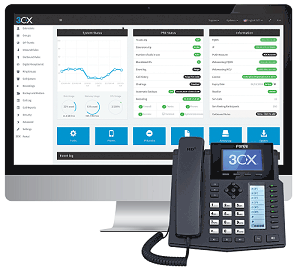
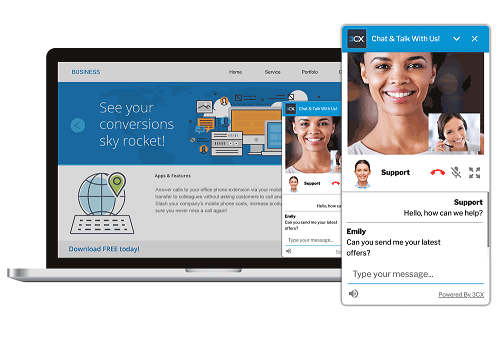
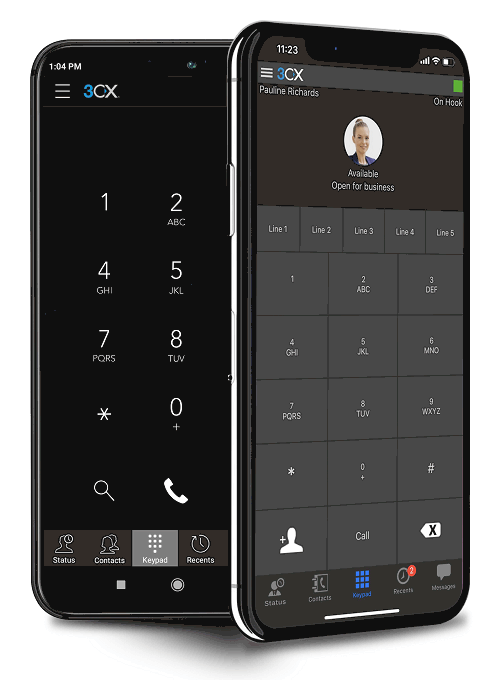
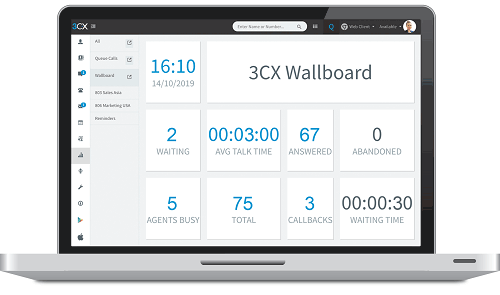
Description
What 3CX actually is
3CX is a software-based PBX (Private Branch Exchange) and unified communications platform built by 3CX Ltd, founded in 2005 in Limassol, Cyprus. The product installs on Windows Server, Linux, Docker, or even Raspberry Pi, and serves more than 600,000 businesses globally across SMB, mid-market, and lower enterprise.
The pricing model is the key differentiator from US cloud VoIP leaders. While RingCentral, Dialpad, Zoom Phone, and similar competitors charge per user per month, 3CX licenses by simultaneous-call (SC) count. A business with 100 employees but only 20 active calls at peak pays for 20 SC, with unlimited extensions for all 100 employees included at no extra cost.
Who actually picks 3CX
3CX fits cost-conscious SMBs and mid-market businesses (10 to 1,000 employees) where most employees use phones occasionally rather than constantly. The simultaneous-call model heavily favors customers with high extension counts but moderate call concurrency: schools, manufacturing facilities, professional services firms, retail chains with phone-light store staff.
Self-hosted deployment also attracts IT teams wanting full control of their phone infrastructure: data residency in specific countries, integration with on-premise SIP trunks, or strict regulatory environments where cloud-hosted phone systems are problematic.
Not for you if: most employees are heavy phone users (per-user pricing math favors RingCentral or Dialpad), you need bundled enterprise UCaaS with CCaaS (Five9, NICE CXone, Genesys Cloud are heavier-lift fits), or you have no in-house IT capacity for the install (3CX requires more technical setup than cloud-only competitors).
3CX pricing reality
| Edition | Price range (annual) | SC range |
|---|---|---|
| Basic | Quote-based | Entry tier |
| PRO | $350 - $5,995/yr | 8 - 128 SC |
| Enterprise / AI Edition | $575 - $8,495/yr | 8 - 128 SC |
| SMB Free | Discontinued | Ended Jan 30, 2026 |
Pricing scales by SC count. PRO at 8 SC (supporting up to 40 max extensions) is approximately $350/year. PRO at 128 SC (supporting up to 896 max extensions) is approximately $5,995/year. Enterprise/AI Edition adds 60-80% to PRO pricing at equivalent SC counts: $575/year at 8 SC, $8,495/year at 128 SC.
The SMB Free edition was discontinued effective January 30, 2026. Existing Free deployments need to migrate to paid PRO or face end-of-life. This is one of the most significant 3CX pricing changes in years and affects thousands of smaller deployments that previously ran free.
Annual TCO benchmarks
A 50-extension small business with peak call concurrency of 8 calls runs PRO 8 SC at approximately $350/year subscription. Adding SIP trunk costs ($30-$100/month from a trunking provider like Bandwidth, Telnyx, or VoIP.ms), phone hardware ($50-$300 per IP phone for the call agents), and one-time install labor ($1,000-$3,000 for self-managed, more for partner-led): realistic year-one TCO $5,000-$12,000 all-in, with year-two-and-beyond dropping to $1,500-$3,000/year as hardware amortizes.
The same business on RingCentral Core would pay $30/user/month for active phone users (10-15 users at active phone seats = $300-$450/month or $3,600-$5,400/year subscription only). Over a 3-year window, 3CX self-hosted often wins on TCO; the cloud-vs-on-premise trade-off comes down to IT capacity and infrastructure preference.
Simultaneous-call licensing in practice
The SC model requires understanding call concurrency: how many calls happen simultaneously at peak, not how many employees have extensions. Common ratios: schools and offices with mostly internal communication need 1 SC per 10-15 extensions. Sales-heavy operations need 1 SC per 3-5 extensions. Contact center operations need 1 SC per 1-2 extensions or move to dedicated CCaaS.
The trade-off: under-sizing SC creates busy signals during peak. Over-sizing wastes budget. Most 3CX partners run a 2-4 week call traffic analysis before finalizing SC count.
Self-hosted vs hosted
3CX runs three deployment models: self-hosted on customer Windows Server or Linux infrastructure, customer-managed cloud (customer provisions AWS, Azure, or Google Cloud instance and 3CX deploys to it), or 3CX-hosted (3CX manages the infrastructure for a fee). Self-hosted gives full data sovereignty and control; 3CX-hosted reduces IT overhead at higher per-year cost.
Web client and mobile apps
The web client runs in any modern browser and handles inbound and outbound calls via WebRTC. iOS and Android mobile apps deliver full extension functionality including call transfer, conference, and presence status. Desktop apps for Windows and macOS provide native softphones.
For remote-first teams, the web-and-mobile coverage matters because employees don't need desk phones. A 50-person company can run 3CX with zero hardware phones, just web client on laptops and mobile apps on smartphones, paying only for the SC license and SIP trunk.
Video conferencing built in
Video conferencing supports up to 250 participants per meeting with screen sharing, recording, meeting scheduling, and password-protected meetings. For businesses replacing both phones and Zoom with 3CX, the bundled video meaningfully reduces total software spend.
WhatsApp Business and live chat
WhatsApp Business integration (PRO and AI tiers) brings WhatsApp conversations into the 3CX web client agent workspace. Live chat widget embeds on the company website and routes chats to the same agents handling phone calls. For SMB customer service teams wanting omnichannel without buying separate Zendesk Chat or Intercom subscriptions, 3CX's bundled approach is competitive.
AI Receptionist on AI Edition
AI Edition (the rebranded Enterprise tier as of 2026) adds AI Receptionist, AI Personal Assistant, AI Agents, and AI Transcription. AI Receptionist handles inbound call greeting, routing, and basic Q&A using LLM-powered natural language understanding rather than traditional IVR menus.
CRM integration
Native integrations cover Salesforce, HubSpot, Zoho CRM, Pipedrive, Microsoft Dynamics 365, SugarCRM, Bitrix24, Vtiger, and others. Click-to-call from CRM contact records, automatic call logging to CRM activity, and screen pops showing the caller's CRM record when phone rings.
What real customers say
3CX user forums and Reddit r/voip discussions show consistent praise patterns: TCO advantage at higher extension counts, control of deployment model, lack of per-user fees as the business grows. Consistent complaints: the SMB Free discontinuation (announced 2025, effective Jan 30 2026) frustrated thousands of small businesses; setup complexity higher than cloud-only competitors; partner quality varies widely with some 3CX certified partners delivering poor support.
One specific recurring complaint: 3CX's pricing adjustments in January 2026 (~10-15% increase across tiers) caught existing customers without warning during renewal cycles.
3CX vs RingCentral
RingCentral is the US cloud UCaaS leader with strong reporting, integrations, and per-user pricing simplicity. 3CX is the self-hosted alternative with simultaneous-call licensing favoring high-extension-count businesses. Choose RingCentral for cloud-only SMB with active phone users. Choose 3CX for IT-capable mid-market with many extensions but moderate concurrency.
3CX vs Dialpad and Zoom Phone
Dialpad and Zoom Phone are cloud UCaaS with AI features (transcription, summary, coaching). 3CX has AI on AI Edition only at higher tier. Choose Dialpad or Zoom Phone for cloud-only with AI-first workflow. Choose 3CX for self-hosted with optional AI.
3CX vs FreePBX and Asterisk
FreePBX and Asterisk are open-source self-hosted PBX alternatives with zero license cost but heavy IT capability requirements. 3CX is the commercial alternative with cleaner UI, professional support, and faster setup. Choose FreePBX or Asterisk for IT-heavy teams comfortable with full open-source stack. Choose 3CX for businesses wanting commercial software polish at on-premise pricing.
3CX vs Microsoft Teams Phone
Microsoft Teams Phone is the Microsoft 365 add-on that adds calling to Teams. 3CX is the standalone PBX with broader CRM integration. Choose Teams Phone for Microsoft 365 shops wanting one unified collaboration tool. Choose 3CX for non-Microsoft shops or businesses needing more flexible PBX configuration.
Common rollout mistakes
The most common 3CX rollout mistake is under-sizing SC count. Buyers estimate concurrency from extension count rather than from actual call traffic data, then hit busy signals during peak hours. Run 2-4 weeks of call traffic monitoring before finalizing SC purchase.
The second common mistake is choosing self-hosted without IT capability. 3CX's installer is automated, but troubleshooting Windows Server, Linux, network configuration, SIP trunking, and firewall settings requires real IT expertise. Without that, customer-managed cloud or 3CX-hosted is the better path.
The third common mistake is picking a poor 3CX partner. Quality varies dramatically. Verify partner certifications, request references from similar-size deployments, and read partner reviews before signing implementation contracts.
Implementation timeline
Self-hosted small deployment (5-25 extensions): 1-2 weeks for installation, SIP trunk configuration, extension provisioning, and basic call routing setup. Mid-market (100-500 extensions): 4-8 weeks adding CRM integration, call queue design, reporting setup, and team training. Enterprise (1,000+ extensions): 12-24 weeks adding multi-site deployment, failover configuration, custom integrations, and dedicated partner engagement.
Support model
Support comes from 3CX certified partners rather than 3CX directly for most customers. Partner SLAs vary widely. 3CX Direct Support is available for an additional fee. The 3CX Forums and community are active with practitioner-level technical content. Documentation is in English with multilingual community translations.
The honest assessment of 3CX
3CX is the right call for IT-capable SMB and mid-market businesses with high extension counts but moderate call concurrency, especially those preferring self-hosted or customer-managed cloud deployment over US cloud UCaaS.
Where 3CX wins: simultaneous-call licensing favoring high-extension/moderate-concurrency businesses, unlimited extensions at no extra cost, self-hosted on Windows Linux Docker or Raspberry Pi, broad CRM integration, bundled video conferencing for up to 250 participants, WhatsApp and live chat on PRO and up.
Pricing: PRO $350-$5,995/year by SC count, Enterprise/AI Edition $575-$8,495/year. Annual TCO for 50-extension business with 8 SC roughly $5,000-$12,000 year one (including SIP trunk, phones, install), $1,500-$3,000 year two onward. SMB Free discontinued Jan 30, 2026.
Where 3CX disappoints: setup complexity higher than cloud-only competitors, partner quality varies widely, SMB Free discontinuation hurts small businesses, January 2026 pricing increases caught customers without warning, AI features only on top-tier AI Edition.
Worth comparing: RingCentral for cloud UCaaS simplicity with per-user pricing, Dialpad and Zoom Phone for AI-first cloud UCaaS, FreePBX and Asterisk for open-source self-hosted, Microsoft Teams Phone for Microsoft 365 shops, Vonage Business Communications for similar SMB-mid-market cloud positioning, 8x8 for unified UCaaS plus CCaaS. Pricing benchmarks from TechMode, CheckThat.ai, and Nextiva 2026 sources; capabilities verified on 3cx.com on 2026-06-27.
Frequently Asked Questions
Is there a free plan or free trial for 3CX?
How much does 3CX cost?
What does 3CX integrate with?
Who is 3CX best for?
What are the best alternatives to 3CX?
Is 3CX GDPR / SOC 2 compliant?
Does 3CX have a mobile app?
What do real users say about 3CX?
How does 3CX compare to its top competitor?
Does 3CX offer customer support?
Find Your Perfect Software
See how it can transform your workflow
- Personalized for your needs Tailored recommendations based on your unique requirements.
- Save time & resources Streamline your workflow and boost team productivity.
- Trusted by thousands Join 10,000+ businesses already growing with SaaSrat.
You're all set! 🎉
A specialist for will reach out within 1 business day with tailored recommendations for your needs.