
TeleTracking
by TeleTracking Technologies
What is TeleTracking?
TeleTracking is a Pittsburgh, Pennsylvania-based US hospital operations platform for patient flow, bed management, EVS workflow, transfer center, and AI-powered capacity forecasting. Founded 1991. The Operations IQ Platform powers 200+ health systems and 1,000+ hospitals managing 200,000+ beds globally, including HCA Healthcare, Northwell Health (23 hospitals), Cleveland Clinic, Mount Sinai, and the Hospital of the University of Pennsylvania. Best in KLAS Patient Flow 2024. We verified vendor data on 2026-05-25.
Get Best Quote for TeleTracking
Connect with SaaSrat experts to get the best quote for your business.
You're all set!
A specialist for TeleTracking will reach out within 1 business day.
TeleTracking Features
Operations IQ Platform
BedTracking
Capacity Management Suite
Transfer Center / Command Center
TransportTracking
Environmental Services (EVS) Workflow
View All 25 Features
TeleTracking Pricing Plans
Operations IQ Platform
- Quote-based enterprise pricing per-hospital and per-bed
- Scoped by bed count, modules (BedTracking, Transfer Center, Capacity Management Suite, Decision IQ), and EHR integration depth
- Optional training subscription at contract signing
- Implementation services and clinical advisory bundled separately
- Verified pricing model 2026-05-25
TeleTracking Screenshots
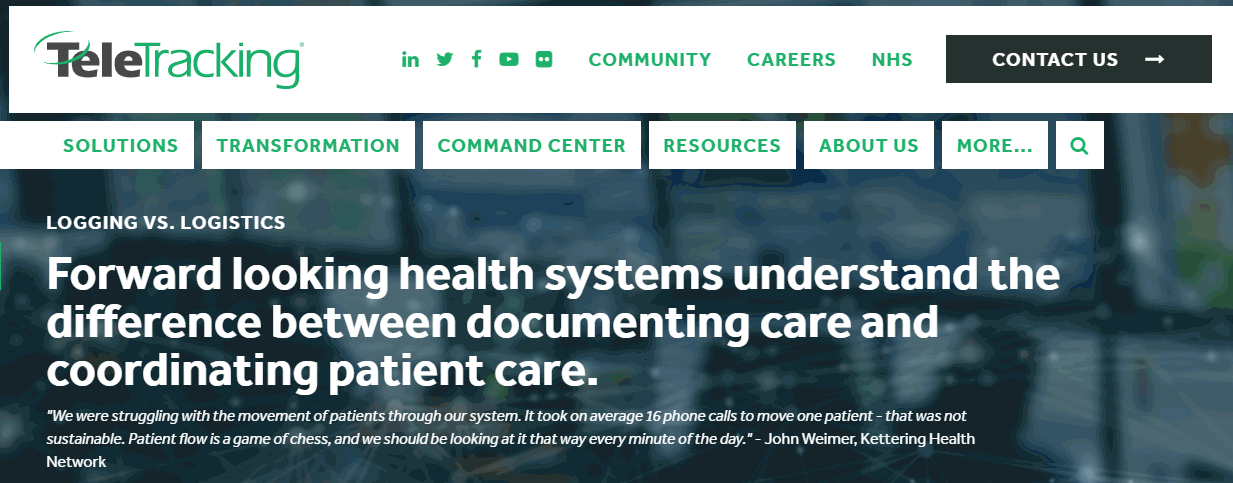
Description
How we evaluated: We verified TeleTracking vendor facts (HQ, founding year, customer count, certifications, named customers) against the vendor's corporate site on 2026-05-25. Pricing model description sourced from Capterra 2026 listing and TeleTracking sales-led process. KLAS Research rating cited from klasresearch.com Capacity Management Suite vendor page (4 unique orgs, 91 customer comments). Capterra 4.4/5 across 5 reviews verified 2026-05-25.
| Vendor | TeleTracking Technologies, Inc. |
|---|---|
| Headquartered | Pittsburgh, Pennsylvania, USA |
| Founded | 1991 |
| Best fit for | US hospitals and health systems (100+ beds primary segment) optimizing patient flow, bed management, EVS workflow, transfer center, and AI capacity forecasting |
| Pricing model | Quote-only enterprise; per-hospital and per-bed; modules and EHR integration depth scoped separately |
| Network scale | 200+ health systems, 1,000+ hospitals, 200,000+ beds managed (vendor-published, verified 2026-05-25) |
| Certifications | HIPAA-aligned, NIST-aligned (PII), GDPR-aligned (UK/EU) |
| KLAS recognition | Best in KLAS Patient Flow 2024; ranked #1 Patient Flow continuously 2011-2018; Overall Performance Score 75.0/100 for Capacity Management Suite |
| Verified on | 2026-05-25 |
Pros and Cons
Pros
- Best in KLAS 2024 for Patient Flow and ranked #1 in Patient Flow in Best in KLAS reports continuously from 2011 through 2018, per KLAS Research.
- Real-time bed-board visibility and EVS-to-transport handoff dramatically reduces communication delays during patient transitions, per G2 Capacity Management Suite reviews and KLAS customer comments (n=91).
- Customizable dashboards and data-driven performance reporting cited as standout strengths, per Capterra 4.4/5 across 5 reviews verified 2026-05-25.
- Most widely adopted Operational Command Center provider in US healthcare per Becker's Hospital Review KLAS study; named customers include Northwell Health (23 hospitals), Cleveland Clinic (90 percent year-round OR utilization), Hospital of the University of Pennsylvania, Abbott Northwestern, and Carilion Clinic.
- 2025 Palantir Foundry partnership brings AI/ML capacity forecasting and discharge prediction via Decision IQ, per TeleTracking press releases and Becker's Hospital Review coverage.
Cons
- Underlying BedTracking technology described as dated with "no investment for 8-10 years" and only 20 patient attributes allowed, per Capterra 3-star reviewer and G2 commentary.
- Upgrade downtimes and recent version flaws flagged as implementation pain points, per Capterra reviews verified 2026-05-25.
- Reporting still requires vendor support in some modules rather than being fully self-service, per G2 user feedback.
- Adding, editing, or deleting data described as a "long, complicated process" by admin users, per Capterra reviews.
- KLAS Overall Performance Score of 75.0 out of 100 for Capacity Management Suite sits below the 80.1 software-category average, signaling room for improvement despite category leadership.
Who Should Use TeleTracking
TeleTracking fits US hospitals and health systems wanting bed-management, EVS workflow, transfer-center, and AI capacity-forecasting consolidation under a single command center. The right shortlist candidate is typically:
- A 100+ bed acute-care hospital losing throughput to slow EVS handoffs, bed-board chaos, or transfer-center bottlenecks.
- A multi-hospital integrated delivery network (IDN) of 3+ facilities wanting a single capacity command center across all sites.
- A health system already running Epic, Oracle Cerner, MEDITECH, or Allscripts and needing HL7 ADT/SIU integration to feed bed status and patient transitions in real time.
- An organization using RTLS hardware (Sonitor, CenTrak, AeroScout) for asset and staff tracking that wants the RTLS data unified with bed/EVS workflow.
- A health system testing AI capacity forecasting via the Palantir Foundry partnership (Decision IQ module, 2025).
Community hospitals under 50 beds typically use simpler bed-management modules native to their EHR (e.g., MEDITECH Expanse Bed Management) rather than standalone command-center software. For lower-cost capacity-forecasting alternatives, see Qventus in the hospital management category.
Product Suite
TeleTracking's Operations IQ Platform is modular:
- BedTracking: real-time bed-status visibility across the hospital.
- Capacity Management Suite: integrated capacity command center.
- Transfer Center / Command Center: external and internal patient transfer workflow.
- TransportTracking: patient transport orchestration.
- Environmental Services (EVS) Workflow: room turnover and cleaning automation.
- SynapseIQ Data & Analytics: operational reporting and dashboards.
- Decision IQ (AI, launched 2025): AI-powered capacity forecasting and discharge prediction via Palantir Foundry.
- Adopt IQ: clinical adoption and change management tooling.
- Ambulatory Access: outpatient access workflow.
- RTLS (Software-Only): real-time location services layer integrating Sonitor, CenTrak, AeroScout hardware.
How Much Does TeleTracking Cost
TeleTracking is quote-only enterprise pricing with no public list price. Pricing is scoped by:
- Bed count of the hospital or health system.
- Modules selected (BedTracking, Transfer Center, Capacity Management Suite, Decision IQ, RTLS).
- EHR integration depth (HL7 ADT/SIU vs FHIR APIs vs custom interfaces).
- RTLS hardware integration (Sonitor, CenTrak, AeroScout).
- Implementation services and clinical advisory (bundled separately from software licensing).
For a 200-bed acute-care hospital deploying BedTracking + Capacity Management Suite + Transfer Center, expect a multi-year enterprise contract in the high-six to low-seven figures depending on negotiation, EHR integration scope, and RTLS hardware. Add-on training subscription is available at contract signing per vendor materials. Compare against Qventus and Lumeon in the hospital management category.
Hidden Costs and Contract Gotchas
- Implementation services. 4 to 24 months depending on scope. Negotiate fixed-fee implementation with milestone payments tied to deliverables.
- RTLS hardware. Sonitor, CenTrak, or AeroScout hardware is purchased separately from TeleTracking software licensing. Budget per badge or sensor.
- HL7 interface fees. Each EHR interface (Epic, Cerner, MEDITECH, Allscripts) is scoped separately.
- Palantir Foundry add-on. Decision IQ AI capacity forecasting is a paid add-on tied to the 2025 Palantir partnership.
- Training subscription. Optional training subscription is quoted at contract signing.
- Annual escalators. Multi-year contracts may include annual price increases. Negotiate caps.
- Upgrade downtimes. Reviewers flag version-upgrade flaws as implementation pain points. Confirm SLA terms.
Alternatives to TeleTracking
Hospitals most commonly shortlist TeleTracking against:
- Qventus: AI-native capacity optimization with KLAS 92.5% score and documented 9.6x ROI at HonorHealth.
- Epic Grand Central (Epic-native bed management for Epic shops).
- Oracle Health Capacity Management (Cerner CareAware for Cerner shops).
- LeanTaaS iQueue for Inpatient Flow (surgical OR optimization).
- Care Logistics: command-center alternative.
- Central Logic: transfer center specialist.
- Hospital IQ (now part of LeanTaaS).
- Artisight: AI virtual nursing and patient monitoring.
- Olive AI Patient Flow.
- MEDITECH Expanse Bed Management (native to MEDITECH shops).
For care orchestration alternatives covering ambulatory + acute pathways, see Lumeon. For broader hospital EHR options, browse the EHR category.
What Real Buyers Report
TeleTracking carries a 4.4 out of 5 Capterra rating across 5 reviews (verified 2026-05-25) and is listed on G2 with small review volume. KLAS Research reports a 75.0 out of 100 Overall Performance Score for the Capacity Management Suite based on 4 unique reporting organizations and 91 customer comments. TeleTracking won Best in KLAS for Patient Flow in 2024 and ranked #1 in Patient Flow continuously from 2011 through 2018.
The praise themes from real customers are consistent: real-time bed-board visibility, EVS-to-transport handoff coordination, customizable dashboards, Best in KLAS recognition, and the 2025 Palantir Foundry AI partnership. The complaint themes are equally consistent: BedTracking technology feels dated, upgrade downtimes are pain points, reporting requires vendor support, data administration is cumbersome, and KLAS overall score sits below the software-category average.
Large multi-hospital health systems and IDNs (HCA, Northwell, Cleveland Clinic) tend to weigh TeleTracking's installed-base depth and Patient Flow KLAS recognition highest. Smaller community hospitals and AI-first buyers more frequently choose Qventus instead.
Bottom Line
TeleTracking is the right shortlist candidate when a US hospital or multi-hospital health system needs a single command center across bed management, EVS workflow, transfer center, transport, and AI capacity forecasting, with 30+ years of US hospital operations domain experience and Best in KLAS Patient Flow 2024 recognition. The 1,000+ hospital installed base, named customers at HCA, Northwell, Cleveland Clinic, and Mount Sinai, and the 2025 Palantir Foundry AI partnership cover the procurement signals that matter for hospital operations leaders.
It is the wrong choice when a community hospital under 50 beds wants lightweight bed management native to its EHR, when modern cloud-native UI is non-negotiable, when fully self-service reporting (no vendor support tickets) is required, or when AI-native capacity forecasting (rather than AI-as-add-on) is the priority. Build implementation services, RTLS hardware budget, HL7 interface fees, Palantir Foundry add-on cost, training subscription, and annual escalator caps into your total cost of ownership before signing. Then compare side-by-side with Qventus, LeanTaaS iQueue, and Epic Grand Central to confirm TeleTracking's command-center depth fits your specific operational pain points.
Frequently Asked Questions
How much does TeleTracking cost?
TeleTracking is quote-only enterprise pricing per-hospital and per-bed. Pricing is scoped by bed count, modules selected (BedTracking, Transfer Center, Capacity Management Suite, Decision IQ), and EHR integration depth. Optional training subscription is available at contract signing per vendor materials. Implementation services and clinical advisory are bundled separately. No public price list is published; sales-led demos only (confirmed Capterra 2026 listing).
Is TeleTracking ONC-certified?
TeleTracking is HIPAA-aligned, NIST-aligned for PII handling, and GDPR-aligned for UK and EU operations. ONC 2015 Cures Update certification applies primarily to EHR products; TeleTracking is an operations platform that integrates with certified EHRs (Epic, Oracle Cerner, MEDITECH, Allscripts/Veradigm) via HL7 ADT/SIU and FHIR APIs rather than acting as the certified EHR itself.
Is TeleTracking a good fit for community hospitals?
Yes for community hospitals with 100+ beds wanting bed-management and EVS workflow improvements. TeleTracking's primary value is throughput optimization at scale; smaller community hospitals (under 50 beds) typically use simpler bed-management modules native to their EHR (e.g., MEDITECH Expanse Bed Management, MEDITECH Expanse's integrated module) rather than a standalone command center. TeleTracking's 1,000+ hospital footprint includes HCA Healthcare's broad community-hospital network.
How does TeleTracking compare to Qventus and LeanTaaS iQueue?
All three target US hospital operations optimization. TeleTracking wins on installed base (1,000+ hospitals, 200K+ beds managed) and Best in KLAS Patient Flow 2024 recognition. Qventus wins on AI-native discharge planning and capacity optimization with documented 9.6x ROI at HonorHealth. LeanTaaS iQueue wins on surgical OR optimization. See the full ranked list in the hospital management category.
What is the Palantir Foundry partnership?
TeleTracking announced a 2025 partnership with Palantir Foundry to add AI/ML capacity forecasting and discharge prediction to the Operations IQ Platform. The integration powers Decision IQ, TeleTracking's AI-powered decision support module. This brings TeleTracking closer to Qventus's AI-native positioning while preserving the deeper bed-management and EVS workflow depth that anchors TeleTracking's 30+ year domain experience.
What integrations does TeleTracking support?
TeleTracking integrates with Epic (ADT, bed status, transfer), Oracle Health / Cerner, MEDITECH Expanse (HL7 ADT/SIU feeds), Allscripts/Veradigm, HL7 v2 ADT and SIU interfaces, FHIR APIs, Palantir Foundry for AI ops, RTLS hardware (Sonitor, CenTrak, AeroScout), Microsoft Azure cloud, and enterprise tooling (Workday, ServiceNow). The platform sits between the EHR and the physical bed/transport/EVS infrastructure.
How long does TeleTracking implementation take?
Single-hospital implementations typically run 4 to 8 months. Multi-hospital health system rollouts commonly stretch to 12 to 24 months. TeleTracking's services team handles HL7 integration with the hospital EHR, RTLS hardware deployment, workflow configuration, and staff training. Reviewers flag upgrade downtimes and recent version flaws as implementation pain points (per Capterra 2026 reviews).
What are the biggest complaints about TeleTracking?
The recurring themes (Capterra 4.4/5 across 5 reviews; G2 listed but small review volume; KLAS Overall Performance Score 75.0/100) are: (1) underlying BedTracking technology described as dated with 'no investment for 8-10 years' and only 20 patient attributes allowed; (2) upgrade downtimes and recent version flaws are implementation pain points; (3) reporting still requires vendor support in some modules rather than being fully self-service; (4) adding, editing, or deleting data described as 'long, complicated process' by admin users; (5) KLAS Overall Performance Score 75.0 sits below the 80.1 software-category average.
Which hospitals run TeleTracking?
Named TeleTracking customers include HCA Healthcare, Mount Sinai Health System, Northwell Health (23 hospitals), Cleveland Clinic (reports 90 percent year-round OR utilization), Hospital of the University of Pennsylvania, Carilion Clinic, Abbott Northwestern Hospital, and Torrance Memorial Medical Center per the vendor's customer success page. The platform's 1,000+ hospital footprint spans US, UK, and EU markets.
Is TeleTracking ranked Best in KLAS?
Yes. TeleTracking was named Best in KLAS for Patient Flow in 2024 and was ranked #1 in Patient Flow in Best in KLAS reports continuously from 2011 to 2018. The 2024 win is supported by 91 customer comments across 4 unique reporting organizations per KLAS Research. The KLAS Overall Performance Score 75.0/100 for Capacity Management Suite sits below the 80.1 software-category average, signaling room for improvement despite category leadership.
Find Your Perfect Software
See how it can transform your workflow
- Personalized for your needs Tailored recommendations based on your unique requirements.
- Save time & resources Streamline your workflow and boost team productivity.
- Trusted by thousands Join 10,000+ businesses already growing with SaaSrat.
You're all set! 🎉
A specialist for will reach out within 1 business day with tailored recommendations for your needs.