
Transfinite
by Transfinite Innovative Solutions Pvt. Ltd.
What is Transfinite?
Get Best Quote for Transfinite
Connect with SaaSrat experts to get the best quote for your business.
You're all set!
A specialist for Transfinite will reach out within 1 business day.
Transfinite Features
General ledger and financials with multi-currency
Accounts receivable and payable
Sales order management with CRM
Purchase order and procurement
Inventory management with bin location tracking
Light manufacturing with BOM and MRP
View All 15 Features
Transfinite Pricing Plans
Cloud Starter Package
- Up to 5 users. Subset of features for the smallest deployments. Hosted by SAP or partner with backups and updates included.
Cloud Limited User
- Limited User license with a subset of modules, common for warehouse, sales, or service users who do not need full feature access. Cloud subscription.
Cloud Professional User
- Full feature access including financials, sales, purchasing, inventory, manufacturing, project management, and reporting. Primary tier for power users. Cloud subscription.
On-Premise Limited
- One-time perpetual license per user (~$1,400-$2,000), plus 16-22% annual maintenance fees. Subset of modules for limited users. Customer manages infrastructure and upgrades.
On-Premise Professional
- One-time perpetual license per user (~$2,700-$4,000), plus 16-22% annual maintenance fees. Full feature access. On-premise gives full data residency in customer environment.
Implementation (one-time)
- Partner-led implementation typically starts at $50,000 and runs higher with custom development, vertical add-ons, or complex data migration. Run by certified SAP Partners.
Transfinite Screenshots
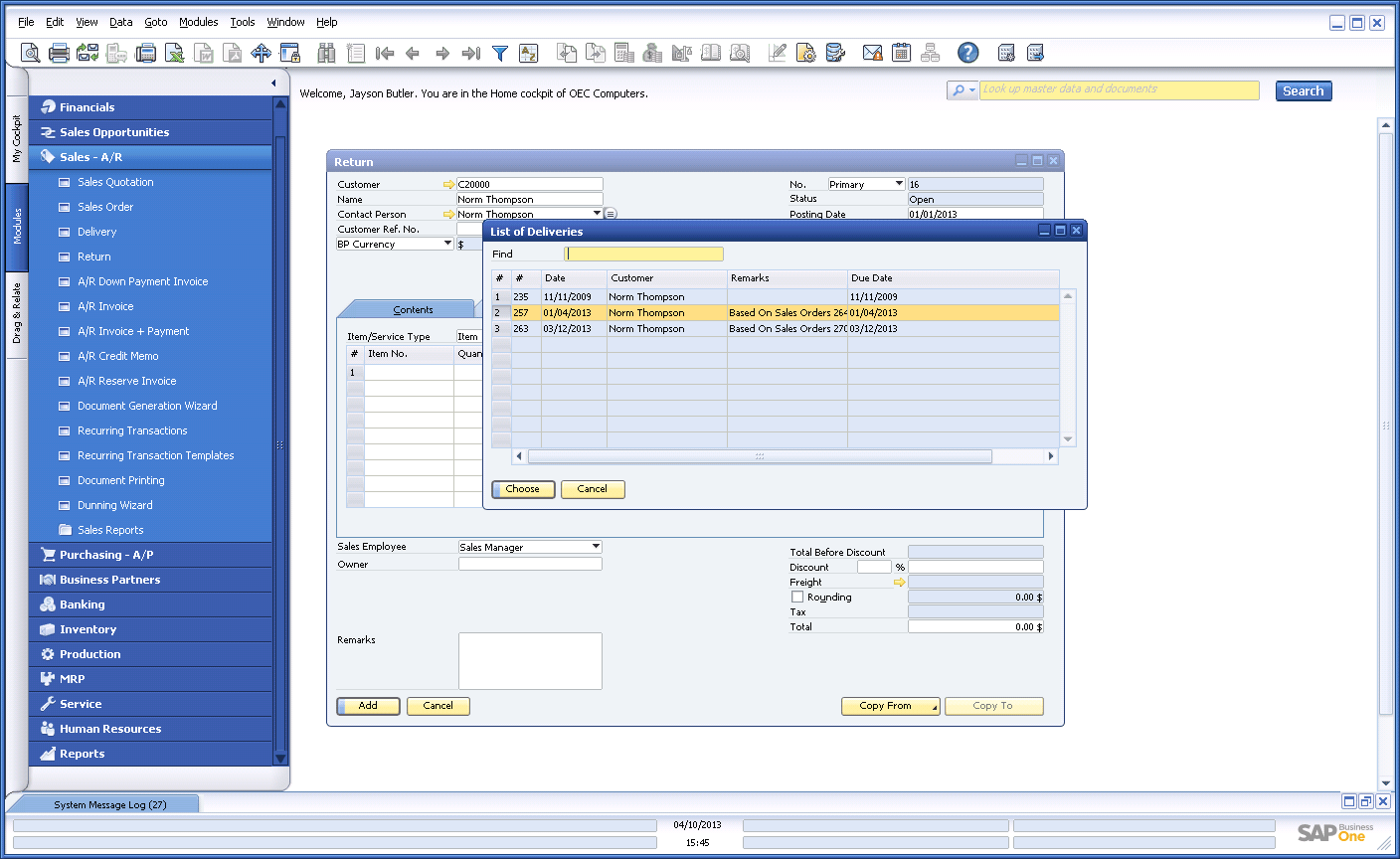
Description
What is SAP Business One?
SAP Business One (commonly called SAP B1) is SAP's enterprise resource planning suite purpose-built for small and mid-sized companies, generally those with 10 to 500 employees. Unlike SAP S/4HANA which targets large enterprises, Business One bundles accounting, sales, inventory, light manufacturing, and project management into one product without requiring a heavy implementation team.
The product was originally acquired by SAP in 2002 from Israeli vendor TopManage Financial Systems. It is sold exclusively through SAP Partner Channel, not directly by SAP. There are more than 80,000 Business One customers across 170 countries, making it one of the most-deployed SMB ERP platforms globally.
Who SAP Business One is built for
Business One fits small and mid-sized companies (10 to 500 employees, typically $5M to $250M annual revenue) that are growing beyond QuickBooks Online, Xero, or Sage 50 and need a single integrated suite covering finance, sales, inventory, and manufacturing. Manufacturers, distributors, retailers, and wholesalers are the strongest verticals.
It is also a strong fit for subsidiaries and divisions of larger SAP-using corporations. Group HQ runs on SAP S/4HANA, the subsidiary runs on SAP Business One, and the two integrate for financial consolidation. This subsidiary-of-an-SAP-shop scenario is one of the most common reasons buyers pick Business One specifically.
It is less of a fit for service businesses (SAP Business One is product-and-inventory-heavy by design; NetSuite or Sage Intacct are better for pure services), for very small businesses (under $5M revenue, where QuickBooks Online suffices), or for technology startups (which usually pick NetSuite for cloud-native ERP with stronger native integrations).
SAP Business One pricing plans
| License type | Pricing | Notes |
|---|---|---|
| Cloud Starter Package | $38 user/mo | Limited features, up to 5 users |
| Cloud Limited User | $47 user/mo | Subset of modules, common in SMB |
| Cloud Professional User | $91 user/mo | Full feature access, primary tier |
| On-premise Limited | ~$1,400 perpetual | One-time per user + 16-22% annual maintenance |
| On-premise Professional | ~$2,700 perpetual | One-time per user + maintenance |
| Implementation | $50K+ typical | Partner-led, varies by scope |
SAP Business One is sold by SAP Partners (not SAP direct), so pricing varies by partner. Independent ERP analyst sources place cloud subscription at $38-$150 per user per month depending on tier. On-premise perpetual licenses run roughly $1,400-$2,700 per user with 16-22% annual maintenance fees on top.
Cloud editions include hosting, updates, and backups. The Starter Package limits feature scope and caps at 5 users; most growing companies need Limited User or Professional User tiers within the first year. Implementation through SAP Partners typically starts at $50,000 and runs higher with custom development, vertical add-ons, or complex data migration.
SAP Business One core capabilities
The financial accounting core covers general ledger, accounts receivable, accounts payable, fixed assets, banking and bank reconciliation, and multi-currency. Multi-company functionality lets a single deployment manage multiple legal entities with consolidated reporting.
Sales order management ties to the built-in CRM: leads, opportunities, accounts, quotes, sales orders, deliveries, and invoices in one workflow. Purchase order management handles purchase requisitions, RFQs, purchase orders, goods receipts, and supplier invoices.
Inventory management supports multiple warehouses with bin location tracking, lot and serial number control, and stock revaluation. Lot and serial tracking matters for regulated industries (food, pharma, medical devices, defense).
Light manufacturing
Business One includes light manufacturing capabilities: bills of materials (BOM), production orders, MRP for material requirements planning, and shop floor data collection. This handles discrete and assemble-to-order manufacturing well; complex process manufacturing or engineer-to-order typically requires industry-specific add-ons from SAP Partners.
For manufacturers outgrowing QuickBooks Enterprise or Sage 100, Business One's manufacturing depth is one of the strongest reasons to migrate. It is more capable than NetSuite's basic manufacturing without the price tag of dedicated MES tools.
Project management and service
Project management covers job costing, time tracking, billing by milestone or T&M, and project profitability reporting. This is differentiated from QuickBooks Online's basic project tracking.
Service management handles service contracts, service tickets, field service dispatch, and warranty claims. For companies with both product sales and after-sale service revenue, this avoids running a separate service desk tool.
HANA in-memory analytics
The cloud edition runs on SAP HANA, the in-memory column-store database that powers SAP S/4HANA. This delivers fast reporting and real-time analytics directly inside Business One, with embedded dashboards that respond to queries in milliseconds rather than minutes.
Pervasive analytics like "top 10 customers by margin this quarter" or "slow-moving inventory by location" render in real time without exporting to a separate BI tool. This is one of the strongest cloud-edition differentiators versus on-premise Business One on Microsoft SQL Server.
SAP Crystal Reports and BI
SAP Crystal Reports is bundled for custom financial and operational reporting. Reports can be parameterized, scheduled, and exported to PDF, Excel, or web. For deeper BI, Business One integrates with SAP Analytics Cloud, Power BI, and Tableau for executive dashboards beyond the built-in reports.
Industry add-ons via SAP Partners
SAP Business One has a long-running partner ecosystem with hundreds of industry-specific add-ons: food and beverage (lot tracking, recall management), pharma (FDA compliance, lot genealogy), apparel (style/color/size matrix), construction (job costing), wholesale distribution (warehouse management), and many others.
The add-on quality varies. Buyers should evaluate the specific partner add-on as carefully as the core Business One product, since the add-on becomes the buyer's daily workflow if their vertical needs go beyond the standard product.
Integration with SAP S/4HANA
For subsidiaries of larger SAP companies, Business One integrates with SAP S/4HANA Cloud through the Intercompany Integration Solution. This handles intercompany sales, financial consolidation, and master data sync. The integration is one of the strongest reasons companies in SAP-shop conglomerates pick Business One over NetSuite for new subsidiaries.
Mobile and offline
iOS and Android apps cover sales rep workflows (customer lookup, quote creation, order entry), warehouse operations (receiving, picking, stock counts), service technician workflows (work order completion, time tracking), and management dashboards. Offline support varies by feature; sales and warehouse apps cache data locally.
Security and compliance
SAP Business One Cloud is hosted on AWS, Azure, or SAP-managed infrastructure depending on the partner. SOC 2 Type II, ISO 27001, and PCI DSS controls apply. Multi-factor authentication and SSO with SAML are supported. On-premise deployments give full data ownership inside the customer environment, which attracts regulated industries and government buyers.
SAP Business One vs NetSuite
NetSuite is the cloud-native SMB ERP leader with strong service business and SaaS company fit. Business One is the SAP-ecosystem SMB ERP with strong manufacturing, distribution, and SAP S/4HANA integration. Pick NetSuite for tech, services, and SaaS companies. Pick Business One for manufacturers, distributors, retailers, and subsidiaries of SAP-shop enterprises.
SAP Business One vs Microsoft Dynamics 365 Business Central
Business Central is Microsoft's SMB ERP, the direct competitor to SAP Business One. Both target similar buyers. Business Central wins for Microsoft 365 shops with tight Office and Power Platform integration. Business One wins for SAP shops needing S/4HANA integration and for manufacturers needing deeper MRP. Pricing is comparable.
SAP Business One vs Sage Intacct
Sage Intacct is the cloud accounting and financial management leader for mid-market services and SaaS companies. Business One is broader ERP covering operations beyond accounting. Pick Sage Intacct for finance-led mid-market services. Pick Business One when inventory, manufacturing, or distribution operations matter.
SAP Business One vs QuickBooks Enterprise
QuickBooks Enterprise is the upmarket QuickBooks tier for growing SMBs. Business One is the next step up the ERP ladder. Companies typically migrate from QuickBooks Enterprise to Business One when they outgrow QB's inventory, manufacturing, or multi-entity capabilities. Pricing differential is significant: Business One is 5-10x QuickBooks Enterprise on TCO.
Buyer pitfalls to avoid
Three patterns hurt Business One rollouts. First, underestimating implementation: $50K is a starting point; many deployments run $100K-$300K once industry add-ons and data migration are factored in. Build a 3-year TCO. Second, picking the wrong SAP Partner: implementation quality varies widely across partners. Get references from similar-size and similar-industry customers before signing. Third, ignoring the partner ecosystem trade-offs: customizations and add-ons become partner-dependent, so changing partners later can be costly.
Implementation and time to value
Standard implementations take 3 to 6 months for first production go-live. Complex deployments (multi-entity, vertical add-ons, custom development) run 6 to 12 months. SAP Partners handle implementation; SAP itself does not sell directly. The Authorized SAP Partner channel includes consultancies in every major market with vertical specialization.
Customer support
Day-to-day support comes from the SAP Partner, not from SAP. Larger partners maintain dedicated support teams with stated SLAs. SAP itself provides product-level support, knowledge base access through the SAP Help Portal, and major version maintenance. The SAP Business One Community and SAP Business One Innovation Summit (annual user conference) are active.
The Bottom Line on SAP Business One
SAP Business One is the right call for small and mid-sized manufacturers, distributors, retailers, and SAP-ecosystem subsidiaries that need integrated ERP covering finance, sales, inventory, and light manufacturing in one product.
Standout strengths: SAP brand and 80,000+ global customer base, deep manufacturing and distribution capability for SMB, HANA in-memory analytics on cloud edition, SAP Partner ecosystem with industry-specific add-ons, native integration with SAP S/4HANA for subsidiary consolidation, on-premise option for data residency.
Pricing varies by SAP Partner. Cloud editions run $38-$150 per user per month: Starter Package $38 (up to 5 users), Limited User $47, Professional User $91. On-premise perpetual is $1,400-$2,700 per user with 16-22% annual maintenance. Implementation typically starts at $50,000 and scales with scope.
Trade-offs to weigh: sold only through SAP Partners (not direct), so partner selection matters as much as product selection. Implementation timelines (3-12 months) require significant team capacity. Industry add-ons add cost and partner-dependency. Less cloud-native than NetSuite, despite the cloud edition.
Alternatives worth comparing: NetSuite for cloud-native SMB ERP with services and SaaS fit, Microsoft Dynamics 365 Business Central for Microsoft-shop SMB ERP, Sage Intacct for finance-led mid-market services, QuickBooks Enterprise for SMB still outgrowing QuickBooks, Acumatica for cloud-native manufacturing and distribution, Odoo for open-source ERP flexibility. Pricing and capabilities verified via ERP Research, Top10ERP, and SAP Business One pricing guides on 2026-06-27.
Frequently Asked Questions
Is there a free plan or free trial for Transfinite?
How much does Transfinite cost?
What does Transfinite integrate with?
Who is Transfinite best for?
What are the best alternatives to Transfinite?
Is Transfinite GDPR / SOC 2 compliant?
Does Transfinite have a mobile app?
What do real users say about Transfinite?
How does Transfinite compare to its top competitor?
Does Transfinite offer customer support?
Find Your Perfect Software
See how it can transform your workflow
- Personalized for your needs Tailored recommendations based on your unique requirements.
- Save time & resources Streamline your workflow and boost team productivity.
- Trusted by thousands Join 10,000+ businesses already growing with SaaSrat.
You're all set! 🎉
A specialist for will reach out within 1 business day with tailored recommendations for your needs.