

Postmark
by Wildbit LLC
What is Postmark?
Get Best Quote for Postmark
Connect with SaaSrat experts to get the best quote for your business.
You're all set!
A specialist for Postmark will reach out within 1 business day.
Postmark Features
Transactional email
Email templates
Smtp service
Api integration
Email tracking
Bounce handling
View All 28 Features
Postmark Resources
Postmark Screenshots
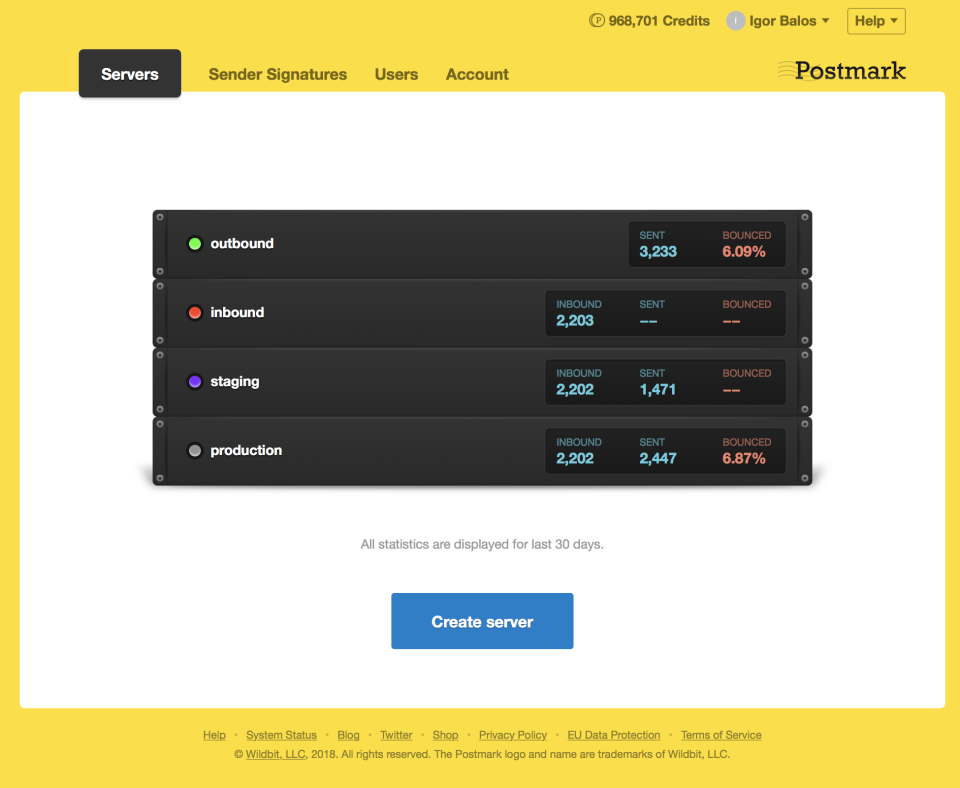
Description
Postmark at a Glance
| Category | Transactional email + Application email API + Message streams |
|---|---|
| Best for | SaaS applications, developers, and product teams sending password resets, receipts, notifications, and product email at scale |
| Deployment | Cloud SaaS via REST API and SMTP; no self-hosting |
| Owner | ActiveCampaign (Wildbit acquired 2022) |
| Message streams | Separated infrastructure for transactional versus broadcast marketing traffic |
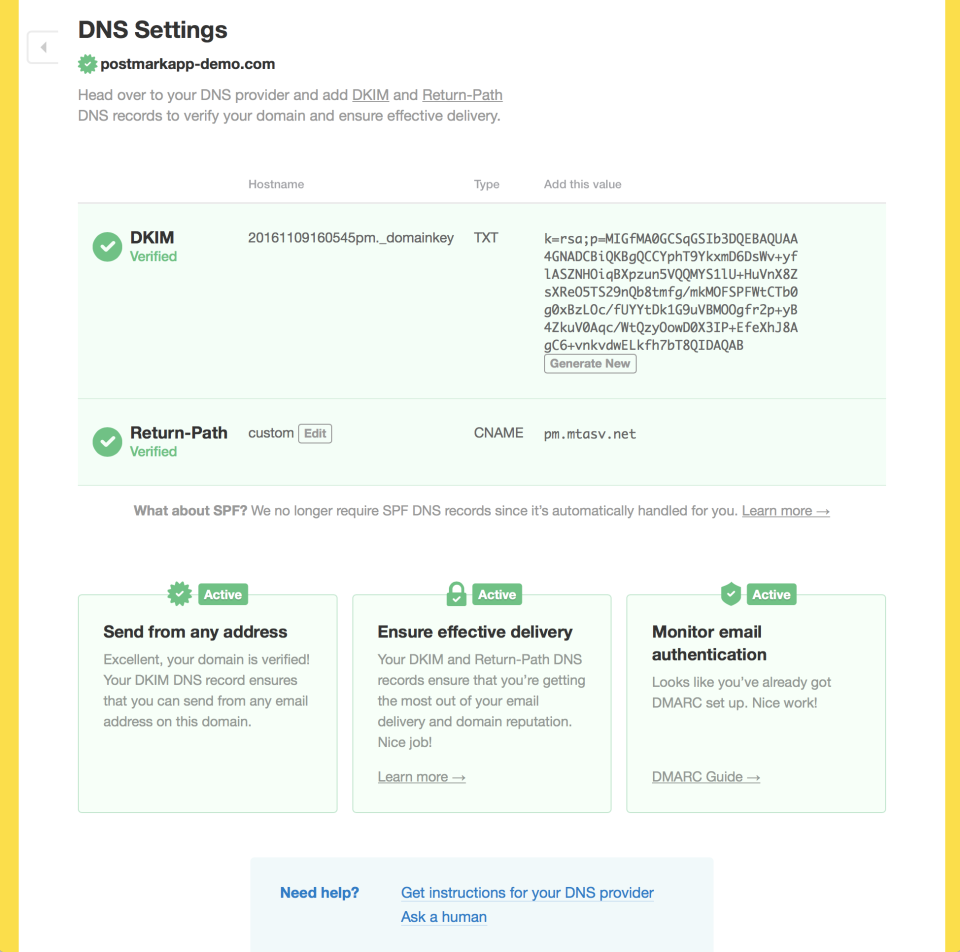
| Authentication | DKIM, SPF, DMARC tooling plus BIMI support and DNS setup wizard |
| Inbound | Inbound message stream parses email into JSON and posts to application webhooks |
| Activity retention | 45 days default, customizable up to 365 days |
| Deliverability | Multi-region routing; 4x median inbox delivery speed vs competing providers in vendor tests |
| HQ | Philadelphia, Pennsylvania, USA |
Postmark Overview
Postmark is a Philadelphia-headquartered transactional email service built by Wildbit and now owned by ActiveCampaign following the 2022 acquisition. The platform provides SaaS applications and developers with a REST API and SMTP endpoint for sending application-generated emails (password resets, receipts, order confirmations, notifications, magic links, invoice emails) with the deliverability and observability that generic marketing email tools do not prioritize.
The core architectural choice is message streams: Postmark separates transactional email traffic (must arrive fast, must land in the inbox) from broadcast marketing traffic (higher volume, less time-sensitive) onto physically separated sending infrastructure. This isolation means a marketing send does not slow a password reset email, and a deliverability incident on one stream does not contaminate the other. Inbound message streams also process incoming email, parse it into JSON, and post to application webhooks for reply-by-email workflows.
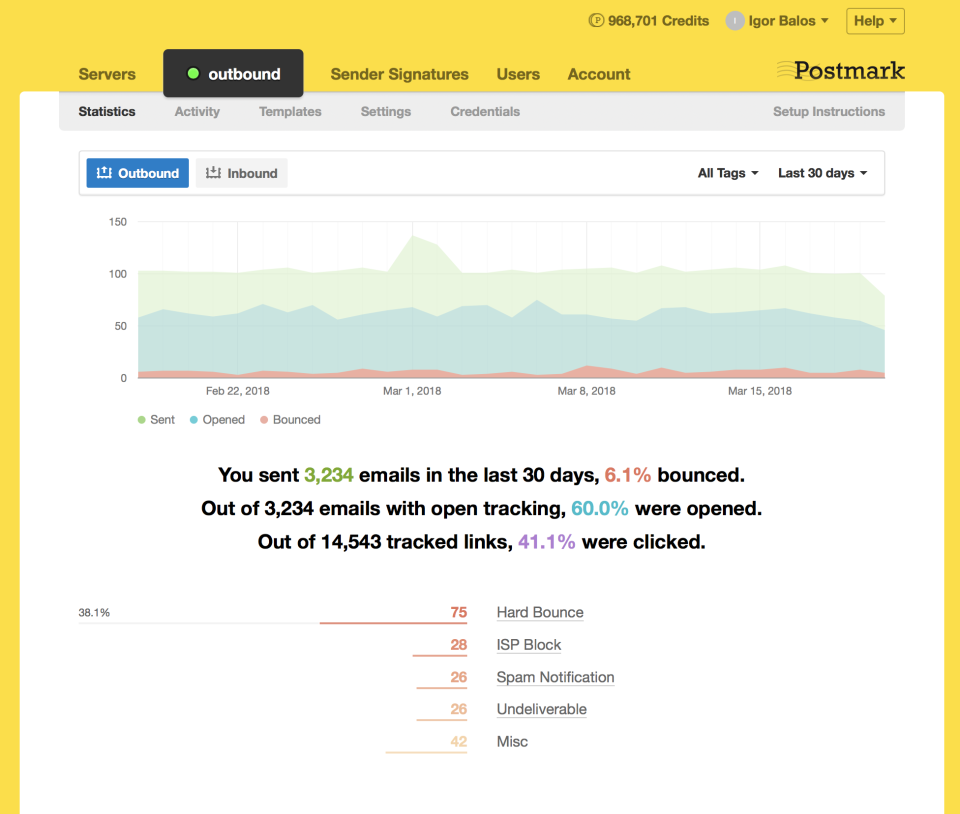
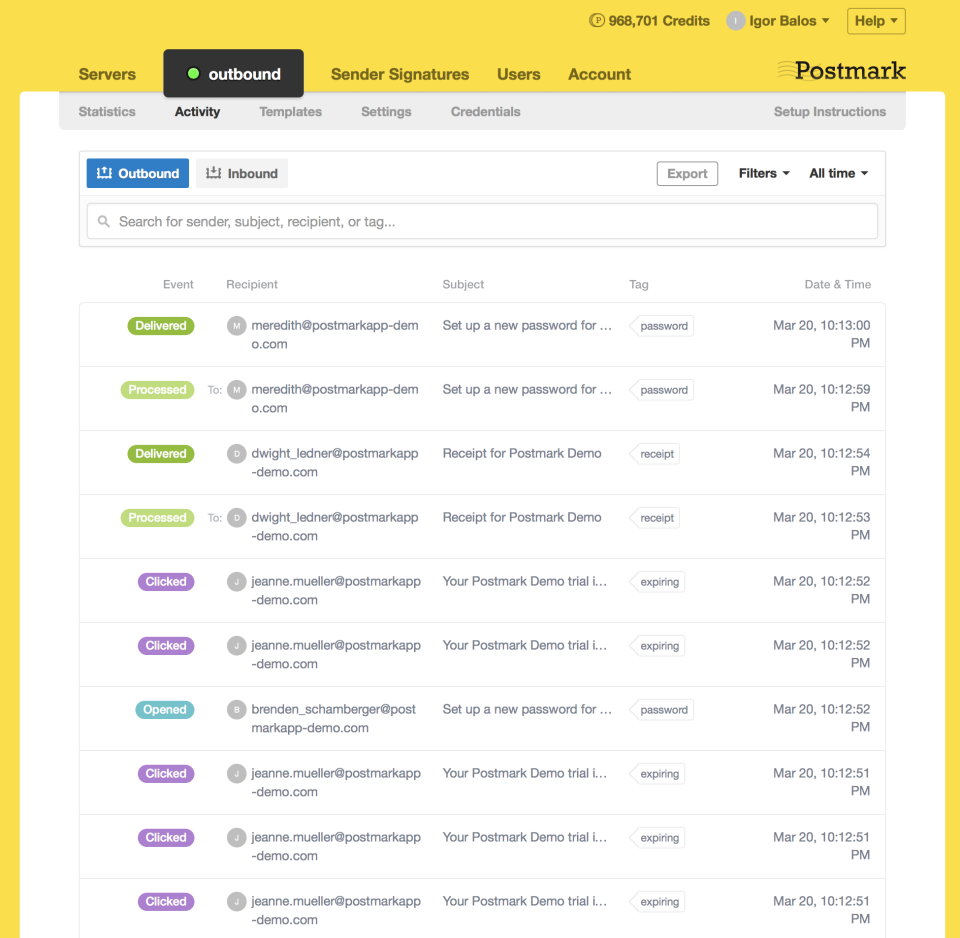
Postmark ships DKIM, SPF, and DMARC authentication tooling, multi-region routing, event webhooks for opens and clicks, secure endpoints for compliance, email tracking, and detailed activity retention (45 days default, customizable to 365 days). Named customers include Asana, Webflow, 1Password, Wistia, IKEA, Moz, LiveChat, Proposify, and Childcare.co.uk. Postmark deliverability data cites 4x faster median inbox delivery than competing providers in vendor-published tests.
Capabilities and Named Features
Postmark is built as a specialized transactional email platform where message streams are the primary architectural unit. Every account starts with two streams by default (transactional and broadcast) but developers can create additional named streams for magic link auth, receipt email, alert email, or any other traffic pattern that deserves its own sending reputation. Each stream has its own IP allocation, its own bounce and complaint tracking, and its own suppression list, so a marketing broadcast issue never poisons the reputation of the password reset stream. This design choice is the single biggest reason product teams pick Postmark over SendGrid or SES for critical application email.
Named feature list
- REST API and SMTP endpoint for sending transactional email with detailed response codes and message IDs
- Message streams separating transactional and broadcast marketing infrastructure with per-stream reputation
- Inbound message stream that parses incoming email into JSON and posts to application webhooks for reply-by-email workflows
- DKIM, SPF, DMARC authentication tooling with DNS setup wizard and record verification
- BIMI support for verified brand logos in Gmail and Yahoo inbox listings
- Email template engine with responsive design, template versioning, and preview across mail clients
- Multi-region routing for reduced latency to global recipients
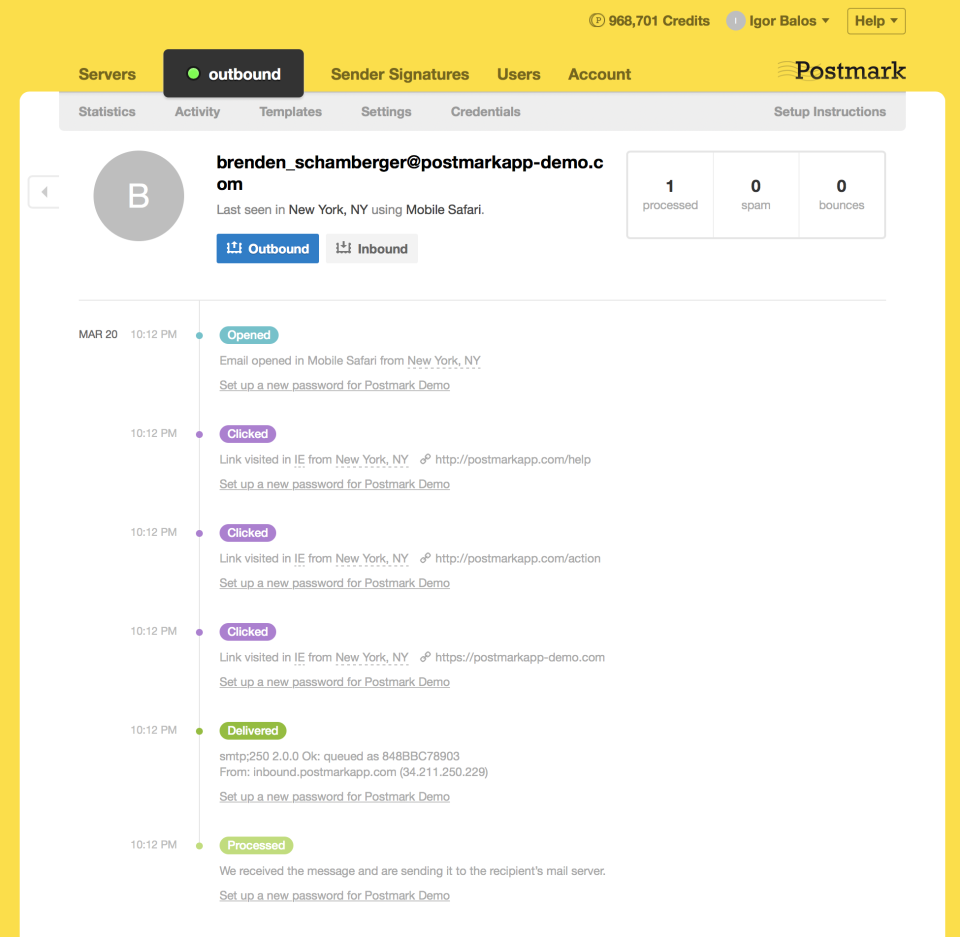
- Event webhooks for delivered, bounced, opened, clicked, complained, and unsubscribed events
- Detailed activity search across 45 days by default (customizable up to 365 days) with full message header inspection
- Suppression list management with per-stream and account-level entries and automated bounce handling
- Server groups for organizing streams by application, environment (production, staging, development), or customer tenant
- OAuth-based API tokens with granular scopes and rotation support
- Test server mode for development environments without real email delivery
- Rate limiting and per-server sending caps with automatic upgrade prompts
- IP warmup workflow for new dedicated IPs with automatic reputation building
- Email verification API and shared IPs plus dedicated IPs for higher-volume accounts
- GDPR compliance, DDoS protection, and third-party penetration testing
- Integrations with Zapier, Segment, PostHog, and thousands of applications through the message streams API
Pricing and Plans
Postmark publishes four monthly tiers plus high-volume custom pricing: Free at 0 USD per month with 100 emails per month and no expiration (suitable for hobby projects and low-volume production); Basic at 15 USD per month with 10,000 emails included and 1.80 USD per additional 1,000 emails; Pro (marked Most Popular) at 16.50 USD per month with 10,000 emails included and 1.30 USD per additional 1,000 emails; Platform at 18 USD per month with 10,000 emails included and 1.20 USD per additional 1,000 emails.
The tier structure is unusual because the monthly price differences are small but the overage rates differ meaningfully: Basic overage runs 1.80 USD per 1,000 while Platform runs 1.20 USD per 1,000. This means high-volume senders benefit from the Platform tier even at 18 USD monthly base cost because the overage rate difference compounds at scale. The Free tier is a durable long-term option for developers running low-volume side projects rather than a time-limited trial.
Custom high-volume pricing kicks in above 1 million emails per month and includes dedicated IPs, dedicated Customer Success Manager, custom activity retention windows up to 365 days, and negotiated per-email rates. Buyers should model expected 12-month email volume including product growth and pick the tier where the overage rate optimizes total spend rather than optimizing base monthly cost.
| Tier | Price | What is included |
|---|---|---|
| Free | $0 per month | 100 emails per month, no expiration; suitable for hobby projects and low-volume production |
| Basic | $15 per month | 10,000 emails included; $1.80 per 1,000 overage |
| Pro | $16.50 per month | 10,000 emails included; $1.30 per 1,000 overage (Most Popular tier) |
| Platform | $18 per month | 10,000 emails included; $1.20 per 1,000 overage (best for high-volume growth) |
| High-volume | Custom quote | 1M+ emails per month with dedicated IPs, dedicated CSM, custom retention windows |
| Dedicated IPs | Add-on quote | Dedicated sending IPs with reputation warmup workflow |
| Activity retention extension | Custom quote | Extend activity search from 45 days default up to 365 days |
Pros
- Message streams separating transactional and broadcast traffic prevent marketing sends from contaminating password reset deliverability
- Deliverability data cites 4x faster median inbox delivery vs competing providers in vendor-published tests
- REST API and SMTP endpoint with detailed response codes make debugging application email straightforward
- Inbound message stream parses email into JSON and posts to webhooks for reply-by-email workflows without a separate parser tool
- 45-day activity search retention with full message header inspection helps debug delivery issues fast
- Free tier with 100 emails per month and no expiration works for durable hobby projects and low-volume production
- Named customers include Asana, Webflow, 1Password, Wistia, IKEA, Moz, LiveChat, Proposify
- ActiveCampaign parent group provides financial stability and integration potential with the ActiveCampaign marketing suite
Cons and Trade-offs
- Focused on transactional email; marketing campaign tools are lighter than SendGrid Marketing Campaigns or Mailchimp
- Tier structure with small monthly price differences but different overage rates requires modeling to pick the right plan
- Custom high-volume pricing kicks in above 1 million emails per month; very high senders should compare against Amazon SES cost per email
- Reddit r/webdev and r/SaaS threads note the free tier at 100 emails per month is quickly outgrown; production apps typically start at Basic or Pro tier
- Multi-region routing exists but Postmark is US-hosted; strict EU data residency buyers should evaluate against Mailjet or European alternatives
- Template engine is functional but less feature-rich than dedicated marketing email design tools
- Some customers report that the aggressive spam prevention approach (Postmark rejects senders that look like spam even after signup) requires up-front sender reputation care
- Dedicated IP warmup workflow requires operational attention during the initial 2 to 4 weeks of ramp-up
Postmark vs Alternatives
| Vendor | Best for | Message stream isolation | Pricing | Notable strength |
|---|---|---|---|---|
| Postmark | SaaS applications and developers sending transactional email | Yes; separated infrastructure per stream | Free plus published tiers from $15 per month | Deliverability speed plus message stream isolation |
| SendGrid (Twilio) | SaaS applications and marketing at scale | Not the same isolation model | Free plus published tiers from $19.95 per month | Broadest feature set with marketing plus transactional in one |
| Amazon SES | AWS-native applications with high volume | No stream isolation | $0.10 per 1,000 emails plus data transfer | Lowest cost at high volume plus native AWS IAM integration |
| Mailgun (Sinch) | Developers needing HTTP API with detailed logs | Domain-level isolation | Published tiers from $35 per month | Strong European presence plus deep logging |
| Sparkpost (MessageBird) | Enterprise transactional email at high volume | Subaccount isolation | Custom quote for enterprise | Enterprise-grade deliverability plus analytics |
| Resend | Modern developer-first transactional email | Domain-level isolation | Free plus published tiers from $20 per month | React Email template DX plus modern developer UX |
Who Should Choose Postmark
SaaS applications and developer teams needing reliable transactional email for password resets, receipts, notifications, magic links, and product email delivery.
Product teams that want message stream isolation to prevent marketing broadcasts from contaminating transactional email deliverability reputation.
Applications with reply-by-email workflows (support tickets, email-to-comment, email-to-task) needing inbound email parsing into JSON via webhooks.
SaaS companies scaling from initial free tier through 1 million email per month volume before evaluating enterprise custom pricing or Amazon SES at extreme volume.
Development teams that want detailed activity search with full message header inspection for debugging delivery issues in production.
Product teams that value ActiveCampaign parent group backing and potential future integration with ActiveCampaign marketing automation.
Named Alternatives to Postmark
- SendGrid (Twilio). Broadest feature set with marketing plus transactional in one
- Amazon SES. Lowest cost per email at high volume with AWS-native IAM integration
- Mailgun (Sinch). Strong European presence with detailed HTTP API logs
- Resend. Modern developer-first with React Email template DX
- Sparkpost (MessageBird). Enterprise transactional email at high volume
- Loops. Product-first transactional and marketing email for modern SaaS
- Postmark Broadcasts. Postmark broadcast stream for lower-volume marketing sends
- Mandrill (Mailchimp Transactional). Mailchimp-owned transactional email add-on
Implementation and Deployment
Developer signup takes 5 to 10 minutes: create an account, verify a sending domain, add DKIM and SPF DNS records, and start sending API calls in test mode.
Domain verification and DKIM plus SPF DNS record propagation typically completes within 15 to 60 minutes but can take up to 24 hours depending on the DNS provider.
Small SaaS production integration (10 to 100 daily emails) reaches steady state in 1 to 3 days including API integration, template creation, and event webhook setup.
Mid-volume SaaS integration (10,000 to 100,000 daily emails) commonly runs 1 to 3 weeks including dedicated IP request (if applicable), warmup workflow, and message stream configuration by traffic type.
High-volume dedicated IP deployments (500,000+ daily emails) require 2 to 4 week IP warmup workflow to build reputation before full traffic migration; the vendor Customer Success team supports this workflow on the Platform and High-volume tiers.
Inbound message stream setup for reply-by-email or email-to-webhook workflows takes 1 to 3 days including MX record configuration, webhook endpoint deployment, and reply parsing testing.
What Real Buyers Say About Postmark
A Reddit r/SaaS thread from mid-2025 titled 'Postmark vs SendGrid vs Resend for a Series A product' captured the recurring developer trade-off: Postmark wins on message stream isolation and deliverability speed; SendGrid wins on broadest feature set with marketing plus transactional in one; Resend wins on modern React Email template DX and developer aesthetics. Additional context: r/SaaS threads on transactional email short-lists, Postmark on LinkedIn, r/webdev threads on email deliverability.
LinkedIn posts by SaaS CTOs highlight the message stream isolation feature as the single reason to pick Postmark for critical application email: a marketing broadcast issue on the broadcast stream does not degrade password reset deliverability on the transactional stream, which matters more as user counts grow.
SoftwareAdvice and Product Hunt reviews consistently rank Postmark in the top three transactional email services alongside SendGrid and Resend, with the strongest positioning for developer-first SaaS applications that value deliverability and observability over marketing campaign feature depth.
Reddit r/webdev and r/SaaS threads warn buyers to model expected 12-month email volume including product growth carefully and pick the tier where the overage rate optimizes total spend rather than optimizing base monthly cost; the small monthly price differences between Basic, Pro, and Platform hide meaningfully different overage economics.
Vendor references: Postmark published pricing tiers, Postmark message stream isolation architecture, Postmark named customer references.
The Bottom Line on Postmark
Postmark is the default short-list candidate for SaaS applications and developer teams that need reliable transactional email with message stream isolation preventing marketing broadcasts from contaminating password reset deliverability. The 4x faster median inbox delivery speed and inbound webhook processing are the strongest technical differentiators.
Named customers span product-first SaaS (Asana, Webflow, 1Password, Wistia), consumer brands (IKEA), and content marketing (Moz, Proposify, LiveChat). ActiveCampaign parent group backing provides financial stability and potential future integration with the ActiveCampaign marketing suite.
Watch the tier selection carefully: Basic at 15 USD monthly and Platform at 18 USD monthly differ by only 3 USD in base cost but differ by 0.60 USD per 1,000 emails in overage rate. Model expected 12-month email volume including product growth and pick the tier where overage optimizes total spend rather than optimizing base monthly cost.
Alternatives to shortlist alongside Postmark: SendGrid (Twilio) for broadest feature set with marketing plus transactional, Amazon SES for lowest cost per email at high volume, Mailgun (Sinch) for strong European presence, Resend for modern React Email developer DX, and Sparkpost for enterprise transactional at extreme volume.
Verified on 2026-08-04 against vendor website.
Frequently Asked Questions
How much does Postmark cost in 2026?
What are Postmark message streams?
Who is Postmark a fit for?
How does Postmark compare to SendGrid, SES, and Resend?
Does Postmark support inbound email?
What authentication does Postmark support?
How long does Postmark implementation take?
What are the biggest complaints about Postmark?
Is Postmark owned by ActiveCampaign?
Does Postmark handle high-volume transactional email?
Find Your Perfect Software
See how it can transform your workflow
- Personalized for your needs Tailored recommendations based on your unique requirements.
- Save time & resources Streamline your workflow and boost team productivity.
- Trusted by thousands Join 10,000+ businesses already growing with SaaSrat.
You're all set! 🎉
A specialist for will reach out within 1 business day with tailored recommendations for your needs.