Quick facts before we start:
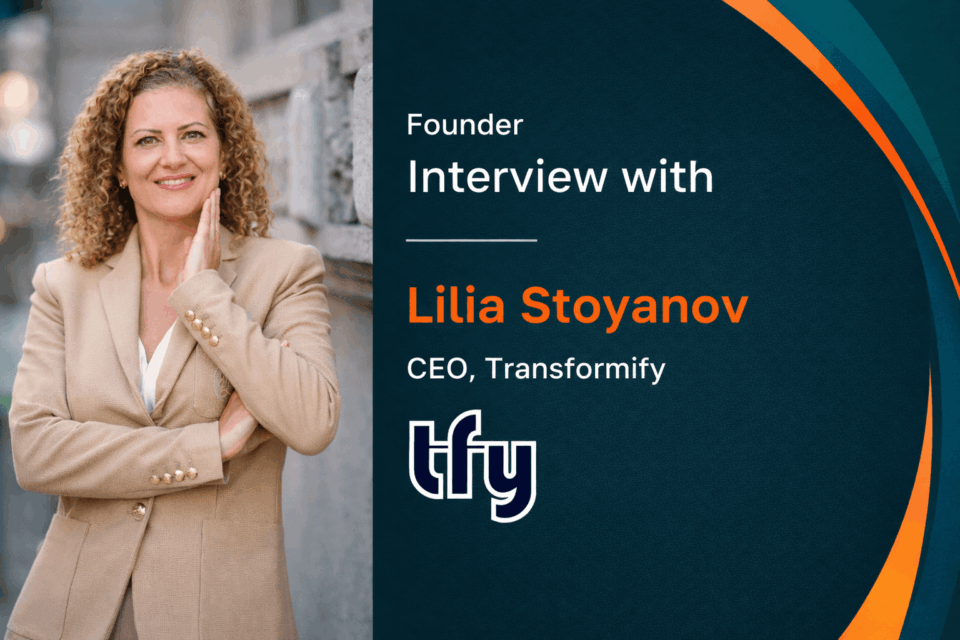
| Founder | Lilia Stoyanov |
| Role | CEO and Angel Investor |
| Company | Transformify (TFY) |
| Founded | 2015 |
| What It Does | All-in-one workforce management: hire, manage, and pay freelancers, contractors, and employees globally |
| Countries | 184+ |
| Revenue Growth | 600% (2021 vs 2020), 250% (2022 vs 2021), 90% profit growth in 2024 |
| Churn Rate | Below 1% |
| Funding | Bootstrapped (no VC rounds) |
| Headquarters | London, UK |
| Website | transformify.org |
Here’s a story you don’t hear often in SaaS. A founder with a background as GM and CFO at a NYSE-listed payments company walks away from the corporate world, bootstraps a workforce management platform from scratch, hits profitability in three years, grows revenue 600% in a single year during a pandemic, and does it all without a single VC round. While competitors with tens of millions in funding filed for bankruptcy, Transformify kept growing.
We talked to Lilia Stoyanov about the decisions that got her here, the traps she deliberately avoided, and why she thinks most SaaS founders raise money too early and for the wrong reasons.
The Background: From NYSE Boardrooms to Building a Startup
SaaSRat: You had a very senior corporate career before Transformify. What was the path that led you here?
Lilia: I enrolled in the High School of Economics when I was 14. Later I went to Oxford, studied Financial Strategy, and built my career in payments and financial services. I ended up as GM and CFO at Skrill, which is now part of Paysafe and listed on NYSE. So I spent years inside large financial institutions, running operations, managing strategy, leading teams across countries.
That background gave me two things that turned out to be critical for building Transformify. First, I understood payments infrastructure deeply, how money moves across borders, what compliance looks like in different jurisdictions, where the friction points are. Second, I saw firsthand how business transformation and automation were eliminating certain jobs while creating massive demand for new skills that most of the workforce didn’t have. That gap between what companies needed and what workers could offer was getting wider every year. I wanted to build something that addressed both sides of that problem.
SaaSRat: Was there a specific moment where you decided “I’m doing this”?
Lilia: It wasn’t one moment. It was an accumulation. I was watching the freelancer economy explode globally, but the tools available for managing remote teams, contractors, and freelancer payments were either built for very large enterprises or were cobbled together from five different platforms that didn’t talk to each other. A mid-sized company with 300 employees trying to hire contractors in four countries had to deal with separate ATS, separate invoicing, separate compliance, separate payment processing. Each one from a different vendor. It was expensive, slow, and full of compliance risk.
I knew from my payments background that all of this could sit on one platform. Hiring, onboarding, compliance, invoicing, and payments, all in one system. That was the vision from day one.
Building the Product: How to Avoid the Payment App Trap
SaaSRat: What did the first version of Transformify look like?
Lilia: We launched the MVP in 2016. It was an applicant tracking system with a job board focused on remote positions. Very simple compared to what we have now. We offered it free initially to build the user base. Monetization came through partnerships and affiliate programs in the early days, not direct SaaS subscriptions.
If there was a business model trap I wanted to avoid, it was becoming the next payment app. The payments space is crowded, margins are thin at scale, and you end up competing with banks and fintechs that have billions in backing. I wanted payments to be a feature inside a larger workforce management system, not the entire product. That strategic decision is probably the single most important one I made early on.
SaaSRat: When did you start adding the freelancer management and payment pieces?
Lilia: 2018. We piloted the Freelancer Management System and again offered it free at the start to attract mid-sized businesses and enterprises. We added new capabilities roughly every six months. By the time we turned on monetization in 2020, companies were already embedded in the platform. Their contractors were on it, their invoicing ran through it, their compliance documentation lived there. Switching cost was high. That’s why our churn rate has stayed below 1%.
SaaSRat: Below 1% churn. That’s unusually low. What keeps people from leaving?
Lilia: Two things. First, once a company runs contractor payments through your platform, their entire billing and compliance workflow depends on it. Moving that to another vendor is painful and risky, especially if you’re operating across multiple countries. Second, and this one is harder to replicate, our team provides a personal touch. Business development and customer support actually know the clients. We’re not routing people through chatbots and ticket queues. When a client in Germany has a compliance question about hiring a contractor in Brazil, they talk to someone who understands both sides. That personal service on top of the automation is what keeps people.
Growth Without VC Money: 600% Revenue Jump During a Pandemic
SaaSRat: Let’s talk numbers. You bootstrapped the entire company. What did the growth curve actually look like?
Lilia: Slow at first, which is normal for bootstrapped companies. We focused on building the product and the user base from 2016 to 2019. We hit profitability in 2019, three years after the MVP. That’s the milestone that changes everything when you’re bootstrapped, because once you’re profitable, you stop worrying about runway and start thinking about growth.
Then 2020 happened. COVID pushed the entire world toward remote work overnight. Companies that had never hired a contractor in another country suddenly needed to hire 50 of them across three continents. We were already built for that. Revenue grew 600% in 2021 compared to 2020. Then 250% in 2022 compared to 2021. And we hit 90% profit growth in 2024. All of this during a period when most of our funded competitors were either burning through their last round or filing for bankruptcy.
SaaSRat: You just said something that needs unpacking. Funded competitors going bankrupt while you were growing. What happened there?
Lilia: Most of them raised money to grow fast, hired aggressively, spent heavily on marketing, and burned through their runway before reaching profitability. When the market tightened in 2022 and 2023 with high inflation and recession fears, they couldn’t raise another round. Several well-known names in the workforce management space have either shut down or been acquired for pennies since early 2023. Meanwhile, we were profitable, independent, and growing. We didn’t need anyone’s permission or anyone’s money to keep operating.
That’s the thing most founders don’t think about when they raise VC money. You’re not just getting capital. You’re getting pressure to grow at a pace that might not be sustainable for your business. And if the market turns, you’re stuck. We never had that problem because we never took that deal.
SaaSRat: How did you grow without a traditional marketing budget?
Lilia: We didn’t spend on traditional marketing campaigns. Instead, we embedded DEI and CSR into our core strategy. We ran programs like “Career Come Back” for mothers returning to the workforce and “1000 Interns” for inclusivity. These weren’t charity projects. They brought real companies to our platform because enterprises with CSR mandates wanted to work with a vendor that aligned with their values. That’s how we got into conversations with mid-sized companies and enterprises without cold-calling or running ads.
We also built a referral program with a 20% revenue share, paid only when actual revenue comes in. That aligned incentives perfectly. Partners only recommend us when they genuinely believe we’ll deliver, because their payout depends on the client actually staying and paying.
SaaSRat: You reached 150+ countries without a marketing budget. That sounds almost impossible. How?
Lilia: The product spreads with the client. When a company in London hires contractors in the Philippines, Nigeria, and Brazil through our platform, those contractors experience the product. Some of them go on to become clients themselves or refer us to other companies. Our global reach happened organically because of how global work actually flows. We didn’t target 150 countries with 150 marketing campaigns. We built a tool that works everywhere, and the work itself took us there.
The Hard Parts
SaaSRat: What’s been the hardest part of building Transformify?
Lilia: The early years. When you’re bootstrapped and pre-revenue, every decision carries weight. You can’t throw money at problems. You can’t hire five people to test a theory. You have to be right more often than you’re wrong, and you have to be disciplined about what you say no to. We could have built 20 features in the first two years. We built four. But those four were the right ones.
SaaSRat: Any close calls? Moments where it almost didn’t work?
Lilia: The entire period between launch and profitability is one long close call when you’re bootstrapped. You’re spending your own savings. There’s no safety net. Every month that revenue doesn’t cover costs is a month closer to a very personal financial problem. But that pressure also forces clarity. When it’s your own money on the line, you don’t waste it on experiments that don’t have a clear path to revenue.
SaaSRat: What about competition? The workforce management space is crowded.
Lilia: It is, but most competitors have yet to reach break-even despite numerous funding rounds. That tells you something about how they’re spending. We compete on cost savings, we save businesses up to 60% on average through talent sourcing, onboarding, compliance, billing, and payment automation. For a mid-sized company managing 100+ contractors across multiple countries, that 60% savings is a real number that shows up on their P&L. That’s what wins deals, not brand awareness or a flashy website.
What’s Next for Transformify
SaaSRat: Where is the company headed?
Lilia: We’re deepening our AI capabilities, especially in the applicant tracking system. We’ve already integrated with ChatGPT for smarter candidate matching and screening. We’re also expanding the Agent on Record model, which handles the entire compliance and payment relationship for independent contractors so companies don’t have to worry about misclassification risk.
And we’re opening up our ATS for free to charities and NGOs. I believe that profitable businesses should give back to society, because success brings joy and satisfaction only if it’s shared. We’ve been running our “Rebuild Lives” program creating remote jobs for people in war and post-war zones, particularly in Ukraine. That work matters to me personally, and it’s something we’ll keep expanding.
Quick-Fire Round
Best business decision you’ve made?
Lilia: Not raising VC money. It forced discipline into every part of the business and let us stay independent when competitors who raised couldn’t survive the downturn.
Worst mistake early on?
Lilia: Not monetizing sooner. We gave the platform away free for too long. Building the user base was important, but we could have started charging earlier without losing traction.
One book every SaaS founder should read?
Lilia: “Be Smarter Than Your Lawyer and Venture Capitalist” by Brad Feld and Jason Mendelson. Even if you never raise money, understanding how the funding game works protects you from bad deals.
Best marketing channel you’ve found?
Lilia: Our 20% revenue-share referral program. Partners only get paid when we get paid. It aligns incentives perfectly and has driven consistent growth without upfront marketing spend.
One thing you know now that you wish you knew at launch?
Lilia: You are selling a product, but it’s sold to people who buy based on their values and emotions. I spent too long thinking features and pricing were the whole conversation. They’re not. The story around the product and what it stands for matters just as much, sometimes more.
One sentence of advice for someone launching a SaaS product this year?
Lilia: Build interest months before your product launches, map your buyer personas, develop your branding story, and secure committed early adopters before you write a single line of marketing copy.
What SaaS Founders Can Learn From Transformify
- Profitability beats growth rate every time – Transformify hit profitability in 3 years while competitors with massive funding rounds never got there. When the market turned, the funded companies collapsed. Transformify kept growing. Being profitable isn’t a lack of ambition. It’s the ultimate competitive advantage.
- Give the product away free to build the base, then monetize when switching costs are high – Transformify offered its ATS and FMS free initially, then turned on monetization once clients had their contractors, invoicing, and compliance embedded in the platform. By that point, leaving was painful. Churn stayed below 1%.
- CSR can be a growth strategy, not just a PR play – Programs like “Career Come Back” and “1000 Interns” brought enterprise clients to Transformify because those companies needed vendors aligned with their own DEI mandates. Social impact and revenue growth worked together, not in opposition.
- Revenue-share referral programs beat affiliate links – Transformify’s 20% revenue share (paid only when real revenue comes in) means partners only recommend the product when they believe it’ll stick. That filter produces better leads than any flat-fee affiliate arrangement.
- Your product is your distribution engine – When a London company hires contractors in 10 countries through Transformify, those contractors experience the product. Some become referrers. Some become clients. Global reach happened through how work flows, not through 150 country-specific ad campaigns.
Explore Transformify and Workforce Management Tools on SaaSRat
Lilia Stoyanov built Transformify into a profitable, independent workforce management platform operating in 184+ countries, with growth numbers that most VC-funded competitors couldn’t match. Whether you’re evaluating freelancer management systems, looking for EOR solutions, or comparing applicant tracking tools, SaaSRat helps you discover what real users are discussing about these platforms based on actual conversations, not paid placements.
Explore the top workforce management, freelancer management, and ATS tools on SaaSRat to find the right fit for your team.